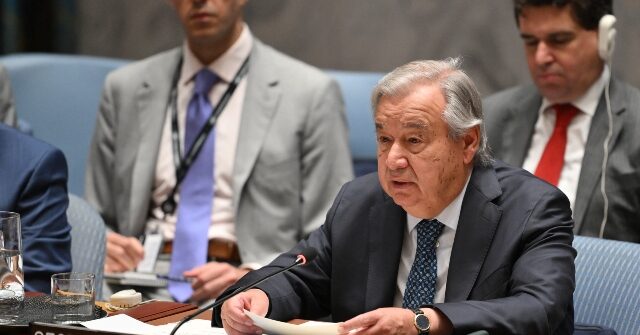
The global stage witnessed a significant upheaval as U.N. Secretary General Antonio Guterres openly criticized President Donald Trump’s decisive action against Iran’s nuclear weapons program. Guterres labeled the strikes as a “dangerous escalation” and a “direct threat to international peace and security.” His remarks reflect a concern that Trump’s bold approach may lead to broader international tensions.
Guterres expressed deep alarm over the United States’ use of force against Iran, emphasizing the potential for the situation to spiral out of control. He warned of “catastrophic consequences for civilians, the region, and the world,” underlining the gravity of the conflict. The Secretary General’s statements suggest a preference for diplomacy over military action.
The call for de-escalation came amid rising fears of escalating violence. Guterres urged U.N. member states to adhere to their responsibilities under international law, stressing the importance of preventing further chaos. His appeal for peace contrasts sharply with the decisive actions taken by the Trump administration.
Critics argue that the United Nations has been ineffective in curbing Iran’s nuclear ambitions. Despite numerous resolutions, Tehran has continued its pursuit of nuclear capabilities with little interference. The U.N.’s inability to enforce its mandates has been a point of contention among conservative observers.
Tehran’s accumulation of near-weapons-grade uranium has been a persistent concern. The International Atomic Energy Agency (IAEA) has struggled to obtain clear answers regarding suspicious nuclear activities. Questions remain about uranium traces found at undeclared sites, which Iran has yet to address satisfactorily.
The Secretary General’s comments highlight a broader debate over how to handle such international threats. Guterres’ call for diplomacy is seen by some as inadequate in the face of Iran’s persistent defiance. The situation underscores a clash between those advocating for firm action and those urging restraint.
Conservative voices have long criticized the U.N. for its perceived leniency towards rogue states. Many argue that a stronger stance is necessary to deter nations like Iran from pursuing nuclear weapons. The strikes by President Trump are viewed by these critics as a necessary measure to address a growing threat.
The U.S. administration has consistently maintained that the protection of international security requires decisive action. Trump’s approach is seen by supporters as a necessary step to counter Iran’s aggressive posturing. They argue that failure to act would only embolden Tehran further.
The debate over military intervention versus diplomatic engagement is not new. However, the stakes in this particular conflict are exceptionally high given the potential for widespread instability. The Trump administration’s actions have sparked a global conversation about the best path forward.
Observers note that Iran’s actions have consistently challenged international norms. Tehran’s refusal to cooperate with the IAEA has been particularly troubling for those concerned about nuclear proliferation. This defiance has fueled calls for a more robust international response.
Despite the controversy, President Trump’s supporters argue that his approach is rooted in a commitment to global security. They view the strikes as a necessary measure to prevent further escalation by Iran. For these supporters, the U.S. must take a stand to ensure stability.
The United Nations’ role in addressing nuclear threats remains a contentious issue. Critics argue that the organization has failed to provide effective solutions to deter Iran’s nuclear ambitions. The ongoing situation with Iran highlights a need for reevaluating international strategies.
While some advocate for dialogue, others believe that action is necessary to prevent Iran from achieving its nuclear goals. The debate reflects broader ideological divides on how to handle such complex international issues. The stakes continue to be high as tensions persist.
The international community remains divided on the best approach to dealing with Iran. On one hand, there are calls for renewed diplomatic efforts. On the other, there is a belief that firm action is necessary to curb Iran’s nuclear ambitions.
The situation in Iran serves as a stark reminder of the challenges facing global governance. The balance between force and diplomacy is a delicate one, fraught with potential risks. As the world watches, the decisions made will have lasting implications for international peace.
The Trump administration’s actions have put a spotlight on the limitations of existing international frameworks. For many conservatives, the strikes are a demonstration of leadership in the face of global threats. They argue that decisive action is necessary to uphold international security.
Critics of the U.N. continue to question its ability to effectively address pressing global issues. The ongoing developments with Iran serve as a test of the organization’s relevance and effectiveness. The debate over the best path forward remains ongoing.
As the international community grapples with these challenges, the importance of strong leadership is underscored. The actions taken by the Trump administration reflect a commitment to safeguarding global security. The world watches closely as these events unfold.