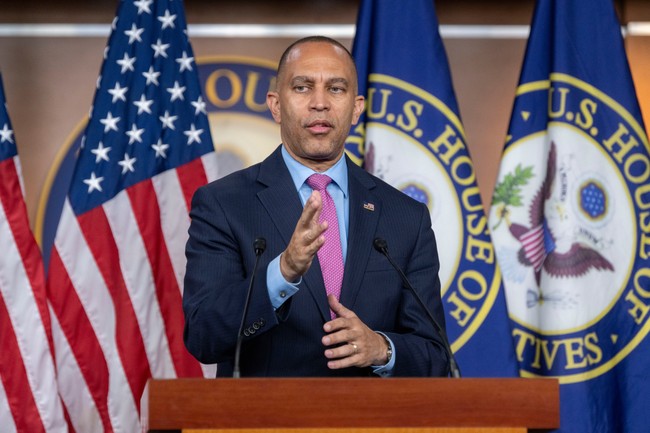
Rep. Hakeem Jeffries went on CNN and tried to pin the government shutdown on Republicans, but host Dana Bash pushed back hard, highlighting that Democrats repeatedly voted against reopening the government. The exchange exposed a disconnect between the Democrats’ talking points and what actually happened on the House floor, and it sparked a blunt, ugly back-and-forth that underscored how political messaging can collapse under basic facts.
The confrontation unfolded on live television when Bash pointed out that Democrats had rejected 14 motions to reopen the government. That simple tally cut through the narrative Jeffries was selling and forced him into a defensive scramble, revealing how fragile some political stories are when subjected to straightforward questioning. Republicans have been making the procedural record part of their case, and Bash’s pushback handed that case a clear talking point to use outside the halls of power.
JEFFRIES: “Donald Trump and Republicans shut the government and refused to reopen it. Donald Trump has spent the last 35 days, more time on the golf course, more time talking to Hamas and more time talking to the Chinese Communist Party than to Democrats on Capitol Hill, who represent half the country.”
Hakeem Jeffries was left momentarily stunned on CNN after host Dana Bash fact-checked his claim in real time that Republicans “shut down” the government.
The House Minority Leader wasn’t expecting the pushback and it showed.
He got heated.
JEFFRIES: “Donald Trump and… pic.twitter.com/DnSy3Gywmc
— Overton (@overton_news) November 5, 2025
BASH: Mr. leader…you guys are voting ‘no’ on opening the government, not…not Republicans…
JEFFRIES: Hold on, hold on one second Dana, let’s just be clear about that. The American people clearly understand who’s responsible for shutting down the government.”
BASH: “Yeah, yeah. But you said ‘they’ shut down the government…”
The exchange left Jeffries trying to reframe responsibility while Bash kept circling back to the roll call results. Republicans argue the numbers matter because votes are the literal means by which the government reopens, and voters can see who is saying yes and who is saying no. That is basic accountability, and it matters when each side claims moral ownership of the outcome.
Republicans offered a seven-week continuing resolution that would have kept funding at Biden-era levels so Congress could finish the remaining appropriations bills. The plan also aimed to preserve time-sensitive measures, including subsidies tied to Obamacare that are set to expire, which many lawmakers wanted to address without a catastrophic shutdown dragging everything into chaos. The stopgap was positioned as a straightforward, temporary step to buy time for negotiations and to prevent plunging federal programs into uncertainty.
Democrats chose to reject that path, and Republicans contend those votes were not a trivial procedural choice but a policy stand. The GOP’s position framed the Democratic refusals as a decision to hold the government hostage over priorities like roughly $1.5 trillion in claimed benefits for illegal alien health care and continued funding for NPR. For conservatives, the math and the priorities reveal stark differences about fiscal responsibility and where taxpayer dollars should go.
Jeffries’ broader rhetorical move was to blame former President Trump for the shutdown and to paint Republicans as obstructionists. That line collapsed under Bash’s clarification that it was Democrats on the floor voting no to reopen. The discrepancy matters because political narratives rely on simple cause and effect, and when those linkages break, the story that survives is the one anchored in records and votes rather than spin.
The television moment also opened the door to criticisms of selective outrage. The criticism of Trump’s travel and public schedule in the quote dovetails with long-standing partisan attacks on presidential time away from Washington, yet many on the left have been forgiving of similar patterns when the person traveling or resting fits their political expectations. Republicans pointed to that double standard and used the interview to highlight it, arguing voters can smell inconsistency.
What happened on CNN was more than a gotcha. It was a reminder that political messaging fails when it ignores basic procedural facts and when leadership talks past the camera instead of answering hard questions. Jeffries’ stumble is useful for Republicans because it exposes where Democrats’ national narrative and tactical choices on the Hill diverge, and it gives rank-and-file voters something concrete to examine beyond slogans and press releases.