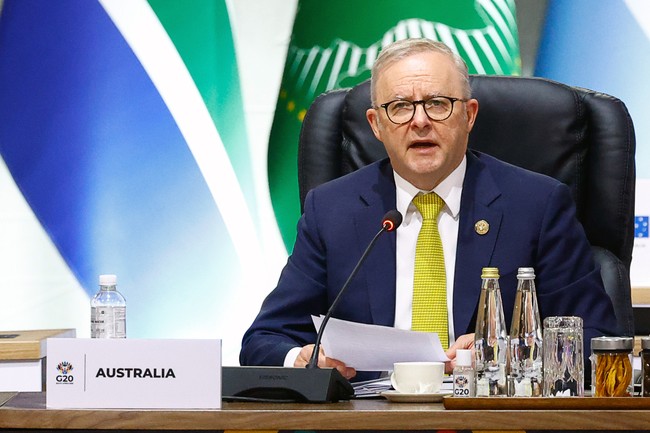
Australia’s leader has pledged tougher gun restrictions after a mass shooting at Bondi Beach, stirring debate about whether stricter laws actually make people safer and spotlighting failures in the immediate response that left many wondering who will protect ordinary citizens.
Prime Minister Anthony Albanese said he would press for more limits following the attack at a Hanukkah event on Bondi Beach that left at least 16 people dead and about 40 wounded. Authorities say the suspected shooters were a father and son, identified as Khaled Al-Nablusi and Naveed Akram, and one attacker was killed while the other was captured in critical condition. Officials believe Jewish people were deliberately targeted during the incident, and the nation is grappling with grief and anger as lawmakers promise action.
At a press conference, Albanese declared, “the government is prepared to take whatever action is necessary, included in that is the need for tougher gun laws.” He said the topic will be raised at the National Cabinet and that he wants measures “including limits on the number of guns that can be used or licensed by individuals.” Those words signal a push for additional restrictions from a government that already enforces tight firearm rules.
Australia long claimed to have among the strictest gun laws in the developed world after the Port Arthur massacre in 1996 led to the National Firearms Agreement. That framework banned civilian ownership of most semiautomatic rifles and shotguns, required nationwide licensing and registration, and triggered a buyback program that destroyed hundreds of thousands of firearms. Still, despite that legacy, two alleged attackers managed to carry out a deadly strike, and questions now turn to enforcement, police response, and whether further restrictions would have changed the outcome.
The scene at Bondi raised serious concerns about how first responders handled the attack, with reports that some officers hid instead of confronting the gunmen. That failure to stop attackers in real time is central to conservative criticism: taking firearms out of public hands does not guarantee safety if responders do not or cannot act. A defensive argument is also made by research such as the Crime Prevention Research Center findings that armed civilians are significantly more likely to stop a mass shooter than police, and those results fuel calls to rethink blanket disarmament policies.
A review of licenses over a period of time. People’s circumstances change. People can be radicalized over a period of time. Licenses should not be in perpetuity. And checks, of course, making sure that those checks and balances are in place as well.
That quoted perspective stresses periodic checks and removing perpetual privileges, but the broader political response is leaning toward even tighter restrictions rather than addressing enforcement gaps and the realities of armed attackers. Critics argue that stripping citizens of defensive tools leaves them dependent on a state that can fail in the moment of crisis, and the Bondi scene is being used as proof that laws without practical, on-the-ground protections are insufficient. The political debate in Australia now mirrors arguments familiar to Americans who value the Second Amendment and personal defense.
From a Republican viewpoint, the lesson should be focused: fix police readiness, improve threat detection and mental health interventions, and allow lawful citizens options to defend themselves rather than reflexively expanding bans. History shows that determined attackers find ways to obtain weapons regardless of laws, and the crucial gap is often the time between an attack’s start and effective neutralization. Policies that ignore that window ask ordinary people to remain defenseless while expecting perfect performance from institutions that sometimes fall short.
Anyone crafting policy after Bondi should address licensing reviews, enforcement of existing statutes, and accountability for responders who fail to act, instead of defaulting to new prohibitions that may only disarm the law-abiding. Even with decades of tight controls, tragic violence still occurred, and that should drive a more sober look at practical safety measures. For nations and states debating their next step, real-world deterrents, rapid response capability, and empowering citizens to protect themselves deserve equal attention to any new bans or limits.
🚨 JUST IN: The Australian Prime Minister is now planning EVEN MORE gun control after the Islamic terror attack in Bondi Beach.
Australia has some of the world's STRICTEST gun laws.
These politicians don't seem to grasp the MUSLIMS were the problem in this case; NOT THE GUNS. pic.twitter.com/y5MUwbP5Rg
— Eric Daugherty (@EricLDaugh) December 15, 2025