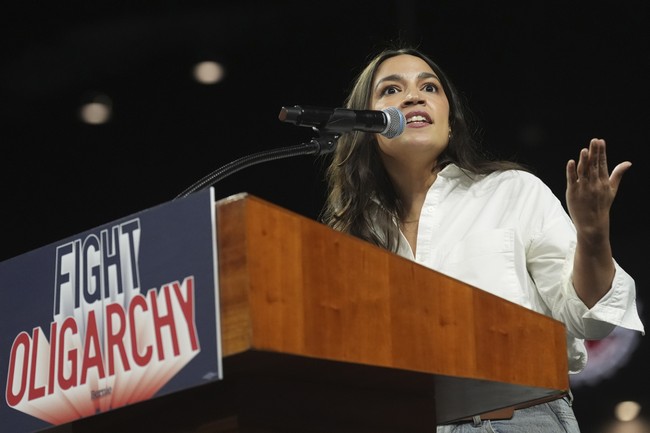
Alexandria Ocasio-Cortez reacted to a three-year-out poll that suggested she could beat Vice President JD Vance in a hypothetical 2028 matchup by laughing and saying, “Listen, these polls, like three years out…are what they are. But let the record show, I will stomp him.” The poll showed a 51 to 49 percent split in her favor, but the survey’s provenance and past performance raise serious doubts about its reliability.
Outside the Capitol, a reporter pressed Ocasio-Cortez on whether she believes she could beat Vance head-to-head in 2028, and she gave that blunt, spirited response as reporters looked on. Her line landed like a one-liner from a stand-up set, and she followed it with laughter, signaling she saw the moment as part joke, part jab. That reaction is politically useful for her brand, but it does not transform a shaky survey into a predictive roadmap.
The poll at issue reported a narrow 51 to 49 advantage for Ocasio-Cortez, a margin small enough to be inside most sampling error ranges and far too early to treat as meaningful. Critics quickly flagged multiple red flags about the survey’s origin and methodology, and pointed out that the survey publisher previously missed major signals in other elections. A single snapshot three years ahead of a presidential election should not be used to rewrite political expectations.
One obvious problem is that the poll comes from a group operating outside the United States, which invites questions about sampling, reach, and local calibration. The same polling operation also dramatically underestimated Donald Trump’s performance in the last presidential cycle, which should make any analyst pause before taking its new numbers at face value. When a pollster has a documented history of missing key voter shifts, their fresh figures deserve heavy skepticism.
AOC says she would 'stomp' JD Vance if she ran against him in the 2028 presidential election. pic.twitter.com/TGXR8yyuv7
— Jeff Charles, Asker of Questions🏴 (@jeffcharlesjr) December 18, 2025
Beyond methodology, the political math around Ocasio-Cortez is complicated. In New York City she energizes a certain progressive segment, but translating that energy into a national coalition is a very different task. National polling consistently shows her name recognition is uneven, and favorability among independents lags significantly behind where you’d expect a viable presidential contender to be.
Those independent voters matter most in general elections, and available national snapshots have shown only roughly a quarter of independents viewing her favorably in recent measures. That level of enthusiasm falls short of what a serious White House contender needs to build the kind of cross-regional coalition that beats a sitting vice president. America is not New York City, and policy positions that play well in her home district often struggle in the broader electorate.
AOC’s policy brand is firmly left of center, and many voters remain wary of proposals they associate with socialism or far-reaching government expansion. Shifting toward the political center is the usual path for primary winners who want to govern successfully in a general election, but past behavior suggests she is unlikely to abandon core positions in a way that would reassure moderate swing voters. So even if a fringe or flawed poll shows a tight result now, converting that into a durable majority would require a major change in message or positioning.
JD Vance, serving as vice president, would enter any 2028 matchup with the advantages that come from national visibility and an established conservative base energized after recent cycles. Name recognition works both ways, and the dynamics of a presidential race can make initial upsets evaporate quickly once voters focus on policy records and real-world tradeoffs. Campaigns matter far more than three-year speculative polling, and political fortunes can shift fast.
At this stage, the sensible takeaway is caution: treat sensational headlines about early matchups as curiosity items, not prophecy. Voters should expect lots of noise, dubious surveys, and headline-driven takeaways long before candidates declare or primaries begin. If AOC wants to turn that early poll into a legitimate threat to any national Republican ticket, she will need to broaden her appeal well beyond the progressive base that elevated her in New York.