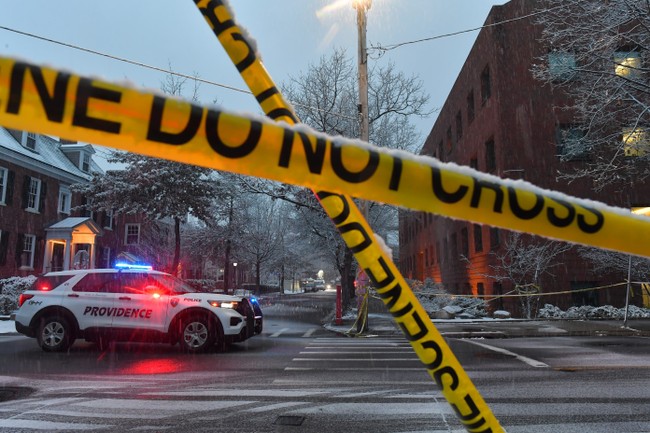
Officials stumbled through another Brown University presser after the December 13 shooting, offering more performance than answers about who did it, how they escaped, or why they haven’t interviewed witnesses.
These briefings felt like a sideshow instead of an incident update, with authorities reciting what they did not know as though that was news. The shooting happened inside the engineering building on December 13, leaving two people dead and at least eight wounded. Details are thin and the timeline reads like a list of lost opportunities.
Witnesses reported that someone shouted something before opening fire, and multiple accounts point to the chant “Allahu Akbar.” The suspect apparently left through an area that is virtually devoid of cameras, which has sparked immediate controversy. People are asking how a gunman can exit a campus building without being tracked when safety is supposed to be the priority.
Five days after the attack, key follow-up steps still haven’t been taken: “It’s been five days”, and police “have yet to interview” witnesses according to the timeline fed to the public. Officials say there’s a second person of interest who was merely “in proximity” to the suspect, a vague phrase that could mean almost anything. Those gaps matter because they turn a criminal investigation into a narrative controlled by leaks and speculation.
🚨 BREAKING: The Police Chief of Providence just confirmed they've found "NOTHING" after an intensive search of the area following the Brown University shooting.
Splendid.
The manhunt continues, days later.pic.twitter.com/BRtd4GYRl0
— Eric Daugherty (@EricLDaugh) December 17, 2025
New images released by authorities are grainy and largely worthless for identifying a suspect or clarifying movement. There’s confusion about how the shooter gained access to the engineering building, and the campus alert system has been uneven in its messaging. When protocols look inconsistent, people understandably assume the school is managing optics before security.
One uncomfortable question that came up at the presser should get more scrutiny: why are key exit routes and camera coverage so sparse where the suspect escaped? A bystander asked if the lack of cameras in that area is because the university posts where cameras are on campus, and whether that policy could be masking vulnerable people, including undocumented immigrants, from law enforcement. Some attendees suggested the university might avoid capturing certain populations on camera to prevent them from becoming targets for ICE, which, if true, raises a real conflict between campus policy and public safety.
The investigative timeline has holes: no confirmed suspect, no stated motive, and precious few witness interviews to move the case forward. That vacuum fuels rumors and lets the narrative be set by speculation rather than facts. The presser should have been about concrete steps being taken, not about how uncertain everything still is.
No suspect. No motive. No answers. What a clown show.
Beyond the immediate failures at the presser, there’s a pattern of institutional defensiveness that Republicans and conservatives have warned about for years: campuses prioritizing politics and image over blunt security measures. When a university directs resources toward PR and compliance over robust camera placement and rapid investigative cooperation, students and staff pay the price. The public deserves institutions that treat crime prevention as a nonnegotiable responsibility.
Law enforcement’s role is to gather evidence and interview witnesses quickly, not to debut sanitized graphics and stock phrases. The fact that investigators still have grainy photos and ambiguous leads five days in suggests either a lack of urgency or poor coordination. Either explanation is unacceptable when lives were lost and more people were wounded.
Universities should not decide camera placement by social or political concerns; they should place them where incidents are most likely to be contained or escaped from. Announcing camera maps publicly without balancing security realities is either naïve or reckless. If a policy makes it easier for an assailant to vanish, that policy needs immediate revision.
Transparency matters: release surveillance footage that is usable, interview people who were there, and stop leaning on vague terminology that hides incompetence. The community deserves clear, direct answers from those in charge, not a parade of officials reading prepared statements. Until investigators start producing verifiable results, skepticism is the responsible response.