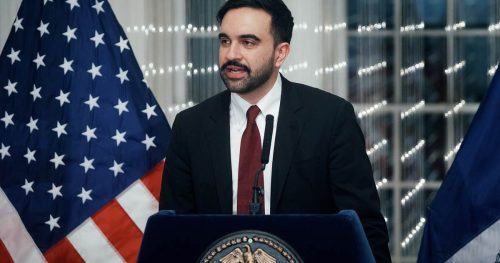
House Minority Leader Hakeem Jeffries sidestepped a question about a Quinnipiac poll that put the Democratic Party’s approval in handling the economy at 18 percent, and critics on the right quickly pounced on the low number and the party’s direction.
Reporters pressed Hakeem Jeffries, D-N.Y., after a Quinnipiac poll found just 18 percent of respondents approved of the Democratic Party in Congress on economic stewardship. The question came amid a wave of Republican commentary pointing to weak Democratic approval and recent election losses. Jeffries declined to own the results, calling the survey an outlier and shifting the focus to election outcomes.
The exchange highlighted how Democratic leaders often respond to damaging numbers by dismissing the poll rather than confronting the substance behind voter dissatisfaction. Conservatives argued that the 18 percent figure is consistent with broader trends showing voters unhappy with pocketbook issues and national direction. That anger translated into blunt on-air criticism from commentators who view the Democrats as disconnected from mainstream concerns.
“But leader Jeffries, on the question of rising prices and the stewardship of the economy, clearly, the public is saying they’re not satisfied with Donald Trump. They don’t approve of him, but actually, the Democrats, in recent polls, are actually faring worse than the Republicans. Take a look at this Quinnipiac poll out just this week shows the Democrats have their lowest approval rating in the polls’ 15-year history. Only 18 percent give Democrats a high approval rating in the handling of the economy. Seventy-three percent disapproval: what are you doing wrong?
Jeffries dodged the question: “Well, clearly that’s an outlier poll. Listen, the most significant indicator of public sentiment is: are you winning elections or are you losing elections?
Karl: Polling shows Democrats’ approval rating at 18%. What are you doing wrong?
Jeffries: That’s an outlier poll. https://t.co/8yD9Oe6Cd7 pic.twitter.com/F2Nng8PALX
— Western Lensman (@WesternLensman) December 21, 2025
On cable, CNN’s Scott Jennings did not pull punches, saying the 18 percent rating shows a party that has lost touch with everyday voters. He argued that Democrats now depend on a narrow coalition and need a serious course correction to regain public trust. Conservative voices see the poll as vindication for an agenda that emphasizes accountability and voter priorities like inflation and public safety.
Pressure on the Democratic National Committee reportedly grew after a string of disappointing results, prompting an internal post-mortem that, according to reports, was never released publicly. That decision to keep the review private only fed speculation among critics that party leaders prefer damage control over frank, transparent fixes. Republicans say withholding such analysis signals an unwillingness to face hard truths.
Across the conservative press and pundit circles, the polling sparked sharp questions about messaging and priorities inside the Democratic Party. Commentators framed the 18 percent approval as a symptom of a broader political disconnect, pointing to losses in state and local races as corroboration. The GOP response has been to press those perceived weaknesses while pushing issues they say matter most to voters.
Jeffries’ strategy of dismissing the poll as an outlier is familiar: when numbers look bad, national Democrats often question methodology instead of acknowledging voter frustration. That tactic may buy time, but critics argue it does nothing to solve the underlying problems that produce low approval. Republicans are using the moment to highlight concrete policy differences and to emphasize electoral accountability.
Meanwhile, Democrats face pressure to explain how they will rebuild trust on economic stewardship and campaign competence. Party insiders reportedly debated the causes of recent losses behind closed doors, while rank-and-file voters see public approval numbers as a clear signal. For now, the low poll rating has become a focal point for political argument rather than a turning point for immediate reform.
The fallout from the Quinnipiac results shows how polls can shape narratives, force responses from leaders, and amplify partisan critiques. For Republicans, the 18 percent figure reinforces a message that Democrats are out of step with mainstream voters. For Democrats, it presents a choice: dismiss and deflect, or accept responsibility and change course.
Reports that the DNC conducted an internal review and opted not to publish its findings added fuel to critics who say the party lacks transparency. That decision fed conservative narratives about a party insulated from consequence and resistant to reform. The debate over whether to release internal analysis will likely continue as both sides use the episode to press their advantages.