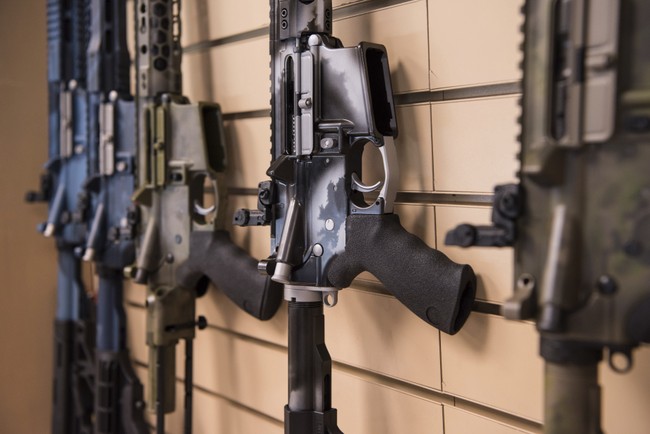
The Justice Department has sued Washington, D.C., challenging its ban on a class of commonly owned semi-automatic firearms and arguing those restrictions unlawfully block residents from keeping certain weapons for lawful purposes like home defense.
The federal lawsuit targets Washington, D.C.’s prohibition on many semi-automatic rifles, several semi-automatic pistols, and some shotguns, arguing the law prevents law-abiding residents from possessing commonly owned firearms. The complaint frames the ban as part of a broader pattern in the District where officials deny registrations and criminalize possession of items they choose not to register. That legal theory puts the city squarely against the Second Amendment protections affirmed by recent Supreme Court precedent.
The filing presses a simple point: you cannot have a durable right on paper and treat everyday firearms as off-limits in practice. The complaint states that the District “continued its efforts to infringe the Second Amendment-protected ‘right of the people to keep and bear arms’ through limiting law-abiding citizens’ ability to register commonly used firearms and criminalizing the possess of firearms that it refuses to register.” That quote is the heart of the DOJ’s claim that D.C. has gone beyond sensible regulation into outright prohibition.
Beyond rhetoric, the Justice Department highlights the practical effect of the District’s code, noting how officials refuse registration for weapons used by millions of Americans for hunting, sport, and defense. The complaint points out that certain firearms “are ‘in common use today’” and insists that bans based on cosmetic features cannot dodge constitutional scrutiny. According to the DOJ, restrictions that are “based on little more than cosmetics, appearance, or the ability to attach accessories” fail to respect the right the Constitution protects.
The suit details how D.C.’s local code “currently prohibits the registration of the AR-15 and other semi-automatic rifles, which makes it illegal for law-abiding citizens to possess these firearms in the home for lawful purposes.” That claim matters because possession in the home for self-defense has been central to Supreme Court decisions on the Second Amendment. The filing points out there “is no historically analogous prohibition of the broad ban of firearms that are in common use by law-abiding citizens for lawful purposes, such as self-defense inside the home.”
Those lines invoke the framework established in New York Rifle & Pistol Association v. Bruen, which requires modern gun laws to be judged against historical tradition. Under that test, a broad municipal ban on commonly used arms is hard to justify, because lawmakers in the Founding Era did not broadly ban the personal ownership of widely used weapons. The DOJ’s argument is built on that historical comparison and on the premise that D.C.’s rules are more about aesthetics than public safety.
Attorney General Pam Bondi framed the suit in plain terms, saying it “underscores our ironclad commitment to protecting the Second Amendment rights of law-abiding Americans.” She added that “living in our nation’s capital should not preclude law-abiding citizens from exercising their fundamental constitutional rights to keep and bear arms.” Those statements reflect the department’s view that constitutional protections must be uniform, not contingent on local political mood.
Fantastic!!! DOJ suing DC over unconstitutional firearm bans https://t.co/VXAxmuVrlo pic.twitter.com/BbaqTzo98o
— Katie Pavlich (@KatiePavlich) December 22, 2025
Critics of D.C.’s approach argue the city has long treated law-abiding gun owners like second-class citizens while violent crime remains a crisis in some neighborhoods. Supporters of the DOJ action say enforcement that singles out popular, lawful rifles for blanket prohibition is both unfair and legally weak. This case is another example of the federal government stepping in when local policy appears to conflict with constitutional guarantees.
Across the country, jurisdictions with similar political majorities have adopted restrictions framed to avoid existing precedent, but courts have repeatedly sent clear signals about limits on novel bans. Many such efforts struggle when judges apply the Bruen historical test rather than deferential balancing. For proponents of individual rights, that judicial approach offers a clear path to challenge laws that feel designed to circumvent constitutional constraints.
The lawsuit does more than ask for a judicial ruling; it forces a national conversation about where lawful regulation ends and effective prohibition begins. If courts accept the DOJ’s arguments, the ruling could constrain municipal experiments that treat popular defensive arms as verboten. For now, the legal fight will play out in filings, motions, and likely appeals that test the contours of Bruen in an urban setting.
Whatever the outcome, the case will be watched closely by lawmakers, gun owners, and civil-liberties advocates who see the stakes as both legal and practical. The issue is framed in constitutional terms but touches on everyday concerns about safety, fairness, and whether rights are truly protected when they clash with local policy preferences. The court’s handling of the historical analogies and the District’s registration practices will determine how durable D.C.’s restrictions remain under federal law.