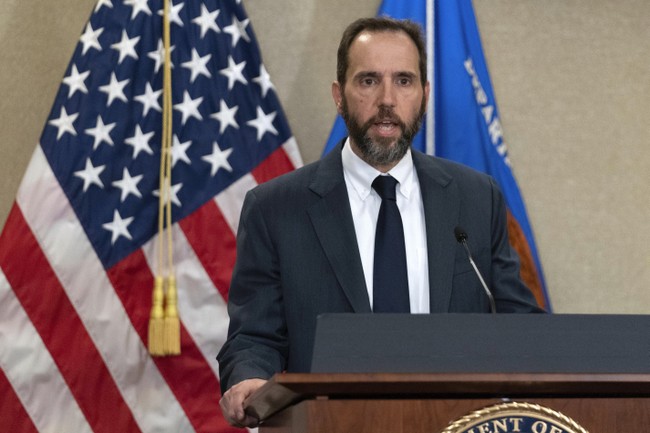
Jack Smith and three former federal prosecutors have teamed up to open a law firm, bringing together the lead players from the probes into January 6 and the Mar-a-Lago documents, and the move raises fresh questions about the revolving door between politically charged prosecutions and private practice.
Former Special Counsel Jack Smith is forming a new law firm with Tim Heaphy, David Harbach and Thomas Windom, and that combination is drawing attention because these are the same prosecutors who pursued high-profile matters tied to President Trump. Those investigations focused on the January 6 events and the handling of classified materials, and critics on the right argue both efforts were politically driven. The firm’s launch is being watched closely for who they represent and how their past roles will influence future work.
People who follow Washington know how quickly prosecution teams migrate into private practice after big-name cases, and that transition can look like a predictable cycle. From a Republican perspective, it’s especially concerning when attorneys who once used government power against political opponents move into a fee-driven business that could profit from the profile those cases created. That dynamic feeds skepticism about whether justice was blind or simply a path to marketable experience.
The rollout of the firm is slated for January, according to public statements, and the partners say they will handle investigations, litigation and full-service legal work. Tim Heaphy brings experience as a former U.S. Attorney and led the House investigative effort into January 6, while Smith, Harbach and Windom served on the special counsel team that pursued the two Trump-related probes. The new practice will position itself as experienced in high-stakes, politically sensitive matters, which will naturally invite scrutiny from skeptical observers.
Republicans who watched the federal raid on Mar-a-Lago in August of 2022 still see it as a turning point that energized opposition and shaped political outcomes in ways that undercut confidence in impartial enforcement. Many conservatives view those events as evidence of prosecutorial overreach rather than a straightforward pursuit of wrongdoing, and the idea those prosecutors will now market their Washington résumés for private gain hardens that view. The optics are clear: powerful prosecutions, high-profile headlines, then a new firm offering clients access to that inside knowledge.
There’s a larger pattern here that matters for how Americans view the justice system: when investigators who led politically charged cases step into private practice, it creates the impression of a marketplace built on partisan battles. That impression damages public trust across the board, and it’s exactly why conservatives demand a firmer separation between prosecutorial power and the appearance of career advancement. The question is not just who they represented before, but how those past choices will influence their client work going forward.
The team’s stated focus on “integrity, commitment, and zealous advocacy” will ring differently for different audiences given their recent history. Supporters on the left may see the firm as a resource for complex investigations; skeptics on the right will view the same promise as the repackaging of political capital. Either way, the new firm’s client list will be the key to understanding whether this is a straightforward practice launch or the next chapter of politicized lawyering.
Jack Smith, the former U.S. Justice Department special counsel who prosecuted Republican President Donald Trump following his first term in the White House, is teaming up with three other ex-prosecutors to launch a new law firm.
Smith is starting the firm with Tim Heaphy, David Harbach and Thomas Windom, each a former federal prosecutor with decades of public service.
Jack Smith is teaming up with other ex-DOJ lawyers to form a firm. https://t.co/yeuBuZSLZx The billable hours could be a concern. Smith reportedly racked up over $50 million in the failed efforts to prosecute Trump. He is a walking advertisement for contingency contracts.
— Jonathan Turley (@JonathanTurley) December 11, 2025
Heaphy in a statement said the firm will launch in January and provide full-service legal work, including investigations and litigation. He said the team will design a legal practice focused on “integrity, commitment, and zealous advocacy” for public and private clients.
The lawyers all played leading roles investigating Trump during his years out of power. Smith and two members of his team, Harbach and Windom, obtained indictments against Trump for attempting to overturn his 2020 election defeat and illegally retaining classified documents.
A former Obama-era U.S. Attorney, Heaphy was the lead investigative lawyer for the House of Representatives committee that investigated the January 6, 2021, attack on the U.S. Capitol and broader efforts by Trump to hold on to power after losing the 2020 election to Democrat Joe Biden.
The reality is simple: when high-profile government lawyers turn private, their choices matter because of the power and influence they once wielded on behalf of the state. Republican commentators will keep a close eye on any clients tied to political causes or high-stakes regulatory fights, and they’ll call out any appearance that government experience has become a stepping stone to lucrative, partisan work. That scrutiny is part of holding the system to account.
For readers watching Washington, the practical takeaway is to wait and see who hires the firm and for what purpose. The partners’ past roles guarantee headlines; their future clients will determine whether those headlines are about legitimate legal service or another round of political theater. Until then, the move remains a classic Washington play: leverage profile into a business and let the marketplace decide the value.
I look forward to seeing the client list and how this firm chooses to position itself in an already noisy legal landscape. The formation of the practice is an unmistakable reminder that the line between government enforcement and private enterprise can blur rapidly in the capital, and that blurring shapes public confidence in the rule of law.