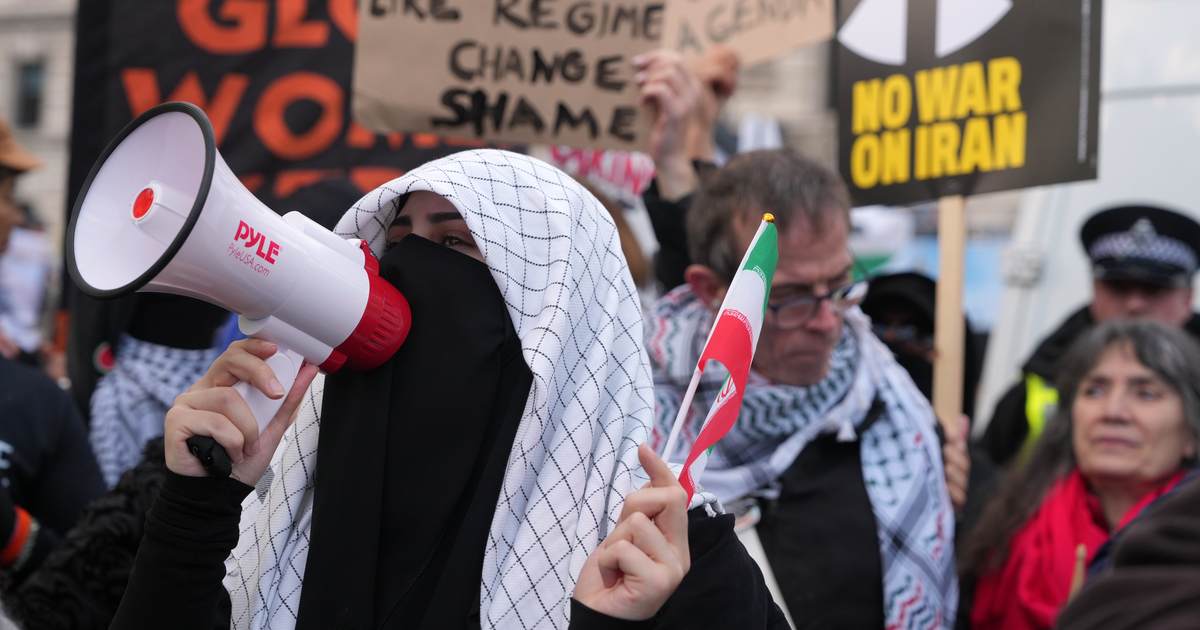
The Left’s astroturfed pro-Iran demonstrations sprang up in Washington and New York this week, featuring canned signs, familiar activist groups, and confusion about what they’re actually protesting.
Left-wing activists showed up outside the White House and in Times Square carrying pre-printed “Hands Off Iran” signs, a display that looked more coordinated than spontaneous. The optics are predictable: groups with names everyone recognizes rallying against American action while defending a brutal regime. That coordination raises the obvious question of who benefits from amplifying Tehran’s talking points on U.S. soil.
Groups like Code Pink and the Palestinian Youth Movement were in the crowd, and other radical outfits also made an appearance. Antifa and anti-ICE activists turned up, which should surprise no one who follows the usual coalition of the extreme left. When the same actors show up under the same banners, it undercuts any claim that this is a grassroots uprising.
The New York demonstration unfolded in Times Square before moving toward Central Park, attracting a small but visible cohort of protesters. Police reports indicate the organizers obtained a permit, so this was a planned event rather than a spontaneous outpouring. In an era of social media coordination, permits and choreography go hand in hand with messaging goals.
Protest outside White House over strikes against Iran https://t.co/E0IAs91ecY
— Reuters (@Reuters) February 28, 2026
The NYPD confirmed the permit, and local reporting placed the crowd at roughly a hundred people in Times Square. Those numbers are modest compared with the scale these groups often imply when they flood social feeds with photos and clip montages. Small, noisy crowds can look bigger online than they are in reality.
The protesters repeatedly mixed talking points that don’t hold up under scrutiny, and some participants were openly contradicting themselves on camera. One protester declared, “Iran isn’t fascist,” then offered a muddled lecture on revolutions and coups. That level of confusion is telling when people defend a government that forces women to wear the hijab and crushes dissent.
“Iran isn’t fascist,” the protester says. “Studying political ideologies, you understand what fascism is, and it’s not Iran. Because Iran…Ayatollah Khamenei’s rule was achieved through a revolution; it was, in effect, a coup d’état. Fascism rises electorally and democratically, and then turns on its constituents. Ayatollah’s regime is not fascist in nature.”
He goes on to call Iran a theocracy while bizarrely insisting the United States is the country that has adopted fascist traits. Those contradictions expose the intellectual slipperiness used to excuse authoritarian allies and attack democratic rivals. It also shows how rhetoric is often weaponized to muddy public judgment.
Outside the rhetoric, most Americans want a strong, clear foreign policy that protects U.S. interests and deters aggression. Polling indicates the vast majority of GOP voters support decisive action when national security is at stake, and key allies voiced support for measures aimed at neutralizing dangerous actors. That reality contrasts with the small, performative demonstrations staged by fringe groups.
The protesters’ theatrical defense of Iran plays well on cable networks and activist channels, but it fails in the court of public common sense. When observers look past the signs and slogans, they see a pattern: the same activist networks, recycled talking points, and strategic optics. This isn’t civic protest so much as a managed public relations operation for a hostile regime.
At a basic level, protests are an American right, and citizens should be free to voice opinions. But there’s a difference between genuine civic engagement and staged PR that masks foreign-friendly narratives. Voters deserve clarity about who is organizing these events and why the message so often aligns with Tehran’s interests.
The takeaway on the ground is straightforward: a handful of well-coordinated activists tried to amplify a pro-Iran message in high-profile locations, yet the core arguments fell apart under scrutiny. The performance served the goals of the regime it defended while exposing the left’s willingness to prioritize anti-administration fervor over consistent opposition to tyranny. In the end, optics and ideology trumped substance for those protesters, and the broader public noticed.