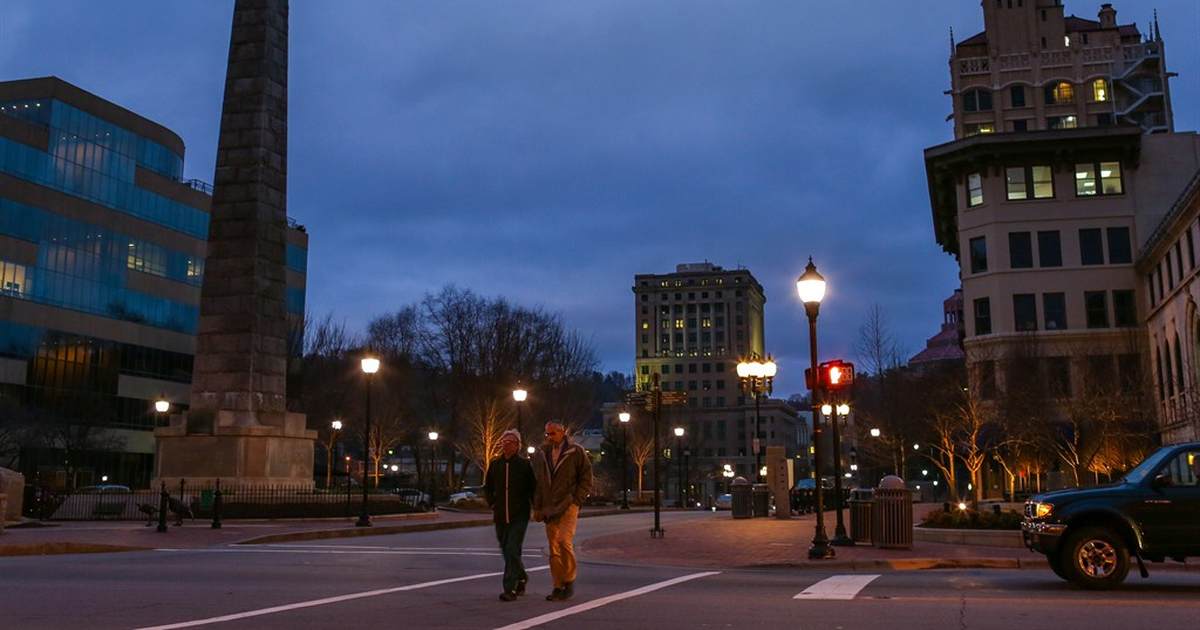
Asheville’s decline is a mix of bad policy choices, cultural displacement, and a failure to face homelessness and public safety realities head on.
Late 2024’s Hurricane Helene left parts of western North Carolina reeling, and Asheville’s recovery exposed cracks in local systems that are now impossible to ignore. Officials and national outlets argued about who should get credit for keeping people informed during the emergency, but the real story is how fragile local infrastructure and policy decisions compounded the damage.
Over the last several years Asheville’s problems didn’t start with a storm; they were already taking root in decisions that shifted priorities away from basic public safety and strong municipal management. When a city stops treating certain 911 calls as routine, you change residents’ expectations about what government will protect. That kind of policy shift doesn’t just affect statistics; it changes how people feel safe walking their streets.
Back in 2021 the police announced they would not respond to some service calls, citing staffing shortfalls as the reason. That move came on the heels of nationwide pressure to rethink policing after the BLM protests and the defund movement, and residents say the timing made the situation worse. Whatever the official explanation, the result has been less visible enforcement and a growing sense that low-level crime and disorder go unaddressed.
Homelessness has swollen into the most visible sign of decline, and the response from many local leaders has been to treat housing supply as the only solution. That ignores a hard truth: a big portion of the unhoused population struggles with addiction and serious mental illness. Without confronting those root causes, housing alone becomes a temporary bandage that masks persistent problems.
Once-charming, US mountain escape has transformed into 'nasty, crazy, and scary' city https://t.co/1dBfc88kTp pic.twitter.com/zfg5FWEULi
— New York Post (@nypost) April 25, 2026
Locals and long-time residents describe a city that used to hum with a distinct culture but now feels unfamiliar and unsafe to those who lived there for decades. Newcomers and tourism dollars changed neighborhoods, but so did policies that tolerated public drug use, aggressive panhandling, and encampments in commercial corridors. The result has been erosion of the small-town rhythms that once defined western North Carolina communities.
A social post from a former regular lays out the change in plain, personal terms and captures why many longtime residents have stopped coming around. That voice isn’t cherry-picked; it’s the kind of observation you hear from folks who watched neighborhood traditions replaced by a different, disconnected urban vibe. Those shifts are cultural as much as political, but policy choices accelerate cultural turnover when they fail to protect community standards.
Back then, Asheville was a hillbilly Mecca. Old men sat on benches outside Hardee’s with their sausage biscuits and coffee to gossip. Bluegrass played on gas station speakers. People clogged on weekends. Folks sounded like they’d never left WNC—the accents were thick.
By the time the city ended Belle Chere in 2013, Asheville had become a place I didn’t recognize.
Transplants had flooded out the locals, who escaped to Madison and Haywood counties.
Local accents? Gone. Bluegrass and clogging? Bastardized by people with zero ties to the traditions. The old men at Hardee’s? Replaced by homeless junkies nodding off and drooling on themselves.
It’s so bad that I’ve avoided Asheville for more than a decade. Only one of my children has ever been to the city, and she only went so I could take her to the Biltmore House.
Asheville is like an infection—and as much as it pains my heart to admit it, that infection is spreading.
The last time I was in Canton, we went out to eat. There wasn’t a single person in the restaurant with a local accent. Women in Lilly Pulitzer and men in dock shoes walked the sidewalks where overalls and work boots once ruled.
It won’t be long before the same policies that created this new Asheville turns the rest of WNC into a shell of its former self.
Short, direct reactions like “Sad, really” reflect the frustration many feel watching their hometowns change in ways that feel avoidable. Those one-liners carry a lot of weight because they aren’t polished op-ed pieces; they’re the notes people leave when they’re fed up. For a lot of residents, the sense that the city’s leaders are either unwilling or unable to stop the decline is the real trigger for anger.
There’s an obvious contrast: other cities have chosen stricter enforcement, targeted addiction treatment, and coordinated shelter-plus-care models that pair housing with wraparound services. Those approaches are not politically sexy but they work when implemented consistently and with accountability. Asheville’s slide shows what happens when experiments replace tried-and-true public safety and social-service strategies.
Hurricanes and natural disasters shine a harsh light on governance. When disaster hits, cities with clear priorities and functioning emergency networks cope better, and the difference is not accidental. Asheville’s problems are a product of choices, and change will require local leaders to admit where those choices led and to act differently going forward.
Other communities are proving alternatives are possible, but turning things around takes clear political will and a willingness to treat homelessness, mental health, and public safety as interlocking problems rather than separate policy talking points. If leaders want their cities to thrive again, they’ll need to make decisions that restore order, address addiction, and put residents first.