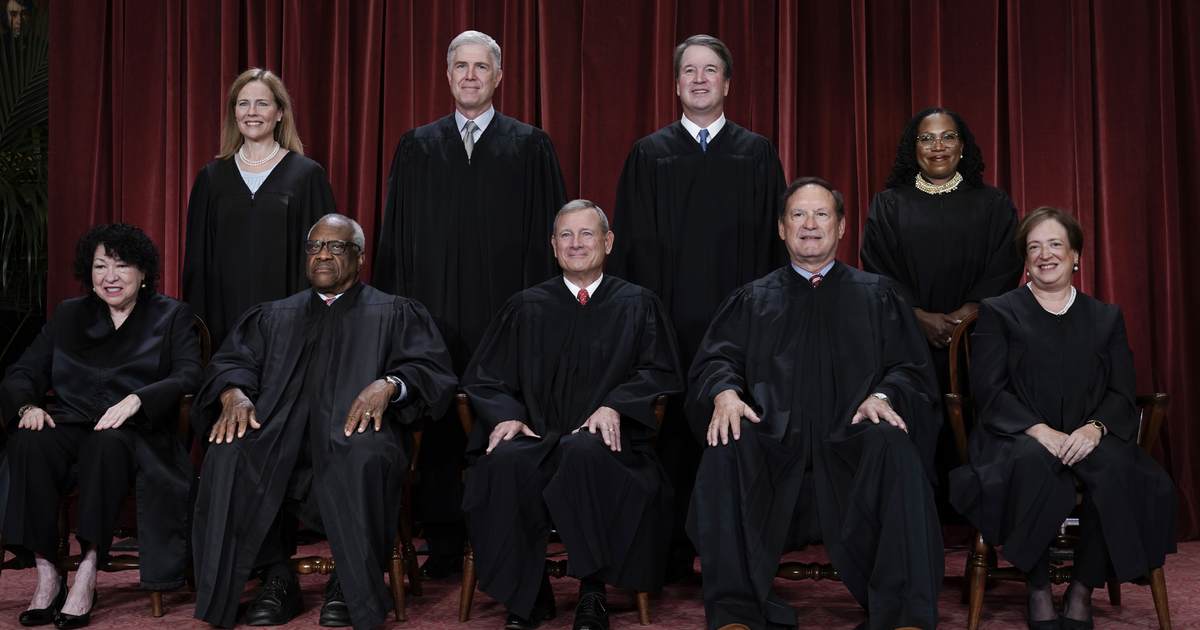
The Supreme Court’s arguments in Trump v. Barbara revealed sharp skepticism from several justices as they probed a Trump administration order that would narrow birthright citizenship, questioning textual claims, practical tests, and potential consequences while the justices weighed constitutional language and real‑world effects ahead of a decision expected this term.
The Court heard oral arguments over an executive order that would deny automatic U.S. citizenship to children born here when the mother is unlawfully present and the father lacks citizenship or lawful permanent residency, or when the mother is a temporary visitor such as a tourist, student, or worker and the father likewise lacks lawful status. The administration’s position challenges the typical reading of the 14th Amendment and seeks a clearer statutory or constitutional limit on who is entitled to birthright citizenship. That legal shift has forced the justices to grapple with history, text, and practical enforcement all at once.
The atmosphere in the courtroom was notable for intense questioning and for President Trump’s attendance, an unprecedented presence for the arguments. Conservative justices did not uniformly embrace the administration’s case, which shows the issue is not a simple ideological split. Even among conservative members, several voiced doubts about how far the government’s proposed rules could go without creating troubling legal gaps or administrative headaches.
Chief Justice John Roberts openly criticized parts of Solicitor General Sauer’s presentation, calling aspects of the argument “very quirky” and rejecting attempts to rely on anecdotal concerns. He specifically dismissed evidence about Chinese birth tourism, saying, “that has no impact on the legal analysis” of the case. That rebuke signaled the Court’s focus on constitutional text and precedent rather than political or policy anecdotes when deciding the matter.
Justice Brett Kavanaugh pressed a core textual point with a pointed question comparing the 14th Amendment’s phrase “subject to the jurisdiction thereof” and language from the Civil Rights Act of 1866 that uses “not subject to any foreign power.” He asked why, if the administration treats those phrases as equivalent, the Court should accept a reading that excludes children born to certain noncitizen parents. That line of inquiry exposed a central tension in the administration’s textual argument and forced the government to explain how its test would operate across contexts.
Two other conservative justices jumped in with tough questions, probing both the mechanics and consequences of any new rule. They asked whether the government’s proposed framework could be administered fairly and whether it created categories that the courts or agencies could realistically apply. Those concerns reflected an evenhanded judicial instinct to avoid rules that would be impossible to administer or that would produce anomalous results.
🚨 JUST IN: SCOTUS Justice John Roberts is VERY skeptical of President Trump ending birthright citizenship, repeatedly firing back at Trump's top lawyer
This would mean we require Amy Coney Barrett for a shot at 5-4.
SAUER: China has 500 birth tourism companies to bring people… pic.twitter.com/3nB3KtIBUd
— Eric Daugherty (@EricLDaugh) April 1, 2026
Justice Neil Gorsuch seemed especially concerned about how the administration’s interpretation would play out in historically fraught contexts, including Native American citizenship and other unique status situations. Solicitor General Sauer argued the phrase required lawful permanent residence by parents to confer automatic citizenship on a child, a stance Gorsuch questioned for its breadth and implications. His skepticism suggested the Court is wary of interpretations that might break longstanding understandings without clear textual or historical backing.
Justice Amy Coney Barrett asked pointed questions about broader, downstream effects if the Court were to accept the administration’s bid to limit birthright citizenship. She probed how changing the application of the 14th Amendment would affect settled legal frameworks and social consequences across many areas of law. Those exchanges underscored the justices’ attention to ripple effects beyond a single doctrinal point.
Justice Samuel Alito appeared receptive to some of the administration’s reasoning, offering lines of questioning that suggested a willingness to consider narrowing current doctrine. Justice Clarence Thomas, as has often been the case, remained largely silent during the argument, offering no explicit hints on his position. The mix of responses left observers uncertain about the Court’s eventual alignment on the key issues.
The ACLU lawyer arguing on the other side faced equally rigorous questioning from the bench as justices tested distinctions between tradition, text, and consequence. That pushback demonstrated that the Court, even with a conservative majority, is skeptical of simple answers and is demanding careful legal reasoning from both sides. The intensity of the exchanges suggests any ultimate opinion will be detailed and narrowly reasoned.
Court watchers will be following how the justices reconcile historical understanding, statutory phrasing, and practical administration if they decide to limit birthright citizenship. The case raises questions about constitutional interpretation, separation of powers, and the role of the political branches in shaping who is entitled to citizenship at birth. The Court’s ruling will likely set a major precedent on how immigration status and constitutional text interact.
A decision in the case is expected by the end of June.