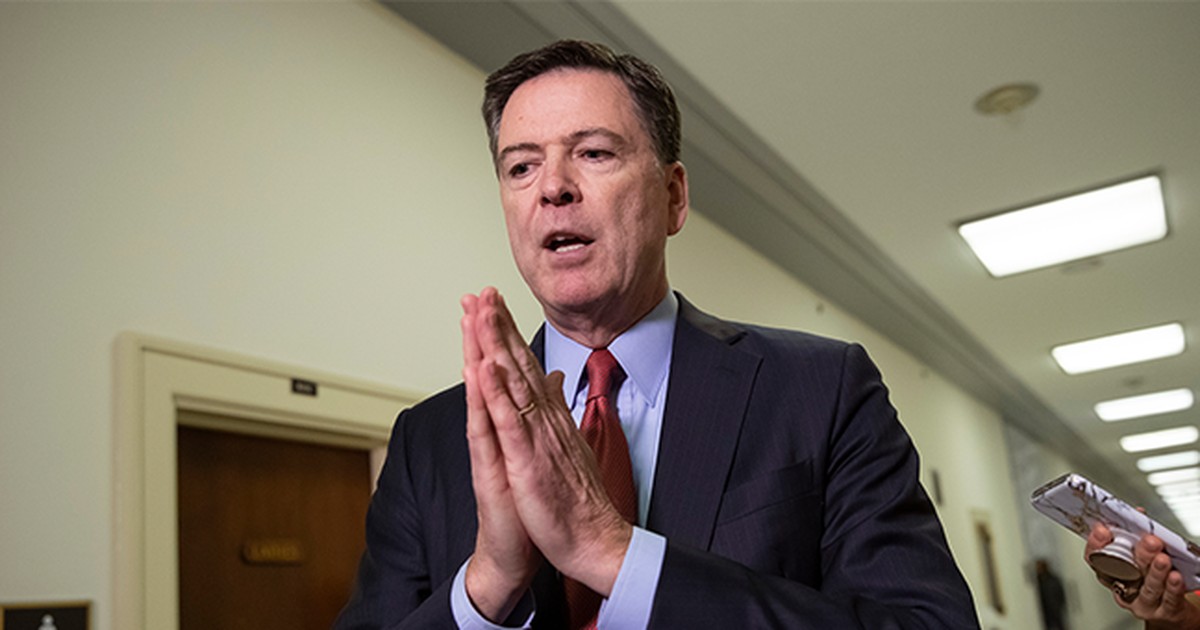
The piece examines the DOJ’s recent move against James Comey, the politics behind the prosecution, and how the process itself can be used as punishment in a polarized environment.
The Justice Department issued an arrest warrant tied to a 2025 Instagram post that reportedly suggested support for President Trump’s assassination, centering on the cryptic reference ‘8647’. That action follows a prior indictment over alleged false testimony to Congress that was dismissed last year, and it has stirred questions about motive and proportionality. The facts here are awkwardly familiar: legal action layered over political grudges, leaving the courts to sort substance from strategy. The news has reignited debates about selective prosecution and whether law enforcement is being used as a political tool.
This is not just legal theater for spectators. The new paperwork threatens Comey with a sentence that could reach up to 20 years, according to the charging documents, which raises eyebrows about the severity of exposure versus the underlying facts. Observers on both sides are asking whether the government is pursuing an actual path to conviction or weaponizing process to intimidate and punish. That distinction matters because the act of prosecuting can chill behavior and reshape reputations long before any verdict is rendered.
People who track these fights see familiar playbooks. Republicans point to the way Democrats pushed criminal and congressional pressure against Michael Flynn and later against President Trump, arguing the pattern shows an appetite for legal escalation as a political response. The counterpoint from many on the left is that accountability must run its course, regardless of who it discomforts. What’s unusual here is how the public perceives motive: if prosecution looks retaliatory, it corrodes trust in institutions, but if it looks corrective, critics accuse prosecutors of grandstanding.
Former CNN political reporter Chris Cillizza captured the strategy in plain terms: this looks less like a bid to secure a conviction than a move to make Comey miserable. That assessment resonates with people who have watched high-profile investigations play out as prolonged public punishments. A deliberate focus on the burdens of litigation—discovery fights, court appearances, media exposure—can be an end in itself. It’s an approach that wins in the court of public attrition even if it loses in a courtroom of law.
Donald Trump doesn't really care if Jim Comey goes to jail.
He just wants to make Comey's life miserable for as long as possible. pic.twitter.com/7wsHW32kGp
— Chris Cillizza (@ChrisCillizza) April 28, 2026
There’s also an element of selective outrage that keeps the story alive. Some are more exercised about the FCC examining ABC over Jimmy Kimmel than they are about this indictment of a former FBI director. That contrast highlights differences in how political and media elites prioritize controversies. For many conservatives, the sequence underscores a double standard: media missteps are treated leniently while political enemies face aggressive legal tactics. The public senses an uneven scale and responds accordingly.
The broader history here is important. Comey’s role during the Hillary Clinton email probe and his prominence in the Russian collusion saga left him a polarizing figure long before this latest legal trouble. Those events shaped narratives used by legal teams and political operatives on all sides. To critics, Comey is emblematic of Washington’s self-defense mechanisms; to supporters, he’s a scapegoat for larger institutional failures. Either way, the disputes are deeply tied to how Americans view justice and accountability.
Legal professionals emphasize process: judges, discovery, and motions can thin out politically charged cases before trial, especially when initial indictments rest on ambiguous evidence. Still, courtroom timelines move slowly and unpredictably, and the interim consequences are real. A drawn-out legal fight can cost money, time, and reputation—the very kinds of costs that deter dissent and punish behavior without a conviction. That’s why the question of intent matters as much as whether guilt can be proven beyond a reasonable doubt.
Republican observers are framing the arrest warrant as part of a tit-for-tat dynamic that has defined Washington in recent years. They point to past episodes where investigations spiraled and then collapsed, leaving careers and lives damaged. The argument is straightforward: if one side can consistently weaponize the justice system, it’s a tool for political warfare more than a mechanism for neutral law enforcement. That reading fuels calls for restraint and for clearer standards before converting headlines into handcuffs.
At the same time, legal accountability cannot be dismissed out of hand. If conduct crosses criminal lines, prosecutors have a duty to pursue charges irrespective of the target’s politics. The challenge is separating valid enforcement from selective persecution, and doing so in a way that preserves public confidence. That balance is delicate and requires transparency, rigorous standards, and judicial oversight to prevent the justice system from becoming a partisan cudgel.
Whatever happens next, this episode will be judged by how courts handle the substance and by whether the public sees the process as fair. The indictment’s shock value has already reshaped narratives and forced political actors to pick sides. In an era where litigation can be both a remedy and a weapon, the Comey matter will be a test case for how American institutions withstand politicized pressure while still delivering impartial justice.