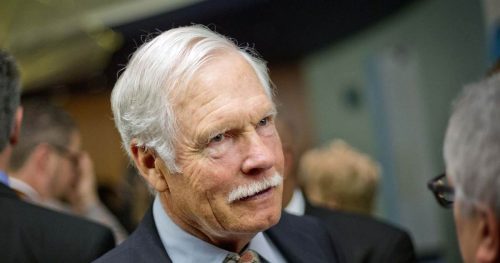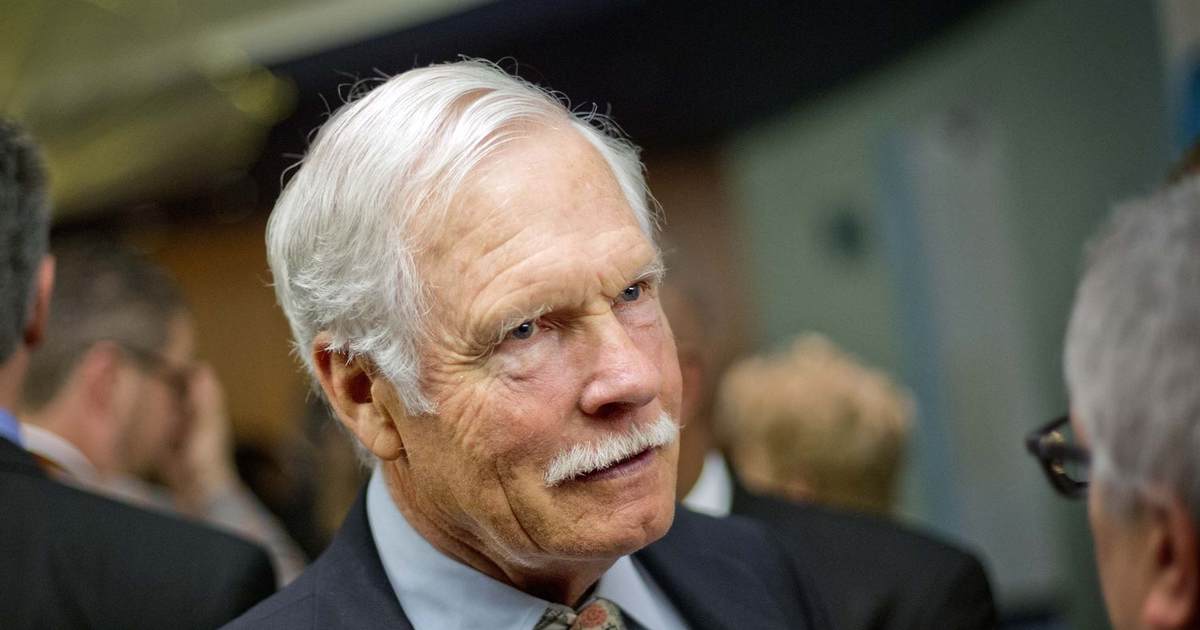
Ted Turner, the 87-year-old media executive who launched CNN and reshaped cable television, has died, leaving behind a complex legacy of broadcasting innovation, sports ownership, philanthropy, and conservation efforts.
Ted Turner, the media mogul and founder of CNN, has died. He was 87 years old.
Ted Turner, the media maverick and philanthropist who founded CNN, a pioneering 24-hour network that revolutionized television news, died Wednesday, according to a news release from Turner Enterprises. He was 87.
🚨 NOW: Founder of CNN Ted Turner has passed away at the age of 87
FOX: "Turner, born in Cincinnati, Ohio, made his fortune first through advertising in the state of Georgia, and then made his way into cable television, where he made a fortune on the seas as a sailor, as a… pic.twitter.com/eZK5IcFkuS
— Eric Daugherty (@EricLDaugh) May 6, 2026
The Ohio-born Atlanta businessman, nicknamed “The Mouth of the South” for his outspoken nature, built a media empire that encompassed cable’s first superstation and popular channels for movies and cartoons, plus professional sports teams like the Atlanta Braves.
Turner was also an internationally known yachtsman; a philanthropist who founded the United Nations Foundation; an activist who sought the worldwide elimination of nuclear weapons; and a conservationist who became one of the foremost landowners in the United States. He played a crucial role in reintroducing bison to the American west. He even created the Captain Planet cartoon to educate kids about the environment.
Turner was born in Cincinnati, Ohio, to parents Florence and Robert Turner and moved with his family to Savannah, Georgia, when he was nine. He later attended The McCallie School, a private boys’ preparatory academy in Chattanooga, Tennessee, before heading to college in the Northeast.
At Brown University he was vice president of the Brown Debating Union and captain of the sailing team, initially majoring in classics before switching to economics. He was expelled before completing his degree for having a female student in his dorm room, though Brown awarded him an honorary B.A. in 1989.
After his expulsion, Turner joined the United States Coast Guard Reserve to fulfill his service obligation as the Vietnam era intensified. That step was part of a pattern of bold moves that later defined his business and public life.
In late 1960 he returned to Georgia and took the reins of the Macon branch of his father’s billboard business, quickly rising after his father’s suicide in March 1963 to become president and chief executive of Turner Advertising Company at the age of 24. The business prospered partly because it held what were described as “virtual monopolies” in several Southern markets.
Turner then parlayed that success into radio stations and, eventually, a struggling UHF television outlet, WJRJ, in Atlanta which he rebranded as WTCG for Turner Communications Group. The early station filled its schedule with old movies, theatrical cartoons, and reruns of shows including “Gilligan’s Island,” “I Love Lucy,” and “Star Trek.”
He later acquired WRET in Charlotte and ran a similar format there, building an audience hungry for familiar entertainment. Those programming choices set the stage for a much larger idea about how television could reach homes across the continent.
In 1976 Turner bought the Atlanta Braves and followed with the Atlanta Hawks the next year, moves that brought local sports into his programming lineup and helped turn those franchises into national brands. Broadcasting Braves games widely via his channels changed how fans connected with professional sports and raised the profile of the team long before their later success.
Turner also launched the Goodwill Games in 1986 as an attempt to ease tensions between capitalist and communist countries through sport, an example of his mix of media, commerce, and public diplomacy. He kept moving between business and civic projects, often on a large scale.
By 1979 Turner had sold the North Carolina station and established what became CNN’s headquarters in Atlanta, betting that a nonstop news channel could find an audience. He named media executive Reese Schonfeld as the first president and chief executive of the Cable News Network, setting a new standard for how news was delivered around the clock.
Turner was also widely known for his philanthropy, notably donating $1 billion to create the United Nations Foundation, and for his devotion to sailing. His yacht Courageous beat challenger Australia in a four-race sweep in 1977, earning him the America’s Cup that year and later induction into sailing halls of fame.
On the personal side, Turner was married three times—first to Judy Nye, then Jane Smith, and later to actress Jane Fonda—and he fathered five children. In 2018 he revealed a diagnosis of Lewy Body Dementia, a serious condition that affected his later years.
Ted Turner is survived by his five children and a number of grandchildren and great-grandchildren, leaving behind a complicated, influential imprint on media, conservation, and philanthropy. His career combined showmanship, risk-taking, and a scale of ambition that remade parts of American culture and industry.