A brutal pair of quakes rocked northern Venezuela, killing and injuring thousands while leaving infrastructure shattered and rescue efforts muddled amid aftershocks and chaos.
Last Wednesday, two powerful earthquakes hit Venezuela, flattening neighborhoods and sending terrifying footage out of Caracas and La Guaira. The US Geological Survey’s wide estimate — between 10,000 and 100,000 likely killed — underscores how catastrophic this event could be. Official counts have been climbing daily, and authorities currently list 1,450 confirmed dead amid rapidly evolving reports.
Nearly 70,000 people are reported missing, and more than 430 aftershocks have rattled the region since the main shocks, complicating search-and-rescue work. Roads and bridges were damaged, slowing convoys and blocking supply routes for medical teams and food. Nearly 2 million people now need assistance, including some 680,000 children, via NYT.
Emergency responders struggled to navigate chaotic roads clogged by desperate civilian aid efforts in quake-ravaged northern Venezuela, as more aftershocks on Sunday rattled nerves and as fears mounted that the window for finding survivors was closing.
https://x.com/MarioNawfal/status/2071257313487306888
More than three days have passed since the 7.2- and 7.5-magnitude earthquakes struck Venezuela, cutting a path of destruction through its northern states. That exceeds the 72-hour window in which many experts and aid groups say the most people can be saved.
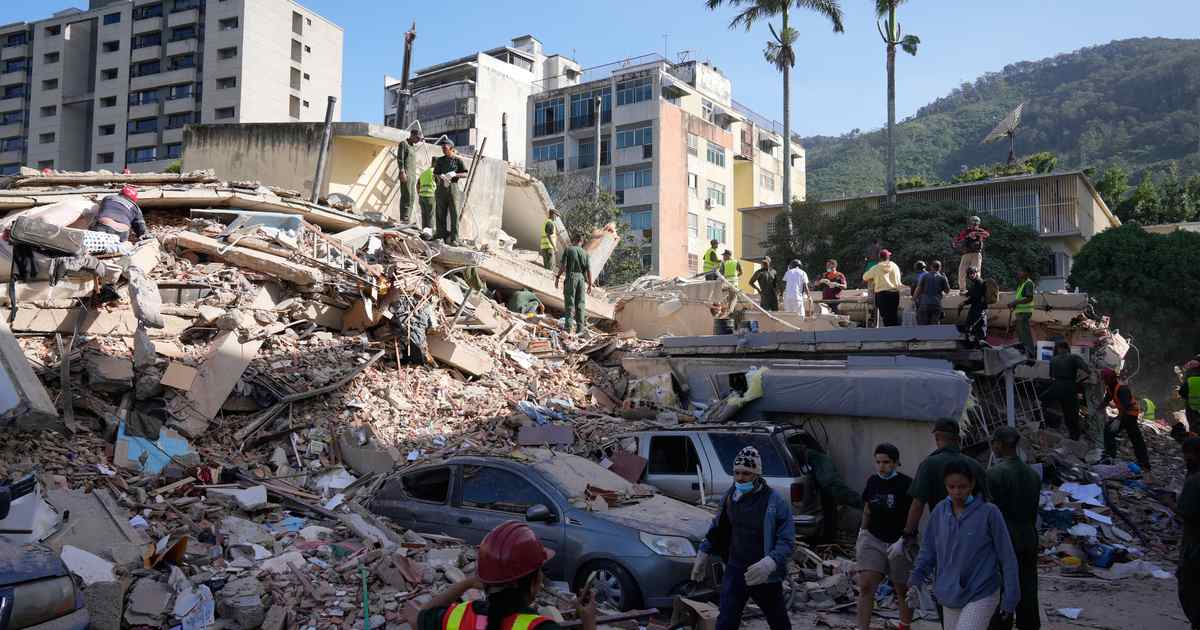
The death toll from Wednesday’s twin earthquakes has risen to 1,450 people and thousands more are injured, Jorge Rodríguez, the leader of Venezuela’s National Assembly, said on Sunday, with 3,150 injured and 12,721 people displaced. He added that 774 buildings had been damaged or destroyed, including 189 that collapsed completely and 585 that suffered damage or partial collapse.
“We are in critical hours, crucial hours,” he said.
On Sunday afternoon, Venezuela’s interim president, Delcy Rodríguez, said search-and-rescue operations would continue after rescuers found additional survivors on Sunday.
“We recovered people alive today,” she said in televised remarks. “Therefore, the rescue operations will not be suspended.”
More than 430 aftershocks have rolled through the region since Wednesday, prompting many people in La Guaira, the most affected state, to sleep outside, fearing more buildings could fall.
Rescue efforts in La Guaira have been hampered by a rush of civilian vehicles carrying relief supplies and volunteers that has jammed the lone highway into the region, leaving many aid workers stranded in traffic. Officials have attempted to limit access to the state to government vehicles and other authorized personnel. But large groups of civilians — many expressing anger at the authorities’ disaster response — still crowded the roads on Saturday to bring food, water and medical aid.
In the ruins of cities and towns across La Guaira, rescue workers, many picking through the wreckage with shovels and bare hands, called out to survivors on Saturday. They were largely met by silence.
The United Nations estimates that 125 buildings have collapsed, which suggests many more deaths than the official figure, Gianluca Rampolla, the U.N. humanitarian coordinator in Venezuela, said in an interview. UNICEF reported that about 1.8 million people, including 680,000 children, were in need of humanitarian aid.
There are impressive, harrowing rescue clips circulating that show first responders pulling survivors from the rubble, but those successes are dwarfed by the scale of damage and the growing casualty lists. The region faces damaged hospitals, fractured supply lines and overwhelmed local teams trying to triage thousands of injured people.
International help is arriving as countries, including the United States, dispatch task forces and equipment to support search, medical care and logistics. Those reinforcements will help, but timing matters: many experts warn that the most lives are saved in the earliest days after a quake, and the window is closing for tens of thousands of people.
Traffic jams caused by civilians trying to bring supplies have become a major bottleneck, prompting officials to restrict access and prioritize government and authorized relief vehicles. That tension between organized relief corridors and spontaneous aid runs into the reality of desperate families trying to reach loved ones. Meanwhile, the tally of damaged structures keeps growing: officials report hundreds of buildings affected and thousands displaced, painting a picture that likely understates the human toll.
Aftershocks continue to sap morale and force many residents to sleep outdoors from fear of more collapses, while emergency teams race to clear roads and stabilize critical infrastructure. Coordinated logistics — secure routes for medical evacuations, fuel for generators, and safe staging areas for international teams — will decide how quickly those basic needs are met. As the situation unfolds, the fragile window for finding survivors narrows, and the focus shifts toward keeping the injured alive and preventing further loss amid ongoing tremors.