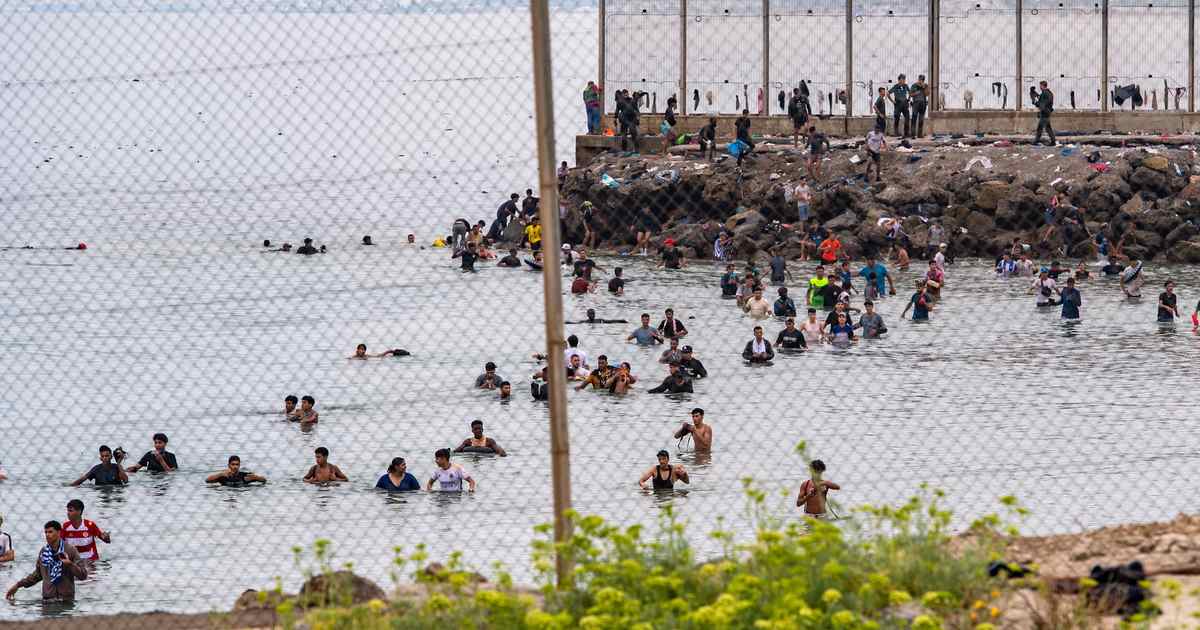
Ceuta, a tiny Spanish enclave in North Africa, has been flooded by tens of thousands of migrants after a legal ruling limited immediate deportations, and the scene on the ground is chaotic and grim.
Local authorities in Ceuta faced an unprecedented surge when at least 60,000 people poured into the territory, overwhelming police and basic services. The surge followed a Spanish Supreme Court decision that ruled migrants arriving by sea could not be automatically expelled, and the result has been immediate strain. Officials scrambled to manage crowds while hospitals, shelters and security services buckled under pressure.
Images and on-the-ground reports show desperate people testing borders and authorities stretched thin, and the social fabric of the enclave frayed by sheer numbers. Law enforcement responses — including water cannons, tear gas and warning shots — were reported as officials tried to stem the flow. That the situation deteriorated so fast points to a disconnect between legal rulings and practical border control.
Tens of thousands of migrants who crossed into Spain’s tiny Ceuta territory returned voluntarily to Morocco on Friday, a day after the influx triggered chaos in the North African city and reignited the immigration debate in Europe and beyond. At least 57 migrants died on the journey.
Ceuta’s president put the number of migrants at 60,000, which was equivalent to 70% of the territory’s population. But most of them soon went back, the Spanish government said, after the sudden arrival of so many people sparked a humanitarian crisis.
Some migrants swam several miles through the sea and faced down authorities who tried to turn them back with water cannons, tear gas and warning shots. Those who died included some who drowned or were killed in a stampede to cross a breakwater barrier near a border checkpoint.
The human cost is stark: dozens died attempting the crossing, including drownings and stampedes at choke points. Even when many returned to neighboring territory, the aftermath left Ceuta’s services broken and its residents shaken. That kind of trauma doesn’t vanish quickly, and cleanup and medical care became emergency tasks.
Reports from the scene described squalid conditions after the surge, with sanitation systems overwhelmed and people forced into public spaces without facilities. Local infrastructure was pushed past breaking point, creating public health and safety challenges that are still unfolding. Those images are hard to ignore for anyone who cares about secure borders and orderly migration.
https://x.com/nypost/status/2083151000731340830
From a Republican viewpoint, this incident underscores how legal interpretations can outpace on-the-ground realities and invite chaos when enforcement tools are limited. Courts may make rulings with important legal points, but when decisions remove immediate deportation options, borders become harder to manage. Conservatives argue policy should respect law while ensuring practical mechanisms exist to keep communities safe.
Ceuta’s population was effectively dwarfed by the sudden arrival, with local leaders noting the scale reached roughly 70 percent of the territory’s normal residents. Emergency responses helped some migrants return voluntarily, but the damage — physical, social and political — was already done. The episode has become a focal point in debates across Europe about migration, sovereignty and the limits of judicial decisions.
Beyond the immediate calamity, this episode raises questions about coordination between judicial rulings, executive action and border enforcement. When legal changes remove quick removal options, governments need contingency plans and fast operational responses. Otherwise, local communities pay the price, services collapse and public opinion hardens against open-border approaches.
No easy fixes present themselves: the situation in Ceuta exposed gaps between law, policy and practical capacity. The aftermath will leave political consequences in Spain and across Europe, and it will shape how lawmakers, courts and enforcement agencies think about migration moving forward. For now, Ceuta’s streets and services are the hard evidence of what happens when a legal shift meets a large and sudden human movement.