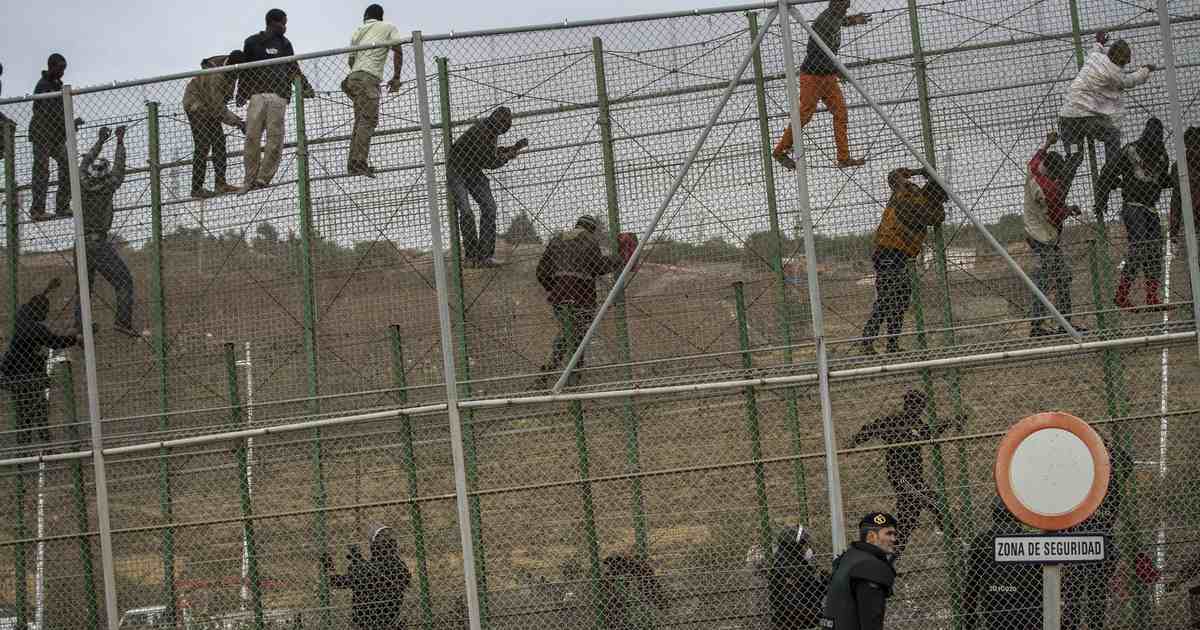
Spain’s North African territories are facing a sudden, overwhelming influx of migrants after a recent Supreme Court decision, with scenes of people arriving by sea, overwhelmed reception centers, and local leaders describing a humanitarian emergency.
The situation in Ceuta and Melilla exploded after Spain’s Supreme Court said migrants intercepted at sea cannot be immediately deported, a ruling that shifted how authorities respond to arrivals. That legal change coincided with large groups attempting to reach Spanish territory from Morocco, and the result has been chaotic and fast-moving. Local officials and residents have been left scrambling for basic capacity and order.
Videos and eyewitness reports show thousands moving toward or entering the enclaves, many wet from the sea and leaving flotation devices or clothing behind on the shore. The images are hard to ignore: people walking through town, exhausted but relieved, and local services stretched thin. Reception centers that were already busy are now beyond saturated and can no longer absorb new arrivals at previous rates.
https://x.com/Breaking911/status/2082865868048904476
Beyond the immediate humanitarian picture, there are real security and policy questions that need answers. How will Spain manage unintended incentives if arrivals can’t be promptly returned? What message does a court ruling send to smugglers and would-be migrants about which routes and tactics will succeed? Those are practical concerns as officials coordinate with Moroccan authorities to restore control.
Local leaders have been blunt about the scale of the challenge, noting daily entry rates that far exceed normal capacity and warning of a social emergency. Hospitals, shelters, and police resources are under strain as new groups show up by sea and land crossings. The human toll is visible, but the logistical strain is equally severe for the communities receiving them.
Migration from Morocco into Spain’s two north African territories, Ceuta and Melilla, has long been a politically sensitive issue between the two countries, as thousands cross the border at times.
AFP reporters saw a stream of adults and children, most of them wet, entering the town. Discarded flotation rings and clothes had been left on the shore near where the frontier barrier meets the sea.
The president of Ceuta, Juan Vivas, said Wednesday that 1,500 migrants had come to Ceuta by sea in the past few days.
“We are in a situation of total humanitarian and social emergency,” he said in comments broadcast Thursday by Spanish television.
Earlier, he had said that the reception centres were saturated as the number of people entering was more than 200 a day.
“There is no more room for anyone,” he said.
[…]
Migrants walked cheerfully through the streets of Ceuta, thanking the Spanish police and calling out: “Bye bye, Morocco, hello Spain.”
Police and Civil Guards in Ceuta appeared to do little to intervene, though some officers attempted to direct the arrivals to the local migrant reception centre.
“It really breaks my heart to see so many people suffering, and who knows how many have actually drowned along the way,” one young man, a local resident, told AFP.
“To be honest, I don’t understand why they come to Spain, why they’re led to believe that there’s a future here,” he added.
“When they arrive, they’re faced with the harsh reality that they have nothing, and that people treat them as if they were nobody.”
[…]
Spain’s Prime Minister Pedro Sanchez said on X that his government was “focussed on providing an immediate response to the crisis in Ceuta.
“We are mobilising all necessary resources, working with Moroccan and international authorities, and preparing the necessary measures to restore normality as soon as possible.”
This episode shows how quickly legal rulings can reshape operational realities on the ground, and why policy must consider both law and enforcement capacity. Border control is not just a legal question; it is also a logistical and political one that impacts local communities and national diplomacy. Officials in Madrid now face pressure to pair legal clarity with practical plans to avoid repeated surges.
There are clear diplomatic layers here as well, since Morocco’s cooperation is essential to managing crossings and returns. Coordination between the two governments will determine whether this remains a temporary crisis or becomes a recurring pressure point. For Spanish conservatives and Republicans watching from abroad, the episode underlines the need for firm, predictable borders and workable agreements with neighboring countries.
Local residents report sympathy for the human suffering but frustration with the immediate consequences: overflowing centers, strained services, and a sudden windfall of unstable arrivals. That tension—compassion colliding with capacity limits—creates political heat and invites debate about long-term migration policy. For border towns, the debate is not academic; it is about beds, food, medical care, and public order now.
Spain is now tasked with balancing humanitarian response and restoration of orderly control while preparing for potential further arrivals. The coming days will test the government’s ability to match legal rulings with operational muscle and international cooperation. Spain’s communities and institutions will be judged on how quickly they can stabilize the situation.
Spain has a mess on its hands, and the courts, government, and local authorities are all part of the cleanup. Fixing it will require clearer policy, stronger on-the-ground capacity, and better cross-border coordination to prevent repeats. The immediate focus, however, has to be on managing the arrivals humanely while reasserting order at the frontier.