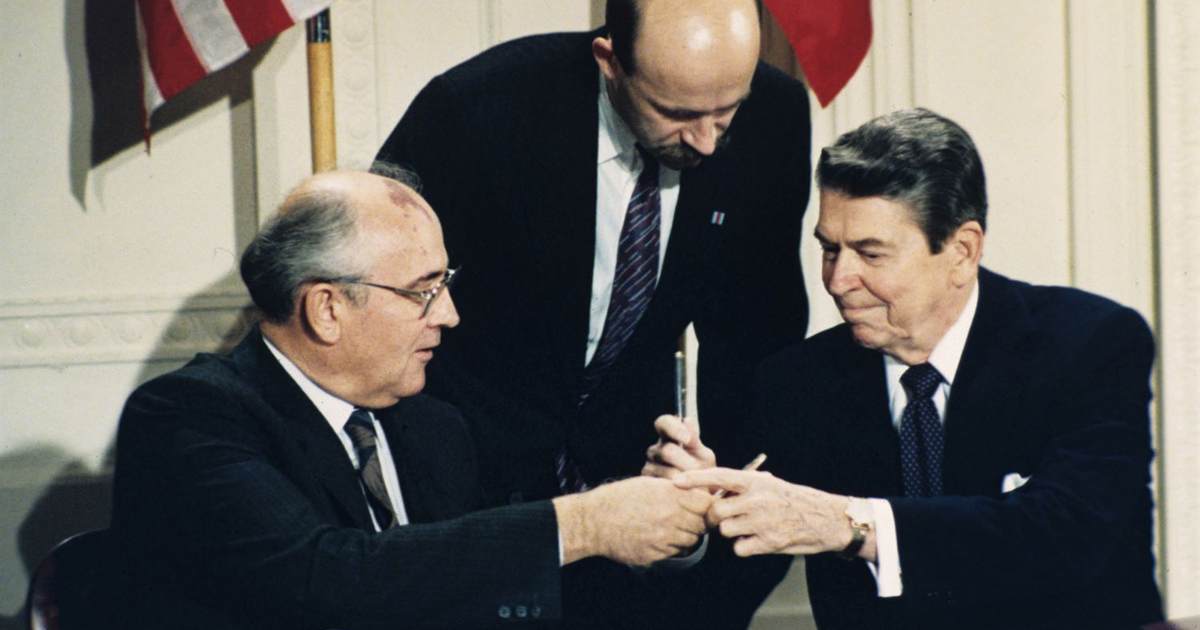
A brisk look at the film The Brink of War, its portrayal of Ronald Reagan and Mikhail Gorbachev, and how the movie balances historical detail, dramatic license, and political interpretation.
The film recreates the 1986 Reykjavik summit where President Ronald Reagan met Soviet General Secretary Mikhail Gorbachev to discuss nuclear arms control. It leans into archival transcripts and interviews to shape the drama, and it centers on two powerful men navigating a dangerous moment for the world. The movie risks courtroom-like fidelity on one hand and crowd-pleasing dramatics on the other, so its choices matter.
Early scenes frame the meeting by opening near the end, with tensions high over Reagan’s Strategic Defense Initiative and a stalled negotiation. That framing device jumps back in time to show how the summit unfolded, a familiar move that reduces suspense when the outcome is already known. Still, the film tries to show why this encounter mattered beyond the punchy headlines.
“If we fail here, there will be war,” warned Secretary of State George Shultz (J.K. Simmons). That line lands as a moral stake in the movie and hammers home the real risk at Reykjavik: the world teetered on a knife edge, and the stakes were national survival, not just diplomatic pride. The film makes that fear central to every exchange, which is appropriate given the historical record.
Casting was the movie’s biggest gamble, with Jeff Daniels as Reagan and Jared Harris as Gorbachev. Both actors avoid caricature and deliver restrained performances that let the personalities breathe without becoming impersonations. Their chemistry carries the dialogue-heavy scenes, and the supporting cast, including J.K. Simmons, provides steady ballast.
The Atlantic criticized the film for leaning too kindly toward Reagan, and the movie doesn’t hide its admiration for a president who could talk tough and still sit down. The director clearly wants to correct the caricature of Reagan as a blustering simpleton, and instead presents a leader willing to engage, stand firm, and use humor as a tool. That tilt will annoy critics who prefer a more skeptical take, but it’s a defensible creative choice.
In October 1986, Reagan and Soviet General Secretary Mikhail Gorbachev met to discuss nuclear-arms control in Reykjavik, Iceland. At the time, I was a young scholar in Washington, training in Soviet affairs and international relations at Georgetown University and working at the Center for Strategic and International Studies. (I was also a two-time Reagan voter.) When the Reykjavik meeting took place, no one was looking ahead to the collapse of the Soviet Union; Kremlin watchers were, mostly, relieved to see a Soviet general secretary and an American president talking with each other.
https://x.com/WallStreetMav/status/2088702374823039031
The Brink of War, a new film released nationwide today, tries to bring texture and detail to those two days in Iceland. The movie relies on transcripts and other documents from the time, along with interviews with a former secretary of state, the late George Shultz (to whom the movie is dedicated). The film is a welcome corrective to the liberal orthodoxy about Reagan—specifically, that he was a disconnected simpleton who didn’t understand the complexities of the arms race. But it leans too much in the opposite direction: It is too kind to the Gipper, and takes too many liberties with the historical record.
The screenplay occasionally slips into melodrama with invented subplots meant to humanize the scene, like personal snipes between the wives and a muted romance between two journalists. Those threads break the rhythm of the summit sequences and sometimes feel like padding rather than insight. Still, the film uses them to contrast private concerns with the public business of bargaining over humanity’s future.
One dramatic liberty involves Reagan’s 1981 assassination attempt, shown as if its wounds and flashbacks were freshly affecting the 1986 gathering. The choice adds a sympathetic vulnerability to the president but blurs the timeline for dramatic effect. The movie’s judgment call here favors emotional truth over strict chronology, and viewers will split over whether that’s forgivable.
Structurally, the film could have traded the backward flash for a sharper critique of the so-called experts who doubted such a summit could work. That angle would have spotlighted the leaders’ willingness to defy conventional wisdom and would have tightened the dramatic arc. As it stands, the film relies on strong performances and careful pacing more than inventive storytelling.
Ultimately, the movie shows a president who engaged and stood up to Soviet communism, a portrayal that will please audiences who see Reagan as central to the Cold War’s end. The characters are handled with respect, the historical texture is there, and the acting is often excellent. For those who want a film that treats American leadership as purposeful rather than accidental, this one delivers.