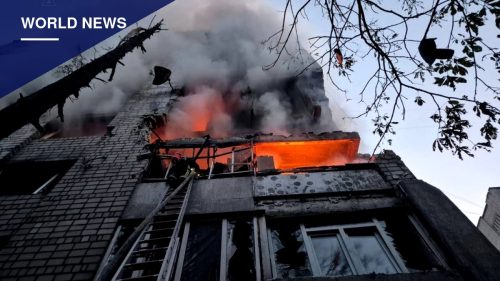
President Donald Trump posted a ten-second AI-generated video on Sunday showing Iran’s Kharg Island oil terminal being, in his words, “blown to smithereens.” The post came shortly after the first confirmed U.S. airstrikes against Iranian forces in a month, though none of those actual strikes targeted Kharg Island.
Hamid Bovard, chief executive of Iran’s state-run National Iranian Oil Company, dismissed the video on Monday as “laughable,” saying “conditions in Kharg are calm and appropriate.” He said the terminal remains operational, that workers are repairing damage from earlier strikes, and that facilities there are being modernized. Kharg Island normally handles about 90 percent of Iran’s oil exports.
The real strikes on Sunday hit two Iranian missile launchers on Larak Island, near Bandar Abbas in the Strait of Hormuz — hundreds of miles from Kharg Island. U.S. Central Command said Iran’s Islamic Revolutionary Guard Corps had been preparing to launch rockets carrying sea mines into the strait.
“Earlier today U.S. forces struck two Iranian launchers on Larak Island. Islamic Revolutionary Guard Corps forces were observed preparing to launch rockets with sea mines into the Strait of Hormuz,” CENTCOM spokesman Capt. Tim Hawkins said.
“Last week, CENTCOM completed clearing sea mines from the strait’s international shipping routes. U.S. forces are monitoring the area closely and remain prepared to protect the free flow of commerce through this essential waterway,” he added.
This was the first acknowledged American attack on Iran since July 29, when U.S. forces struck dozens of surveillance and coastal weapons sites run by the IRGC. Trump had halted further strikes on August 1, reportedly at the request of Saudi Arabia, Qatar and the United Arab Emirates, to give diplomacy another chance. That pause came after CENTCOM’s Thursday disclosure that American personnel had quietly disarmed and cleared most of the mines Iran had previously laid in the strait.
Iran retaliates, makes disputed claims
The IRGC responded to the Larak Island strikes by firing drones and ballistic missiles at U.S. positions in Jordan and the UAE. Most or all of the weapons were intercepted, and no damage had been reported as of Monday morning. Iran called its attacks a “necessary and lawful” response, a characterization CENTCOM rejected outright.
“U.S. forces took limited, precise action against IRGC minelaying forces posing an imminent threat in the Strait of Hormuz. In essence, Iran created the threat and the U.S. military eliminated it to protect civilian mariners, commercial shipping, and the free flow of global commerce,” CENTCOM said.
Iran also claimed an oil tanker struck one of its mines in the strait on Monday and caught fire — a claim CENTCOM said was false. “No ships have hit mines in the Strait of Hormuz. This is yet another IRGC attempt to intimidate regional commercial shipping through disinformation,” the command said.
Iranian state media reported explosions near Larak Island, and the IRGC said several of its fighters were killed or wounded, calling the U.S. strikes “a fatal mistake by the Trump regime during the economic war.”
Kharg Island’s strategic weight
Trump has repeatedly floated seizing or destroying Kharg Island, a step that would effectively cripple Iran’s oil industry. Iran has a backup terminal at Jask on the Gulf of Oman, but it lacks the pipelines and loading capacity to replace Kharg Island’s output.
“At some point in the not too distant future, we will be taking Kharg Island, and other oil infrastructure points, and assume total control of their Oil and Gas Markets, much like we have with Venezuela, which is working out brilliantly for both Venezuela and the United States of America,” Trump wrote on Truth Social on June 11.
The U.S. naval blockade of Iran, paused in June and reimposed on July 14, has cut Iran’s oil loadings by about 70 percent over the past month. Iran currently has roughly 20 million barrels of crude at sea and about the same amount in onshore storage.
Despite Iranian claims of shutting down the Strait of Hormuz through terrorist threats, ship-tracking services show up to 6 million barrels of oil per day still moving through the strait under U.S. Navy protection, a figure that is slowly rising. Before the conflict began in February, about 15 million barrels a day flowed through the strait.