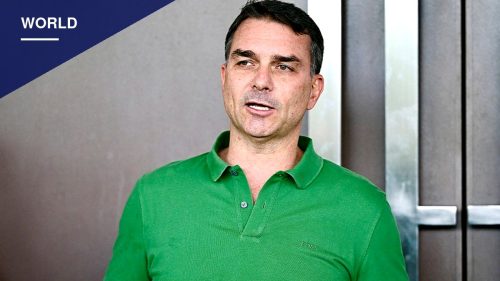
Senator Flavio Bolsonaro, the son of former Brazilian President Jair Bolsonaro, won the first round of Brazil’s presidential election, outperforming nearly every pre-election poll and setting up an October 25 runoff against incumbent President Inacio Lula da Silva.
With 99% of votes counted, Bolsonaro led Lula 47.2% to 44.9%. Most polling in the weeks before the vote had shown Lula with a single-digit lead, making the result a significant upset.
The gap between polling and results has fueled longstanding complaints from Brazil’s right that major pollsters favor Lula and his Workers Party. Similar polling misses occurred ahead of Jair Bolsonaro’s 2022 and 2018 campaigns, though the discrepancy this time was notably larger.
Bolsonaro performed strongly in Brazil’s three largest states. He led Lula 52% to 38% in Sao Paulo, the country’s most populous state; 48% to 43% in Minas Gerais, often described as Brazil’s bellwether; and 53% to 39% in Rio de Janeiro, his political base.
Lula held his traditional strongholds in the Northeast, winning Bahia, Pernambuco and Ceara by wide margins, but those gains were not enough to offset Bolsonaro’s performance in the south.
Bolsonaro maintained a close relationship with former President Donald Trump throughout the campaign. Trump had been open about his desire to see Lula, a longtime geopolitical rival, removed from office. The result adds Brazil to a string of recent right-wing electoral wins across Latin America, including in Chile, Argentina, Peru, Ecuador and Bolivia.
At 80 years old and seeking a fourth presidential term, Lula had been viewed as the figure most capable of uniting Brazil’s divided left. His political career includes a dramatic reversal: imprisoned on corruption charges, he was later freed by Brazil’s Supreme Court and went on to narrowly defeat Jair Bolsonaro in the 2022 election. Lula had pledged in 2022 to serve only one term before deciding to run again.
Heading into the runoff, Bolsonaro holds several advantages. He is expected to pick up support from voters who backed minor candidates Augusto Cury, Renan Santos, Ronaldo Caiado and Romeu Zema, who together drew nearly 8% of the first-round vote. Caiado and Zema are believed likely to endorse Bolsonaro, while Cury and Santos are not expected to make an endorsement.
If elected, Bolsonaro would be positioned to free his father and senior military officers currently jailed on charges related to an alleged plot to remain in power after the 2022 election.
Other members of the Bolsonaro family also won office in this election. Jair Bolsonaro’s wife, Michelly, was elected senator, as was his son Carlos, while another son, Renan, won a seat as federal deputy. Bolsonaro’s Liberal Party also performed strongly in congressional races, and is projected to hold 29 Senate seats compared with 9 for Lula’s Workers Party.