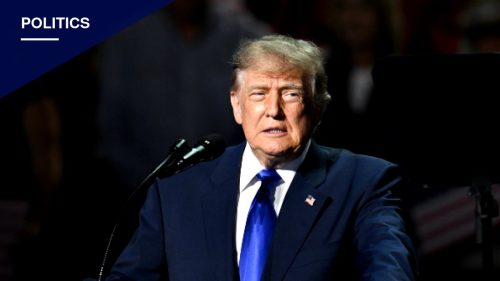
President Donald Trump told an audience of Hispanic supporters and business executives that immigration policy is the hardest part of his job, as he continues to navigate pressure from both hardline supporters who want tougher enforcement and business groups pushing for more legal migrant labor.
“Frankly, it’s the hardest job that I’ve had — the hardest job,” Trump said, according to remarks reported from the September 30 event. “Because they’ll say ‘You’re too tough’ or ‘You’re too soft.’ ‘Get tougher!’ ‘Get softer!’ No matter what you do, it’s always tough.”
Trump told the gathering that politicians ultimately have to answer to voters. “We have to have the votes,” he said, warning that the alternative was a return to “open border lunatics.” He claimed that under President Joe Biden, 25 million people crossed the border illegally, and said his administration has removed “thousands of murderers” from the country while running “zero” illegal crossings over the past 17 months, with migrants now arriving through legal channels instead.
A balancing act
Mark Krikorian, director of the Center for Immigration Studies, said Trump’s comments offered a rare window into the competing pressures he faces. “He’s saying this issue is tough. You guys want one thing, other people want something else, and I’m constantly pulled in both directions,” Krikorian said. “That’s a look behind the curtain, and is encouraging in the sense that he at least is acknowledging that he’s pushed by business in the wrong direction.”
Krikorian argued that incremental progress is still progress. “I’m not willing to concede that he’s doing the best he possibly can given current pressures. But he’s doing a lot more than any other president, and so you know, I’m happy to take half a loaf,” he said. “If you’re willing to settle for something as long as you’re moving in the right direction, you know you’re operating in reality. This administration is clearly moving in the right direction, even though there are areas where they’re not doing as much as they should be doing.”
Since taking office, Trump has shifted between satisfying voters who back strict enforcement and donors who favor continued migrant labor. That tension has grown as border and deportation policy puts pressure on companies to hire American workers rather than migrant labor.
Business and advocacy groups push back
Todd Schulte, president of the pro-migration group FWD.us, criticized the scale of Trump’s deportation effort, saying it is “bad for immigrants, bad for immigrants who are citizens, bad for Latinos and blacks and all sorts of people who are getting caught up in an expanding profiling and criminal justice system.” Schulte’s organization has been working with Hispanic business leaders and ethnic advocacy groups to press Trump toward legalizing a larger flow of migrant labor.
At the same time, Trump faces pressure from supporters who say his administration isn’t deporting enough people and is allowing too many visa workers into the country, including from American college graduates who say they have lost jobs and career opportunities to H-1B and other visa workers.
Mike Howell, president of the Oversight Project and a member of the Mass Deportation Coalition, said voters, not donors, should guide the administration’s direction. “If he gets tough on the issue, the voters will reward him,” Howell said. “People should make their voices heard. This is still a constitutional republic where voters allegedly matter, and so I would advise the President to remember that each billionaire has one vote, and the voters have a lot more.” Howell added that politicians need to “dance with the girl you brought to the prom.”
Enforcement numbers and next steps
The Department of Homeland Security is currently arresting roughly 50,000 illegal migrants a month for deportation, a pace that remains popular with GOP-leaning voters and has made immigration one of Trump’s most favorably rated policy areas.
Krikorian suggested the administration could go further without necessarily increasing political backlash, by focusing less on high-profile raids and more on quiet workplace audits. “He should be doing more company audits — not showy raids — but just audits by officials who don’t have guns or badges,” Krikorian said. “Just guys in briefcases bringing the IRS and the Labor Department with them and doing a paperwork colonoscopy on your payroll, especially if there’s some reason to believe this is an employer with real problems.”
Krikorian said sustained pressure from voters remains essential to keeping the administration focused on enforcement rather than business interests. “He needs constant encouragement” to resist pressure from business and ethnic lobbying groups, Krikorian said.