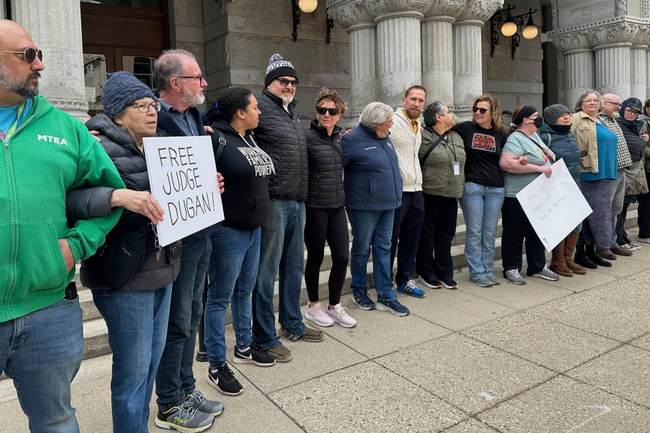
Hannah Dugan, a Milwaukee County judge arrested in the spring for allegedly helping a court defendant evade ICE, is facing a high-profile federal trial this week amid protests, media scrutiny, and heated political responses.
The trial begins Monday after months of maneuvering and public argument over how the case should be handled. The arrest and its fallout have become a flashpoint in Wisconsin politics and across national media, drawing unusually intense attention for a local courtroom matter.
Prosecutors say Dugan helped Eduardo Flores-Ruiz, an undocumented defendant facing charges including endangering safety, reckless use of a firearm, use of a dangerous weapon, and cocaine possession, evade federal immigration agents while he was in her court. Her arrest in the spring triggered an uproar from local Democrats and sympathetic media outlets, who framed the FBI action as heavy-handed enforcement at a county courthouse.
Milwaukee County Executive David Crowley condemned the arrest, telling MS NOW, “I couldn’t believe what I had seen and was horrified by the actions of the FBI coming onto our county courthouse grounds, literally going after a sitting judge who’s not a flight risk.” Wisconsin state Rep. Ryan Clancy also posted on X that he and his party “stand with Dugan” as the case moved forward.
— TMJ4 News (@tmj4)
Federal Judge Lynn Adelman presided over pretrial proceedings and drew criticism for initially barring audio of juror questioning when it took place in his chambers. After objections from several media organizations, Adelman allowed audio for additional jurors but retained the right to cut the feed if questions turned personal, a compromise that still left newsrooms and the public debating transparency.
U.S. District Judge Lynn Adelman adjusted a previous ruling Thursday afternoon about questioning individual jurors in private, after objections from several media organizations, as day one of jury selection in the Hannah Dugan trial moves forward.
Adelman initially barred audio on an in-house stream for members of the media, as jurors were questioned in the judge’s chambers, citing concerns from attorneys about whether some potential jurors would be fully transparent in their answers if the questioning was broadcast to the media and public.
U.S. District Judge Lynn Adelman changed his decision in the middle of jury selection Thursday, now allowing for access to individual jury questioning after objections from several media organizations including Hearst Television and Gannetthttps://t.co/upfwemeoZT
— Matt Smith (@mattsmith_news) December 11, 2025
But over the lunch hour, an attorney representing Hearst Television, which owns WISN 12, and Gannett Media, which owns the Milwaukee Journal Sentinel, intervened, asking Adelman to allow the in-house feed for members of the media.
To the objection of both the defense team and federal prosecutors, Adelman ruled audio would be allowed for 11 additional jurors left in the afternoon questioning, while still reserving the right to turn off the in-house feed if questions became personal.
Both sides told the court they worry the jury pool may be compromised by the case’s publicity and the political heat around it. After a lengthy selection, the seated jury includes nine men and five women, with two alternates named, setting the stage for trial testimony and witness disputes.
Democrats and progressive activists have broadly defended Dugan, arguing that cooperation with federal immigration enforcement is a fraught and politicized issue in local courts. Critics on the right see the defense as emblematic of a double standard where some officials feel exempt from federal law enforcement, a sentiment that has colored public reaction and protest activity outside the courthouse.
Milwaukee County courts have declined to release an audio clip reportedly capturing Dugan saying she would “take the heat” for helping Flores-Ruiz avoid ICE, a line that has become a focal point for prosecutors and critics. That refusal to publish the recording has only amplified calls for clarity about what happened inside the courtroom.
The controversy also intersects with state-level guidance: Governor Tony Evers issued a memo to state employees around that time advising actions that would complicate ICE activity, telling staff they could question agents, contact attorneys, refuse to answer, and restrict access to non-public areas. That memo has been raised by opponents as evidence of a permissive local attitude toward obstructing federal immigration enforcement.
Expect protests at the Milwaukee courthouse through the trial, with activists on both sides likely to turn out and amplify the political stakes. The case will test not only the legal limits of a judge’s conduct but also how federal enforcement, media access, and local politics collide in a charged environment.
Editor’s Note: Unelected federal judges are hijacking President Trump’s agenda and insulting the will of the people.