Republican senators pushed back strongly against critics of recent airstrikes on vessels near Venezuela, arguing the operations targeted dangerous networks and followed legal precedent.
Several Republican lawmakers defended the administration’s use of force after reports that a second strike hit a boat that had already been disabled. The actions have prompted intense debate about policy, legality and the risks of alternative responses. Senators emphasized long-standing practices and the threats posed by transnational criminal groups operating in the hemisphere.
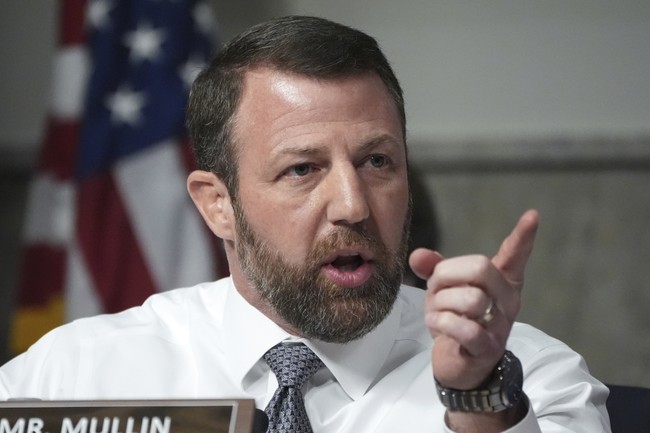
Sen. Markwayne Mullin (R-OK) spoke bluntly to reporters, saying he’s “losing patience on the whole thing because I think it’s ridiculous that we’re having this conversation.” He reminded critics of past administrations, noting that “underneath [President Barack] Obama, he had 500 strikes, 3700 different individuals were killed,” and that “there wasn’t a big show about this.”
Mullin argued the activity in the region is about confronting violent criminal networks rather than staging political theater. He said, “What you guys are all upset about is the hemisphere that’s working in. The hemisphere is these are drug, terrorist organizations,” Mullin continued. “The same people that Obama went after, some people we’ve been over for the last 24 years were terrorist organizations that were wanting to kill Americans. There have been more Americans killed because these terrorist cartels drugging our streets, drugging every one of your all’s streets, every one of your all’s towns, every one of the audiences towns.”
Mullin also made a stark claim about the toll from cartels, stating that cartels “kileld more people in 2024 on our streets than we lost in the entire Vietnam War.” He framed the strikes as part of a broader effort to stop organizations that poison American communities. For him, aggressive action at sea targets those who traffic narcotics and violence into U.S. neighborhoods.
These are terrorist organizations that are poisoning our streets. The President has the authority to do so. The argument is, is this too close to our shores? Does anybody doubt that these are terrorist organizations? Does anybody have a question about these being terrorist organizations? What’s the difference between Obama attacking these individuals when they were deemed terrorist organizations in the Middle versus the ones that are here right now poisoning our streets?
Sen. Tim Sheehy (R-MT) defended the military chain of command and Admiral Frank Bradley’s decision to order a second strike after a vessel was disabled. Sheehy warned that criticizing service members for carrying out these operations “is to indict the very system that was used bipartisanly for the last 24 years.”
He described personal experience with such missions and stressed the legal groundwork that guides them, saying, “I personally was involved in many of these operations, from kinetic strikes to direct action operations. The process we have is legally sound. It’s been supported by legal opinions for a quarter century now of how we find these people, we fix them, and we finish them,” the senator added. “Keep in mind, if we don’t drop a bomb and we decide to interdict, as is being said by many folks, we have an obligation to send a team to interdict. When we make that decision, you’re putting our lives at risk. You’re putting Americans’ lives at risk.”
Not everyone on the right accepted the strikes without question, and that split was visible in media appearances and on the Hill. Sen. Rand Paul (R-KY) raised concerns about due process and evidence collection after the “double tap” incident, noting survivors were reportedly returned rather than detained for prosecution. He argued the policy cannot rest on mere allegation and lethal force alone.
.@SenMullin: "Does anybody doubt that these are terrorist organizations?… So what's the difference between Obama attacking these individuals when they were deemed terrorist organizations in the Middle East vs. the ones that are here right now poisoning our streets?" 🔥 pic.twitter.com/II5T9kpiky
— Rapid Response 47 (@RapidResponse47) December 16, 2025
Paul highlighted practical problems with assuming every interdicted vessel carries contraband, saying, “a bunch of the people on the boats died, but two people survived.” He pressed the point that seizures at sea often turn up no drugs and questioned whether lethal force is justified when a significant share of interdicted boats might be innocent.
The reason being that we interdict ships all the time off the Coast of Miami, off the Coast of California. And the Coast Guard statistics say that about 25% of the boats that we stop to search don’t have any drugs. So if one out of four of the boats don’t have drugs on them, what person would justify blowing up people when one out of four boats may well not have drugs on them?
Other Republicans signaled legal concern while stopping short of blanket opposition, with Ohio Rep. Mike Turner warning that repeating a second strike after a vessel was disabled could cross a legal line. He said he would view a follow-up strike after a disabling strike as unlawful, stating, “I agree that that would be an illegal act.”
Officials say the military has killed at least 95 people in a series of airstrikes on boats in the Caribbean, and the White House has maintained that the targeted vessels were involved in smuggling dangerous narcotics into the United States. The dispute now centers on whether the strikes fit long-standing legal frameworks and whether alternative tactics would endanger American personnel or allow shipments to reach U.S. streets.