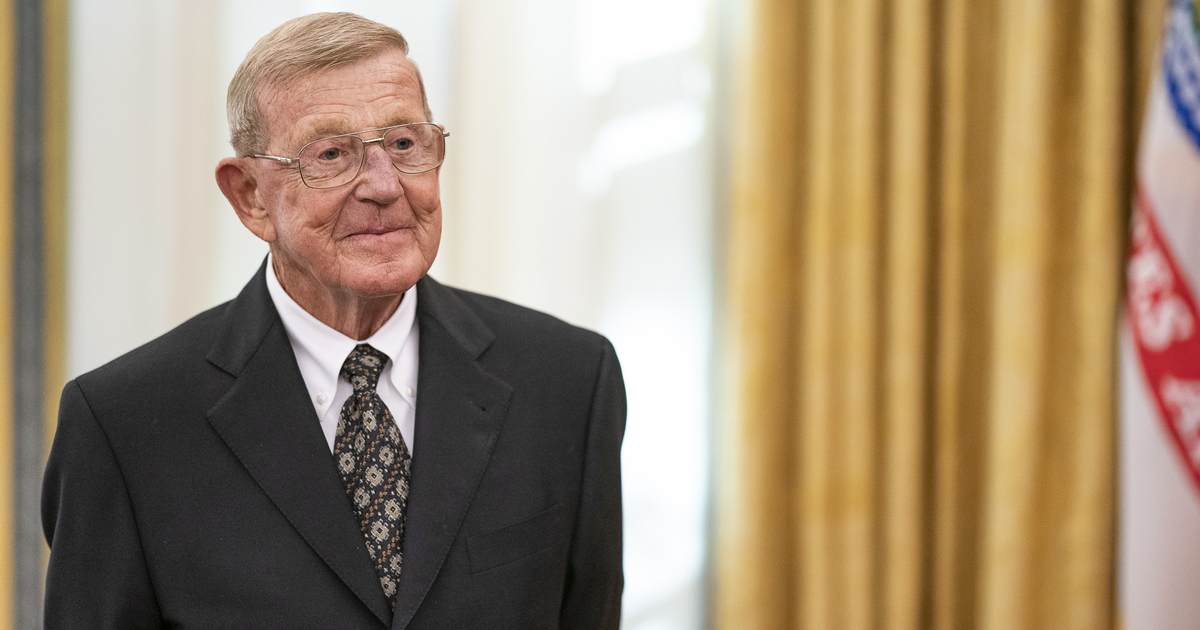
Lou Holtz, the Hall of Famer who guided Notre Dame to the 1988 national title and built a five-decade coaching legacy, has died at 89; this piece walks through his life, career stops, and the statements released after his passing.
Lou Holtz died at the age of 89, leaving behind a coaching legacy that includes the perfect 12-0 season and national title with Notre Dame in 1988. He passed away in Orlando, Florida, surrounded by family, according to the family statement. His death prompted immediate tributes from former players, colleagues, and the university he helped revive.
The Holtz family made the announcement on Holtz’s official X account, sharing the news with followers and fans who remember his presence on and off the field. The public post framed his life as one shaped by faith, family, and service, while noting plans for a funeral Mass at Notre Dame’s Basilica of the Sacred Heart. Messages and remembrances poured in from across college football and beyond.
LEGEND LOST: Lou Holtz, the Hall of Fame coach who led college football programs for 33 years including the Notre Dame Fighting Irish, has died at 89. pic.twitter.com/lelWay0cAn
— Fox News (@FoxNews) March 4, 2026
The statement read:
Louis Leo “Lou” Holtz, legendary college football coach, Hall of Famer, bestselling author, and one of America’s most influential motivational voices, has passed away at the age of 89 in Orlando, Florida, surrounded by family. Born January 6, 1937, in Follansbee, West Virginia, Holtz rose from humble beginnings to become one of the most respected figures in college athletics. Over a remarkable five‑decade career, he led college programs at William & Mary, NC State, Arkansas, Minnesota, Notre Dame, and South Carolina. He transformed every team he inherited and captured the 1988 National Championship with the Fighting Irish. Holtz was preceded in death by his beloved wife of more than 50 years, Beth, with whom he shared a life grounded in faith, devotion, and service.
Holtz is remembered for his enduring values of faith, family, service, and an unwavering belief in the potential of others. His influence extended far beyond the football field through the Holtz Charitable Foundation and the many players, colleagues, and communities shaped by his leadership. He is survived by his four children, nine grandchildren, and two great‑grandchildren. Funeral arrangements, including a Mass of Christian Burial at the Basilica of the Sacred Heart at the University of Notre Dame, will be announced as details are finalized.
Holtz was born on January 6, 1937, in Follansbee, West Virginia, to Anne Marie and Andrew Holtz, who worked as a bus driver. He spent his childhood in East Liverpool, Ohio, and graduated from East Liverpool High School before attending Kent State University. At Kent State he joined the Delta Upsilon fraternity and finished his undergraduate degree in 1959.
Following graduation, Holtz moved to Iowa to work as an assistant coach while earning a master’s degree, and then built his résumé with a series of assistant roles. He coached at William & Mary from 1961 to 1963, at Connecticut from 1964 to 1965, at South Carolina the next season, and at Ohio State in 1968—the year Ohio State won the national championship. Those stops established him as a rising coaching talent in college football.
In 1969 Holtz returned to William & Mary as head coach and led the program to a Southern Conference title and a Tangerine Bowl appearance. He moved on to NC State in 1972 and posted a 33-12-3 record over four seasons, turning heads with consistent results. Those achievements set the stage for his first head-coaching opportunity in the NFL two years later.
Holtz’s NFL tenure was brief: he took the New York Jets job in 1976 but resigned in December with the team sitting at 3-10. The following year he accepted the Arkansas job, where he compiled a 60-21-2 record over seven seasons and led the Razorbacks to six bowl games, including the 1978 Orange Bowl against Oklahoma. His success at Arkansas re-established him as a top collegiate coach and opened the door to national prominence.
In 1986 Holtz left Minnesota to take over a struggling Notre Dame program and set about rebuilding culture and discipline. One of his notable moves was removing players’ names from the backs of jerseys to emphasize team over individual, a tradition that largely remains at Notre Dame. From 1988 through 1993 his teams posted a 64-9-1 record and reached bowl games in nine straight seasons, culminating in the 1988 national championship.
Marcus Freeman, Notre Dame’s current head coach, issued a statement recognizing Holtz’s influence and support, noting a personal relationship and the values Holtz embodied. Freeman praised Holtz and his wife Beth for their generosity and commitment to Notre Dame’s mission and extended condolences to the family. That tribute reflected how deeply Holtz’s legacy is woven into the program’s fabric.
That statement read:
We are deeply saddened to learn of the passing of Lou Holtz. Lou and I shared a very special relationship. He welcomed me to the Notre Dame family immediately, offering me great support throughout our time together. Our relationship meant a lot to me as I admired the values he used to build the foundation of his coaching career: love, trust, and commitment.
Lou’s impact at Notre Dame has gone well beyond the football field. He and his wife, Beth, are respected across campus for their generous hearts and commitment to carrying out Notre Dame’s mission of being a force for good. On behalf of the Notre Dame Football program, we send our love to Lou’s family, friends, and former players, wishing you all comfort and peace during this difficult time.
After leaving Notre Dame following the 1996 season, Holtz spent time as a broadcaster for CBS Sports before returning to the sideline at the University of South Carolina in 1999. He engineered one of the program’s sharpest turnarounds, taking them from 0-11 to an 8-4 season and an Outback Bowl victory. Holtz announced his second retirement in 2004 after a long, productive run in college football.
Notre Dame invited Holtz back in 2008 for a statue unveiling, cementing his place in the school’s history and in the memories of its fans. Beyond coaching, he stayed visible as an analyst for major networks and as an author and speaker who emphasized motivation and leadership. Those post-coaching roles broadened his influence beyond the sideline and into national conversations.
Holtz married Beth Barcus in July 1961, and the couple had four children: Elizabeth, Luanne, Kevin, and Skip Holtz, who followed his father into coaching. Beth died of cancer in 2020 after nearly 60 years of marriage, and on January 30 of this year the family announced Lou had entered hospice care. He is survived by his four children, nine grandchildren, and two great-grandchildren, leaving behind a large family and a long list of former players and colleagues who remember him fondly.