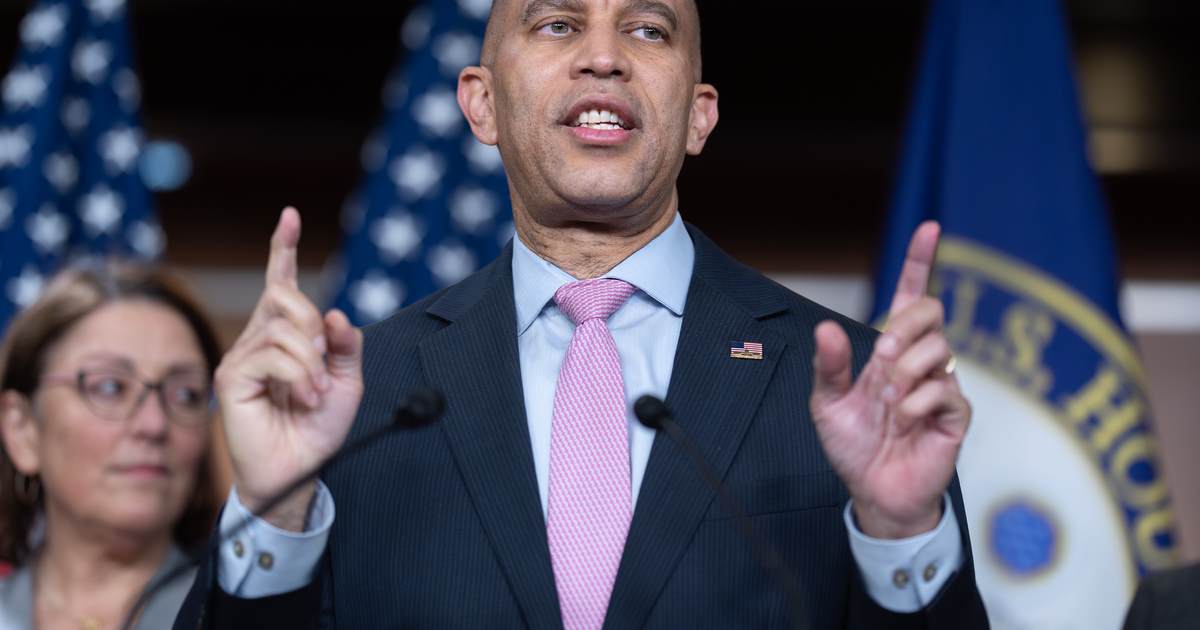
House Democratic leader Hakeem Jeffries hesitated when asked whether Jose Medina, the 25-year-old man accused of killing 18-year-old Loyola student Sheridan Gorman on March 19, should be deported, responding “I’ll look into the case,” a reply that has infuriated critics who see it as emblematic of weak Democratic stances on border security and public safety.
Sheridan Gorman, an 18-year-old student at Loyola University, was shot and killed in the early hours of March 19, and authorities say the suspect is 25-year-old Jose Medina. Reports indicate Medina entered the United States illegally in 2023 and that there was an active warrant for shoplifting on his record. Those facts have hardened the argument that basic immigration enforcement failures continue to carry deadly consequences.
When the question of deportation was put to Hakeem Jeffries, the leader of House Democrats, his answer was brief and noncommittal: “I’ll look into the case.” That one line landed like a shrug to a lot of people who want clear, decisive answers from their leaders when a young American has been killed. For many, a refusal to clearly support deportation in a situation like this looks like a failure of leadership.
To conservatives it reads as another Laken Riley-like story: a U.S. citizen killed by someone who shouldn’t have been here, someone with an outstanding warrant and a recent illegal entry. It’s another Joe Biden special. The pattern fuels outrage because it feels avoidable—simple enforcement steps could have prevented the situation.
NEW: I asked House Minority Leader Hakeem Jeffries (D-NY) if House Democrats believe the Venezuelan illegal alien charged with murdering Sheridan Gorman in Chicago last week should be deported?
“I’ll look into the case,” Jeffries told me. pic.twitter.com/zZpBwv2LKM
— Bill Melugin (@BillMelugin_) March 24, 2026
The reaction on the left has been muted in many quarters while outrage simmers on the right, and that contrast is striking. An illegal alien detained in an airport can prompt accusations of cruelty and hyperbole, with commentators invoking extreme analogies like “Berlin 1943,” yet a deadly shooting gets cautious statements and promises to “look into” matters. That gap in tone and urgency is exactly what voters notice when deciding who takes public safety seriously.
Jeffries’ answer draws an uncomfortable echo of past political missteps; critics compare the tone-deafness to Michael Dukakis’ infamous response on the death penalty, an answer that many say cost him a presidential race. The point isn’t to rewrite history but to point out how a single moment of perceived coldness or evasiveness can reshape public trust. When elected leaders falter in moments like this, it costs them credibility.
No one is arguing that suspects should escape due process, but plain fairness demands clear lines on deportation for those who entered illegally and carried active warrants. Medina should be returned to his country of origin if he is convicted or otherwise found to have no legal right to remain, and he should face the full force of the law for any crimes committed here. Saying anything less is to invite more avoidable tragedies from porous borders and lax enforcement.
Local political responses have been even worse in spots, with some Chicago Democrats engaging in victim-blaming rather than addressing the policy failures that let this happen. That posture is telling: when a party needs votes from new arrivals, it sometimes sacrifices frank talk about the real costs of its immigration approach. The result is an eternal balancing act where public safety takes a back seat to short-term electoral calculations.
Republicans will point to this episode as proof that the current system is broken and that talk of empathy cannot replace basic competence at the border and in local law enforcement. Families want answers and remedies, not a promise to “look into” the problem weeks after it exploded into tragedy. If leaders won’t act decisively, voters will keep the pressure on for results rather than platitudes.