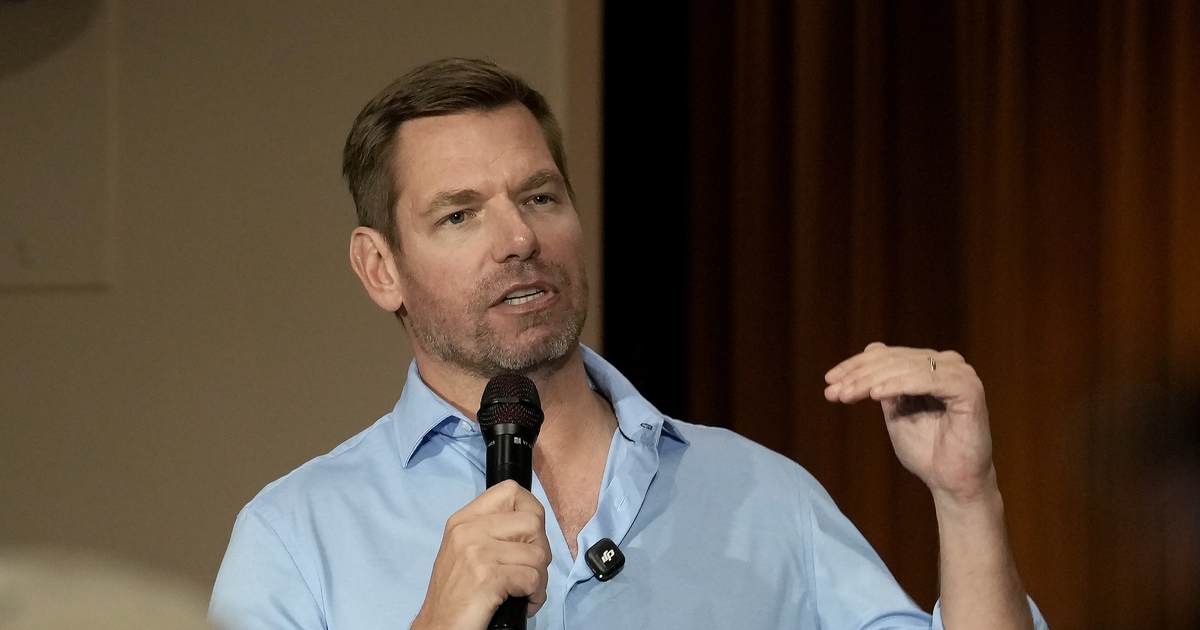
Eric Swalwell faces fresh legal peril as the Department of Justice opens an investigation into new sexual assault allegations, adding to multiple accusations and mounting political fallout.
Eric Swalwell should consider hiring some aggressive lawyers, because his problems just escalated. The former California congressman saw his career unravel in a matter of days, and now the Justice Department is reportedly probing fresh claims that he raped a woman in 2018. This new development layers federal scrutiny on top of existing inquiries in Los Angeles and Manhattan.
The Department of Justice is investigating allegations of sexual assault against former Rep. Eric Swalwell, according to a source with knowledge of the matter.
Swalwell has been accused by at least five women of sexual assault and harassment and is already under investigation in both Los Angeles and New York those respective district attorneys.
Multiple women have stepped forward with disturbing accounts, and the allegations span years and settings. One former staffer has accused Swalwell of an assault in 2019 while she worked for him and says he assaulted her again at a 2024 charity event in New York City, a complaint that pulled in the Manhattan district attorney’s office. Another woman has now gone public with a claim dating back to 2018, which reportedly triggered the DOJ inquiry.
Once the second woman’s story surfaced, Swalwell resigned, effective immediately, avoiding a prolonged spectacle in the media. He had already dropped out of the California gubernatorial race the prior Sunday after the allegations emerged, and his resignation was announced the following Monday without a clear timeline. For a member of Congress to collapse politically that fast under a cloud of such serious accusations tells you how toxic the situation became.
Wow – Swalwell accuser claims he drugged and violently r*ped her.
This is hard to watch. pic.twitter.com/BQhd7c2lbC
— Townhall.com (@townhallcom) April 14, 2026
Swalwell tried to spin the revelations as a smear, insisting the accusations were part of a conspiracy, that the women were anonymous, and that the timing was all about politics. Those lines didn’t hold up; at least some accusers are known to him, one has accused him of rape, and the primary isn’t until June 2. That sequence makes the claim of a cynical political setup a weak defense against multiple, detailed allegations.
From a Republican standpoint, this episode underlines a simple point: when officials face credible criminal allegations, institutions must act and voters deserve clear answers. Swalwell’s rapid fall shows how quickly alleged misconduct can derail a public career, and how investigations from local prosecutors to the DOJ can converge when the claims are serious enough. Accountability should be enforced without partisan wink or dodge.
There are real legal stakes here beyond headlines and op-eds. A DOJ investigation elevates the matter from political drama to potential federal criminal inquiry, and that changes both the legal calculus and the public signal. Prosecutors in Manhattan and Los Angeles already had matters to review; a federal probe means evidence, witnesses, and contacts will be examined with greater reach.
Politically, Democrats now face a tricky balancing act between standing by due process and responding to mounting allegations against one of their own. For rank-and-file Republicans, the focus will be on ensuring investigations proceed unimpeded and on highlighting the contrast between rhetoric and conduct. This isn’t about scoring points so much as insisting on the rule of law and consequences where warranted.
The next steps will play out in courtrooms and in press cycles, and both will shape how this episode is remembered. Swalwell’s immediate resignation limits his political options, but it does not halt law enforcement inquiries. Whatever the final legal outcome, the rapid unraveling of his political prospects is already a stark reminder that public trust can evaporate fast when serious allegations surface.