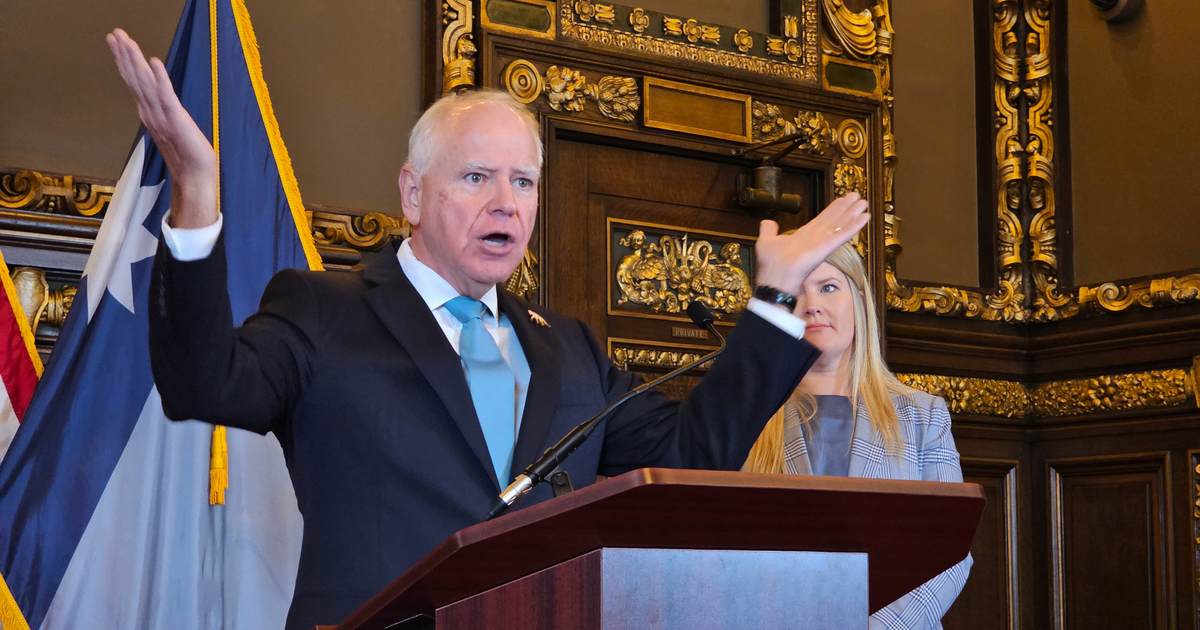
Summary: Minnesota Gov. Tim Walz publicly attacked President Trump over the Iran conflict, calling the action reckless and labeling it “fascism,” while critics point to decades of Iranian hostility and recent missile activity to argue the strikes were justified.
Minnesota Gov. Tim Walz blasted President Donald Trump at an international event, accusing him of dragging the nation into a war with no threat present. His remarks were blunt and personal, framing the president as “feeble-minded” and “trigger-happy.” That language set the tone for a larger debate about threat assessment and America’s response to Iran.
Walz said at the Global Progressive Mobilization event in Barcelona, Spain, “We’ve got a feeble-minded, trigger-happy president who plunged us into a war where no threat was present, with no clear objectives and no exit plan. We need to call that what it is. That’s fascism.”
He added, “There are more good people that care about equality, that understand it’s not America First. It’s humanity first.”
The Trump administration responded with force starting on Feb. 28, coordinating strikes with Israel after sustained Iranian refusal to abandon its nuclear ambitions. Officials argue those operations targeted capabilities that would have threatened American forces and allies. The decision to strike followed years of buildup and provocations from Tehran.
Critics like Walz treat the strikes as unnecessary escalation, but a broader view of Iran’s behavior tells a different story. For nearly five decades Iran has been hostile toward the United States, openly chanting “death to America” and supporting violent proxies. That history is not just rhetoric; it has produced repeated attacks and destabilizing actions across the region.
🚨 NOW: Traitor and pro-Somali Tim Walz goes BERSERK in a pathetic moment
“We've got a feeble-minded, trigger-happy president who plunged us into a war where no threat was present, with no clear objectives! That's FASCISM!”
Walz should resign NOW. pic.twitter.com/hhz4gcZ5Vr
— Eric Daugherty (@EricLDaugh) April 18, 2026
Iran funds and directs proxy groups such as Hezbollah, Hamas, and the Houthis, using them to project power and attack U.S. interests without direct attribution. Those proxies have carried out operations that endangered American personnel and regional stability. For many Republicans, confronting Tehran and its networks is a matter of national security, not political theater.
Since the 1970s, Iran and its aligned groups have killed hundreds of Americans through terrorism and proxy violence, a fact that hardens conservative skepticism about calls to downplay the threat. Lawmakers and veterans who followed those incidents view a forceful response as painful but necessary. The memory of past attacks shapes today’s policy choices.
In March, Iran launched missiles at Diego Garcia, a joint U.S.-UK base in the Indian Ocean roughly 4,000 kilometers away, demonstrating a growing strike capability. Tehran also misrepresented its arsenal, claiming it lacked intermediate-range missiles when evidence suggested otherwise. Those revelations pushed military planners to act to prevent future attacks on allied infrastructure and European targets.
Given that backdrop, defenders of the February strikes argue the timeline and targets made sense. The White House framed the operation as a calibrated step to degrade Iran’s ability to produce a nuclear weapon and to punish clear aggression. From a Republican perspective, weakness invites more aggression, so decisive moves are presented as deterrence.
Walz’s “fascism” charge resonated with his base, but it also raised eyebrows among officials concerned with national defense. Labeling a defensive response to a persistent adversary with such a loaded term narrows the debate rather than advancing policy solutions. GOP critics say rhetorical excess obscures the core question: how to keep Americans safe.
Supporters of the strikes point to the coalition work with Israel and other partners as evidence the action was measured and internationally coordinated. Military planners maintain they sought to limit civilian harm while hitting military and nuclear-related sites. That emphasis on precision is central to the argument that the operation was not an open-ended war strategy.
President Trump later said the Iran conflict objectives are “nearing completion,” a claim that administration allies use to show the campaign has been focused and goal-oriented. For Republicans, proving clear objectives and measurable results differentiates responsible use of force from blundered military adventures. That claim has been used to push back against criticisms of a lack of an exit plan.
Domestic political divides quickly turned Walz’s comments into a talking point about party loyalties and national security instincts. Democrats on the left often prioritize diplomatic engagement and caution, while Republicans stress deterrence and readiness to use force. This episode highlights how those differing philosophies play out when a crisis hits.
On the foreign policy front, Tehran’s pattern of deception and proxy attacks complicates arguments that no threat existed. Iranians have repeatedly denied capabilities or intentions until presented with evidence to the contrary, which feeds mistrust. For many in the GOP, past lies justify hardline responses today.
At home, the debate also touches on political accountability: governors and other officials have limited control over national security moves, yet they influence public opinion with strong statements. Walz’s Barcelona remarks were aimed at a global audience and his political base, but they also forced defenders of the president’s policy onto the defensive. That dynamic is likely to persist as operations continue.
Handling Iran will remain a central challenge for the administration and Congress, blending intelligence, military readiness, and allied cooperation. Republicans argue that patience with Tehran’s behavior only emboldens its regional campaigns. The coming weeks will test whether the strikes achieve their stated goals without broader escalation.
Whatever one thinks of the rhetoric, the facts of Iran’s long record of hostility and recent missile activity are driving the debate. Those facts shape Republican insistence that America confront threats rather than dismiss them. The political fight over how to respond will play out in public statements, congressional hearings, and on the battlefield.