
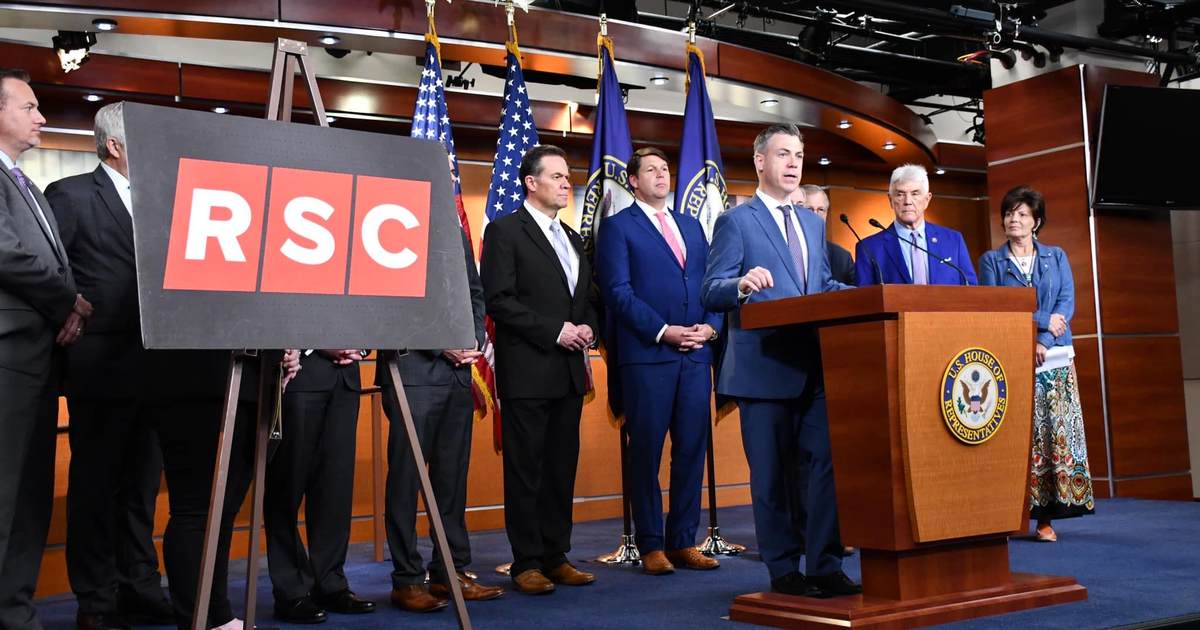
The Republican Study Committee convened a roundtable ahead of the holiday to spotlight what House Republicans describe as tangible legislative wins—from major tax relief for families and the launch of federally backed Trump Accounts to aggressive actions on waste, fraud, and border security—backed by committee leaders and members who framed these moves as results that put money back in pockets and strengthen national security and the military.
The RSC framed the meeting as a celebration of results delivered by House Republicans, listing tax relief, Trump Accounts, stricter oversight on federal spending, and investments in defense. Attendees emphasized measurable benefits for workers, small businesses, farmers, and future generations. The tone was confident and forward-looking, stressing accomplishment over rhetoric.
Chairman Rep. August Pfluger (TX-11) opened the discussion by cataloging landmark steps the conference says it achieved. He tied those actions to a larger goal of prioritizing families and fiscal responsibility. His remarks set the theme that Republicans produced policy with immediate effects on American households.
We didn’t just talk about putting families first. We passed the historic Working Families Tax Cuts Act and put money back into the pockets of the people who are working, a generational win for the American people. We helped make sure Trump Accounts happened, to give every child in this country a head start before they even cast a vote or file a tax return. We didn’t just talk about a secure border. After years of illegal crossings under the last administration, we shut it down to the tune of zero crossings in 12 months.
Committee members highlighted the Working Families Tax Cuts Act as a standout achievement that they say delivered immediate relief. Republicans described the package as returning roughly $82 billion directly to Americans while claiming broader refund increases that benefited millions. They presented those numbers as evidence that conservative tax policy can produce fast, tangible results at a time of economic strain.
Rep. Mark Alford (MO-4) praised the tax reductions for easing costs on everyday families and urged an eye toward future policy wins. He argued that reflection on past accomplishments must be paired with a plan that gives voters hope ahead. His remarks emphasized optimism and the need for sustained momentum in Congress.
Several members pointed to Trump Accounts as a signature, long-term investment in kids born now and in the next few years. Those accounts are described as federally backed, tax-advantaged savings with a $1,000 initial deposit for babies born between 2025 and 2028. Advocates framed the policy as a generational gift tied to the America 250 celebration.
Rep. Erin Houchin (IN-9) brought attention to how tax changes affected small businesses and farmers in her district. She praised the repeal of the so-called death tax for enabling family farms to transfer assets without state-level penalties. Colleagues added examples from the auto industry and other sectors to underscore broad-based benefits.
Rep. Marlin Stutzman (IN-3) and others cited consumer-focused wins, noting that specific provisions eliminated taxes on certain auto loan interest claims for millions. That point was used to argue that policy can directly lower household expenses and support American manufacturing. Republican members connected these outcomes to a narrative of economic renewal.
On spending oversight, the panel celebrated the rescission package and stepped-up scrutiny aimed at waste, fraud, and abuse. Members said recent investigations uncovered systemic problems and led to concrete reforms to stop improper payments. They credited citizen journalists and watchdogs for helping expose some of the biggest schemes.
Rep. Pete Stauber (MN-8) called out massive fraud uncovered in his state as an example of broken systems now under pressure to improve. He argued that rooting out that abuse protects taxpayers and public confidence in government programs. Republicans on the panel linked these efforts directly to a promise of better stewardship of federal dollars.
Discussion also touched on defense priorities, with members pointing to what they described as historic investments in the military. That focus was presented as central to a conservative agenda that pairs fiscal discipline with strong national defense. Members warned that continued progress depends on maintaining political control.
Absent from the roundtable was any deep dive into campaign strategy, but several speakers made clear they see control of the House as critical to preserving these gains. They warned that a shift in power could reverse legislative wins or halt oversight efforts. The message was simple: voters face choices that carry real policy consequences.
“Not a single Democrat voted to cut taxes, they all voted for a $4.5 trillion dollar tax increase, the largest tax increase in history. They voted against increasing compensation to our servicemen and women…they voted to continue allowing fraud, waste, and abuse in Medicaid. They gave America a stark choice. This caucus, and our Republican caucus, chose to do a different thing, and that was to shine light on the greatness of America, and continue to put our trust and faith in the American people.”
Members reiterated that temporary provisions like no taxes on tips, social security, and overtime were part of the broader Tax Cut Act debate, even as they acknowledged those provisions currently have sunset dates. Republican speakers framed the package as delivering immediate relief while promising to push for longer-term fixes. The emphasis remained on results and accountability.
Overall, the roundtable doubled down on a narrative of delivering measurable benefits—tax relief, targeted investments, and tougher oversight—while urging voters to keep supporting a conservative agenda. The tone was unapologetic and results-focused, positioning these policies as proof that Republican governance produces real-world effects. Leaders insisted that work is ongoing and that future sessions will continue to aim for similar wins.
