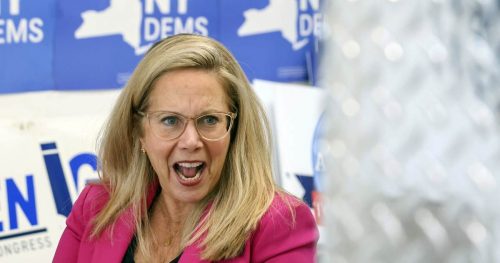
Lindsay James, a Democrat running for Iowa’s 2nd Congressional District, faced repeated confrontations from constituents who pressed her on votes they say eased bail for violent repeat offenders, and at least twice she avoided answering on camera.
Lindsay James has been talking about being accessible to constituents, but recent street confrontations show a different side. While campaigning, she walked away from people demanding answers about a vote tied to pretrial bail rules for violent criminals. Those moments were caught on video and shared with the public.
On a podcast she described early legislative work and said she engages with anyone who asks to talk. She recounted meeting an Amerigroup lobbyist after criticizing the company in her first floor speech, and she insisted of her approach that “because I will speak to anyone who wants to talk to me” and “I’ll work with anyone who wants to work with me because this is about getting the work done and doing right by our neighbors.”
That promise was tested when a constituent confronted her about a specific vote and followed her across a street into a shop, asking directly about making it easier for violent repeat offenders to get bail. The exchange included the questions: “Lindsey, why did you vote to make it easier for violent repeat offenders to get bail?” and “Any answer to that question, Lindsey?”
Reporters and cameras captured more than one instance of James walking away from direct questions, and footage shows staffers moving between the candidate and constituents. That pattern continued at a separate event where a similar exchange ended with James stepping aside and staffers guiding her onward.
In June, Iowa Republicans advanced a measure that changes pretrial procedures, setting limits on bail bonds and indexing bond levels for inflation while stopping “promise to appear” releases for certain violent and drug-related charges. Supporters said the bill seeks consistent treatment for serious offenses, while critics argued it could affect defendants’ access to release. The legislation drew sharp debate in the statehouse as lawmakers pushed to tighten public safety rules.
The statute also requires judges to provide written justification any time they depart from the uniform bond schedules, and it restricts lower bail or pretrial release without valid, documented reasoning for a range of offenses. Proponents frame those changes as a way to hold judges to transparent standards, and opponents say the rules could complicate case-by-case discretion.
Beyond the bail debate, James’s attendance record in the legislature has become a focal point for critics. Records show she missed a substantial portion of floor votes during the past year while campaigning for higher office, and opponents argue that absenteeism undercuts claims of a strong work ethic.
Lindsay James, a state legislator and Democratic candidate for Congress in Iowa, missed over half of her votes in the state’s House of Representatives this past year, records show.
https://x.com/townhallcom/status/2087902559943954818
In 2026, James missed 177 of 342 votes, according to the legislature’s records, accounting for 51.7% of the whole.
The absences clash with assurances James made about how her campaign might impact her legislative duties and has opened her up to Republican-led criticisms that she has prioritized her potential role instead of the one she has now.
A National Republican Congressional Committee spokeswoman put the criticism bluntly: “No-show Lindsay James can’t defend her record, so now she’s literally hiding from Iowans.” That charge has been repeated by local GOP operatives as they point to video of the encounters. The exchanges have become a campaign talking point around accountability and transparency.
As voters watched those encounters unfold on social media and local news, James’s public interactions with constituents became part of the broader scrutiny over her legislative choices and campaign priorities. Cameras following candidates at events and on the street have a way of turning routine stops into recordable moments that shape perceptions.