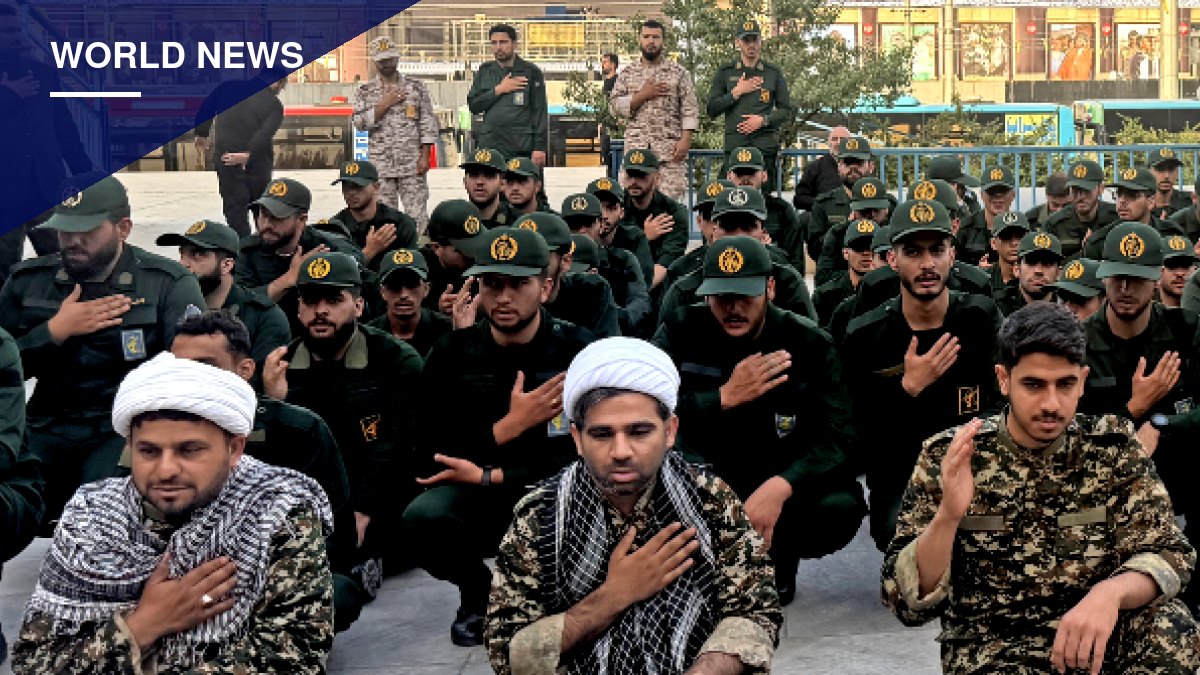
Kurdish officials say they intercepted 10 explosive-laden drones near Erbil on Tuesday, as Iran’s Islamic Revolutionary Guard Corps (IRGC) launched what it described as a coordinated missile and drone attack on U.S. bases in the Iraqi Kurdish capital, part of a broader retaliatory strike across the region.
The IRGC claimed the Erbil attack destroyed warehouses, a maintenance center, and the guidance system of a U.S. surveillance aerostat. The claims have not been independently verified.
The strikes on Erbil came after U.S. Central Command (CENTCOM) said American forces began hitting IRGC targets around 12:00 p.m. Eastern time on Tuesday. CENTCOM said the U.S. action was a response to “recent attempted attacks by the IRGC against commercial shipping in the Strait of Hormuz and against American service members deployed to the region.”
“U.S. forces struck Islamic Revolutionary Guard Corps (IRGC) targets including air defense sites, radar systems, maritime assets, and facilities, mine-laying capabilities, and communications sites,” CENTCOM said.
Iran had attacked civilian vessels in the Strait of Hormuz on Monday night. Saudi-based shipping company Bahri said on Wednesday that two Filipino crew members were killed when the supertanker Sidr, carrying about two million barrels of Saudi crude, was hit.
Claims and Counterclaims
Iranian state media said four IRGC members, three members of the IRGC’s Basij militia, and four or five civilians attending a wedding were killed in the U.S. strikes on Tuesday. Iranian Foreign Ministry spokesman Esmaeil Baqaei called the U.S. action a “war crime.”
“The truth of this unlawful war of choice — and the true face of the war crime — is in Sirik, where a wedding ceremony was brutally bombed as part of America’s desperate struggle to conceal its failure,” Baqaei said.
Iranian state media published names of the alleged victims along with footage of a nearby telecommunications tower that officials suggested could have been struck by a U.S. cruise missile.
CENTCOM spokesman Capt. Tim Hawkins said the military was reviewing the claims. “We’re aware of the reports, which originated from Iranian state media, and we are looking into them,” Hawkins said, adding, “The U.S. military never targets civilians, unlike the IRGC.”
Strikes Across the Region
Beyond Erbil, Iran claimed it conducted “heavy” airstrikes on drone hangars at the Prince Hassan Air Base in Jordan, saying a number of pilots and flight maintenance crew members were killed and multiple structures were set on fire. The IRGC also claimed heavy damage and casualties at a U.S. Marine barracks at Camp Tintin in Jordan, and said it struck the Al Dhafra and Al Minhad airbases in the United Arab Emirates and Sheikh Isa airbase in Bahrain with drones.
Officials in Jordan, the UAE, and Bahrain said most of Iran’s weapons were intercepted without significant damage. Two U.S. officials said on Wednesday that, contrary to Iran’s claims, there were no American casualties from the Iranian attacks on Jordan.
The Jordanian Armed Forces said it engaged 13 Iranian ballistic missiles, destroying ten of them, while the remaining three landed in remote areas. Emergency services in Kuwait said they contained a fire started by an Iranian drone that struck a residential complex.
In Erbil itself, the interception of the 10 drones by Kurdish officials underscores the city’s exposure as a hub for U.S. military presence in Iraqi Kurdistan amid the escalating confrontation between Washington and Tehran.