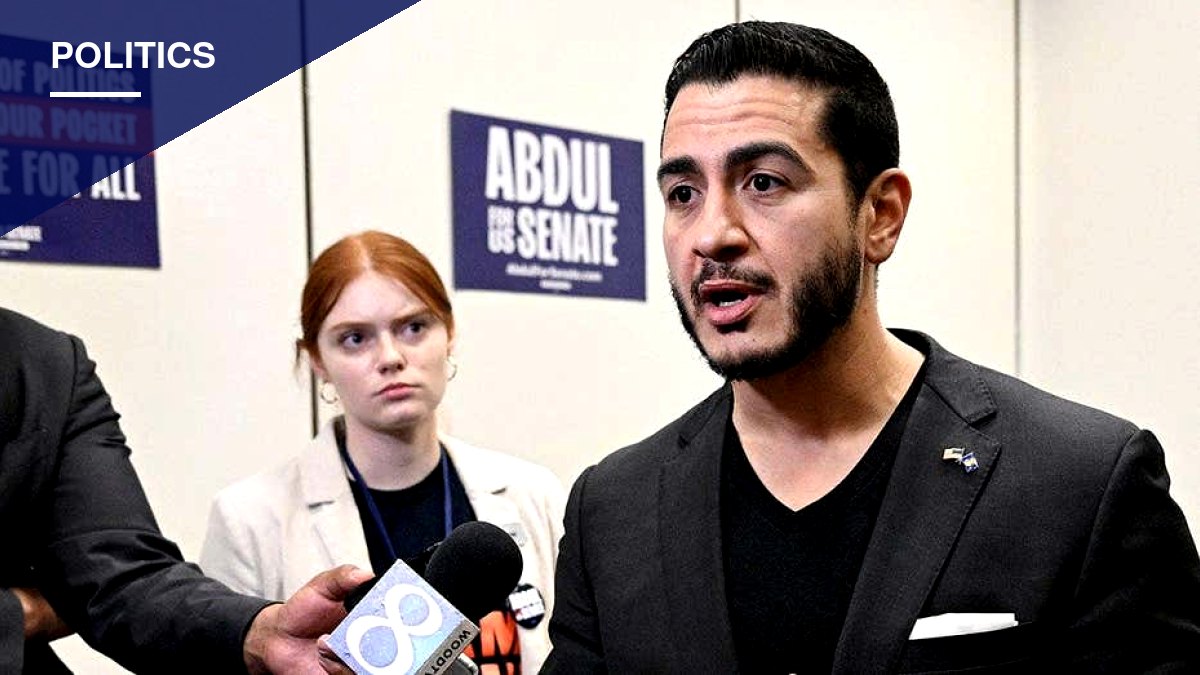
Michigan Democratic U.S. Senate candidate Abdul El-Sayed said at a Friday rally at Michigan State University that decisions about gender-affirming care for minors should remain between a patient, their parents and their doctor, not the government.
Responding to a student’s question about protecting access to sex-change treatments, El-Sayed emphasized his own medical training and that of his peers.
“I went to a whole a– medical school, everybody I graduated with also went to whole a– medical school,” El-Sayed said. “And then … they went to whole a– residency. Right? And some of them went to whole a– fellowship. They took whole a– exams to provide whole a– healthcare.”
El-Sayed, the former head of the Detroit Health Department, has campaigned as a physician and has said he would be the first doctor to serve as a Democratic senator in 50 years. Fox News Digital has previously reported that he has never held a medical license in Michigan or New York.
“They are the experts that a patient wants to see when they seek care,” El-Sayed continued. “And the decision about what healthcare is necessary ought to be held between a patient — and or their parents if they’re under the age of 18 — and their doctor. That’s it.”
His comments came the same week the Justice Department announced that Mount Sinai had agreed to halt sex-change procedures for children, joining Texas Children’s Hospital, the Cleveland Clinic Foundation and Connecticut Children’s Hospital in similar agreements with the Trump administration. The administration has also moved to end Medicaid funding for such procedures for minors, calling them “experimental.”
El-Sayed has built his Senate campaign around a proposal for Medicare for All, a government-run health care system. He argued that even under such a system, the government should not dictate treatment decisions.
“I don’t think the government gets to have a say about what health care is provided in what circumstances and why,” El-Sayed said. “And to me, that is the standard on which we decide how we make health care decisions.”
“Not what the government says you can or can’t do, but what a patient and/or their parent, if they’re under 18, and their provider to decide. That’s the most important thing,” he continued. “And there’s a lot of disinformation about us, what we’re talking about, when we talk about reproductive rights and when we’re talking about health care for the trans folks. But, in the end, the place where the rubber meets the rope is in that clinical room between a patient and a provider, and that to me is the center we should engage on.”
El-Sayed pointed to the Right to Try Act, which allows terminally ill patients to access experimental drug treatments not yet approved by the FDA, as evidence that conservatives share his view that treatment decisions belong between patients and doctors.
“Because conservatives fought for a very long time for this legislation called ‘Right to Try’ legislation, which is the idea that the government couldn’t tell you [that] you couldn’t have a certain medication,” El-Sayed said. “So they agree that the decision about healthcare ought to be between the person and their provider. That’s it. So let’s use that standard, and keep to that standard, and make sure the government doesn’t have the ability to tell you what you can or cannot do with your own life.”
Research on the effectiveness of treating gender dysphoria in minors through cross-sex hormones and puberty blockers remains limited. The World Professional Association for Transgender Health, whose guidelines are used by groups including the American Academy of Pediatrics, is facing a Federal Trade Commission lawsuit alleging its guidance misled parents about the medical consensus, necessity, safety and effectiveness of these procedures, including failing to disclose side effects such as incontinence, erectile pain, mood disturbances, and pelvic and vaginal pain.
Other countries with government-run health systems have also restricted access for minors. England’s National Health Service paused cross-sex hormones for 16- and 17-year-olds in March, citing weak supporting research, on top of an existing ban for those under 16.
El-Sayed’s office did not immediately respond to a request for comment regarding his medical credentials.