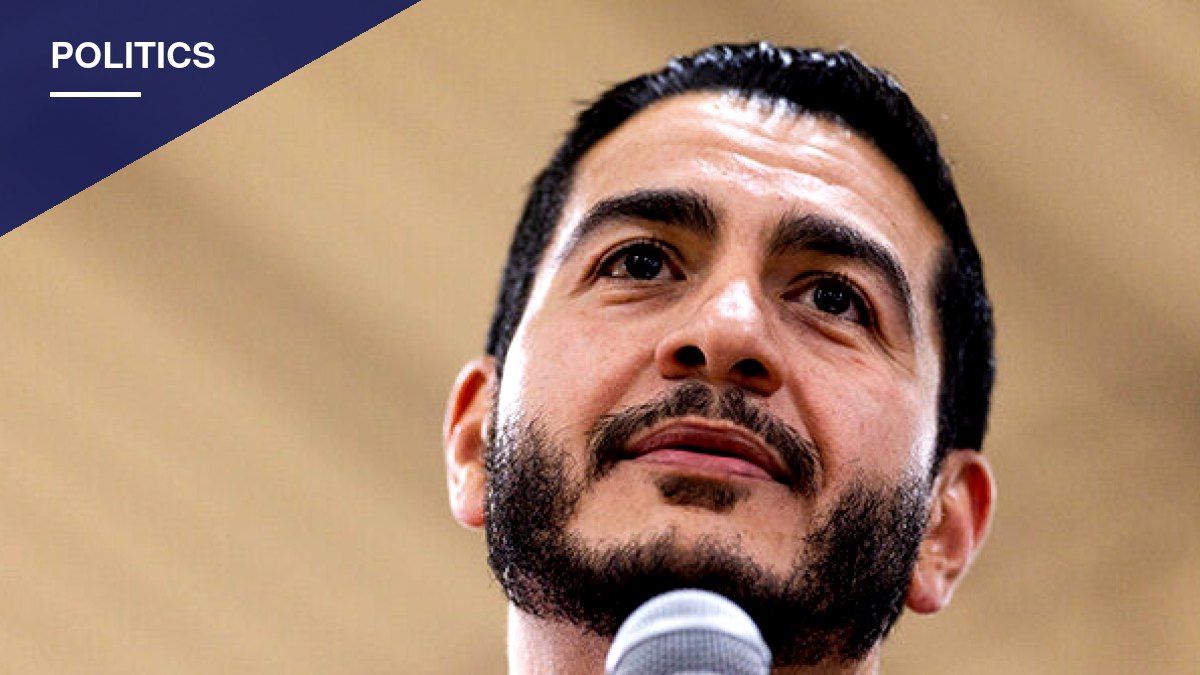
A video from a 2022 speech by Michigan Democratic Senate nominee Abdulrahman Mohamed El-Sayed has surfaced showing him comparing Oklahoma’s ban on Sharia law to some of the darkest chapters in American history, including the forced removal of Native Americans, the destruction of Tulsa’s Black Wall Street, and the Oklahoma City bombing.
El-Sayed made the remarks at an event hosted by the Council on American-Islamic Relations (CAIR). He questioned why Oklahoma voters approved a constitutional amendment banning Sharia law.
“When the state of Oklahoma voted in a referendum to amend the constitution to ban Sharia law. What does that mean? I don’t know. And yet the voters banned it anyway,” El-Sayed said.
“What I offer today is just a reflection on the American history that runs through this state,” he continued.
“You all sitting in this room, in this town, we’re sitting in a space, in a time when I don’t have to tell you that the same exact forces that drove Native peoples from their land two centuries ago, destroyed Black Wall Street a century ago, bombed a building decades ago, and tried to ban Sharia law not a decade ago. Those forces are alive and well today.”
The comments have resurfaced as El-Sayed campaigns for the U.S. Senate seat in Michigan, and as the topic of Sharia law has drawn renewed attention in national politics. Sen. Ted Cruz (R-TX) recently criticized Sharia law during a speech at the Republican convention, saying it has “no place in America” and calling it “fundamentally inconsistent with the Constitution.”
El-Sayed’s Personal Religious Practice
El-Sayed’s campaign confirmed in August that he continues to observe Sharia law in his personal life, after a 2009 New York Times interview resurfaced in which he described following Islamic religious law as an obligation. “Ultimately, the question is, when I die and I stand before God and go through everything I did in my life, I don’t want to say I did it the easy way instead of the Shariah-compliant way,” El-Sayed said at the time. “Not because of fear but because of obligation.”
Campaign spokeswoman Roxie Richner later clarified that El-Sayed “believes in the separation of church and state” and “opposes any effort by any religious community to write their faith laws into the laws of our country.”
A Contentious Senate Race
El-Sayed won Michigan’s Democratic Senate primary in August. Since then, Republican nominee Mike Rogers has leveled a series of accusations against him, claiming El-Sayed pledged support to the Muslim Brotherhood and has campaigned alongside people who won’t condemn terrorism. “Abdul isn’t just another liberal. He’s an extremist,” Rogers said, also alleging El-Sayed wants to empty prisons and supports substantial tax increases.
Rogers has called on El-Sayed to return campaign contributions from donors he says have ties to terrorist organizations, including individuals affiliated with CAIR. Rogers’ campaign identified nearly $130,000 in donations from more than 41 CAIR staff and board members, along with at least $300,000 contributed by El-Sayed’s father-in-law to a super PAC supporting the campaign. Rogers’ campaign further alleged that the father-in-law held a leadership role in an organization linked to the Muslim Brotherhood. These allegations do not by themselves establish any unlawful activity or that El-Sayed supports terrorism.
“This is not about anyone’s faith,” the Rogers campaign said. “This is about judgment, transparency, and who is financing a candidate for the United States.”
At the Republican convention in September, Rogers also criticized El-Sayed’s association with streamer Hasan Piker, saying, “You don’t sympathize with terrorists. You don’t sanitize extremism, and you sure don’t ask the people of Michigan to send you to the United States Senate while surrounding yourself with people who despise America.”
El-Sayed’s Response to Criticism
Speaking on The Progressive Christians Podcast in May, El-Sayed pushed back on the idea that politically active Muslims are seeking to impose religious belief on others. “There’s this verse in the Quran, Lā ikrāha fī d-dīn, which literally means there’s no compulsion on faith,” he said. “Your job is to live out your faith, and to try to do so in a way where you’re offering dignity and opportunity to other people — not to compel them to behave in any sort of way.”
Asked in the same interview about being labeled a radical for supporting policies like Medicare for All, El-Sayed said, “Jesus, peace and blessings be upon him, was considered radical in his time too. And there is a radical nature to being willing to stand forthright in a time of corruption.”
El-Sayed has drawn support from prominent progressives including Sen. Bernie Sanders (I-VT), Rep. Alexandria Ocasio-Cortez (D-NY), and Rep. Ilhan Omar (D-MN). At a July rally in Detroit, Ocasio-Cortez told supporters El-Sayed “represents the politics of the future” and urged voters to elect him to the Senate.