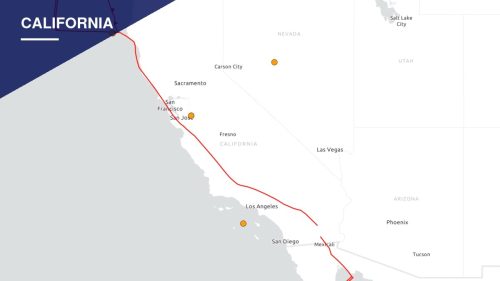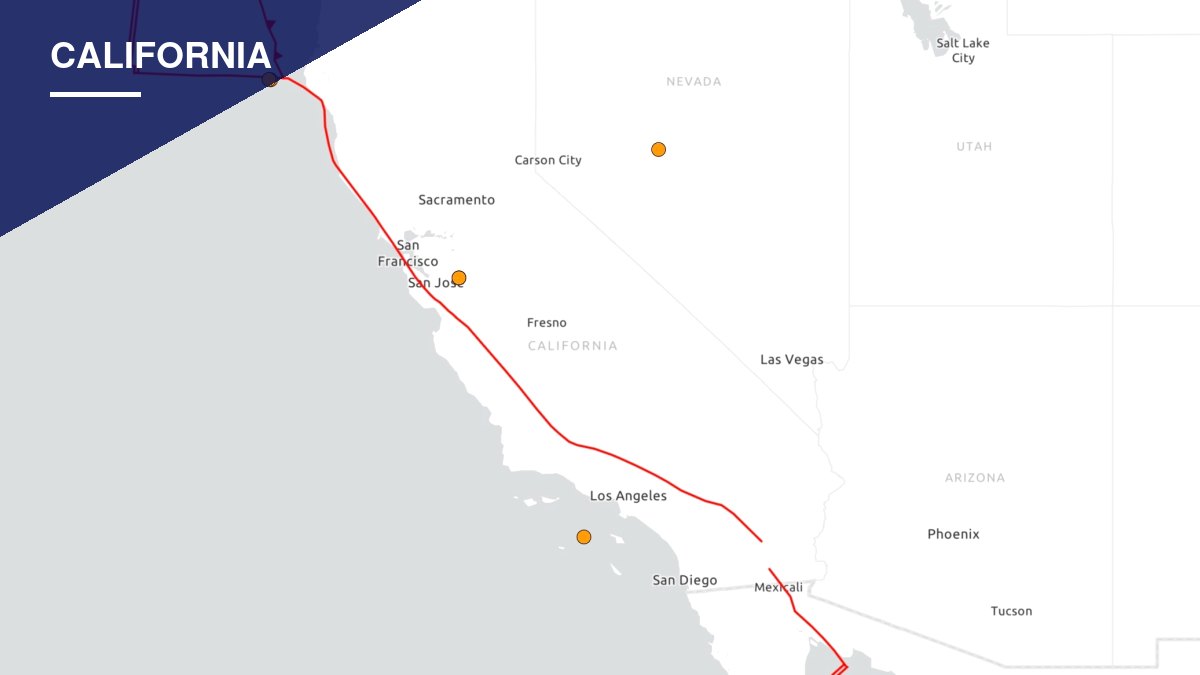
Three minor earthquakes struck along the San Andreas Fault in California overnight, each registering in the mid-magnitude 2 range, according to the U.S. Geological Survey.
A 2.7 magnitude quake hit Petrolia at around 4:31 a.m. Sunday, followed by a 2.6 magnitude tremor near Santa Barbara at about 4:39 a.m., per the USGS Latest Earthquakes Interactive Map. The night before, a 2.5 magnitude quake shook Westley on Saturday.
The USGS map marks major tectonic plate boundaries in red, and the line running through California traces the path of the San Andreas Fault, which cuts through much of the state including areas near San Francisco.
The small quakes come months after researchers raised fresh concerns about the fault’s long-term behavior. In August, scientists at San Jose State University found evidence that the San Andreas Fault has been slipping at a faster and more consistent rate than previously understood. The research, conducted at Sanborn County Park, examined the landscape for signs left by past earthquakes and concluded the fault’s movement has held roughly steady for nearly 10,000 years rather than slowing over time.
The most recent major earthquakes along the San Andreas Fault were the 1989 Loma Prieta earthquake and the devastating 1906 San Francisco earthquake.
A separate study released in June found that stress levels along three segments of the San Andreas and San Jacinto faults have reached their highest point in at least 1,000 years.
Ahmed Elbanna, director of the Statewide California Earthquake Center and a professor of earth sciences and engineering at the University of Southern California, told The Sacramento Bee that the state has avoided a major urban earthquake since the 1994 Northridge quake.
“The authors themselves, and the community, do not find the findings of the study surprising,” Elbanna said, noting that Southern California’s crust is “critically stressed and ready to rupture in a large-sized event. Whether that event would happen tomorrow, or in 10 years, that’s the part that we don’t know.”