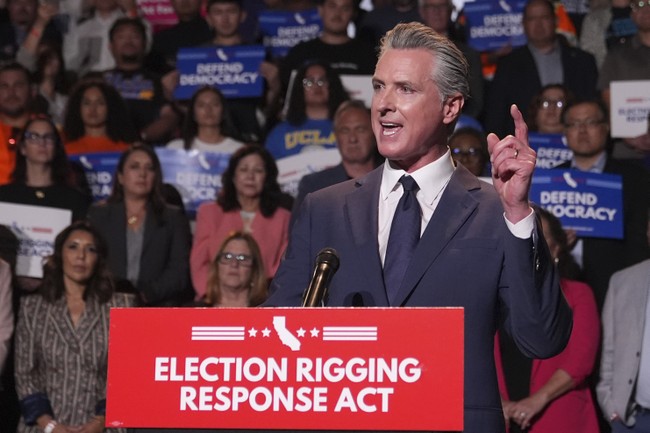
Gavin Newsom is rolling out a memoir titled “Young Man in a Hurry,” and the timing, tone, and presentation read like a well-rehearsed move toward 2028 rather than a purely literary effort.
California Governor Gavin Newsom announced on X that his memoir, Young Man in a Hurry, is set for early 2026 after a launch delay caused by wildfires in Los Angeles. The announcement came with a familiar blend of glossy image management and scripted vulnerability meant to reshape how voters see him. It’s a polished delivery, the sort political operatives use to reboot a public persona ahead of bigger ambitions.
Newsom’s own words landed in the publicity: “A lot of people look at me with my stark white shirt, blue suit, and yeah, the gelled hair, and they think, ‘I know this guy, oh I know him better than I’d ever want to know him,’ and I get it,” Newsom said. “I hope, whatever your opinions on me are, the openness and honesty I felt writing this and living it will resonate.” He added that the memoir “is a truly vulnerable book.”
The book retraces Newsom’s upbringing in San Francisco, highlighting his connection to his father, attorney and judge William Newsom, and to the Getty family. Reports say Gordon and Ann Getty stepped in after his parents divorced, funding lavish experiences that included an African safari and other perks that helped smooth a fast path into elite circles. Those early advantages are framed as a part of the origin story Newsom now wants voters to embrace.
Details in the memoir also nod to strained personal ties, including a falling out with Billy Getty, the son of Gordon Getty, which suggests the narrative won’t be purely triumphant. That kind of intimate anecdote is exactly the sort that gets amplified and parsed during a national book tour. The format fits a familiar pattern used by politicians who are “testing the waters” for higher office.
This might not be the book people expected me to write.
It's about something universal — the messiness of becoming who we are.
Young Man in a Hurry is out February 2026.
Pre-order it here: https://t.co/WMGKrREIre pic.twitter.com/OtB0MlcFSf
— Gavin Newsom (@GavinNewsom) December 9, 2025
Critics are blunt about the motive. Some say this memoir is less a standalone literary project and more a public relations tool gearing up for a presidential bid in 2028. “It’s all part of the ‘exploring the presidency’ formula: book tour, couple sexy anecdotes that get picked up in major news outlets … you get everybody talking about you,” Christina Bellantoni, a USC professorsaid. “We know what he’s positioning himself for and in the end, it’s not about selling books — it’s about getting your name out there and talked about.”
That calculation matters because Newsom’s record and personal history give critics plenty of material to work with, and a book can only mask so much. As San Francisco mayor he weathered personal scandals amid a messy divorce from Kimberly Guilfoyle, and in 2007 he admitted to an affair with his campaign manager’s wife, Ruby Rippey Tourk, while pledging to seek treatment for alcohol abuse. Later headlines touched on a brief relationship with a 19-year-old before he married Jennifer Siebel.
The memoir’s curated vulnerability is precisely what makes it suspect to skeptics who recognize the politics behind personality-driven narratives. The rollout so far — a glossy announcement, carefully chosen quotes, and the framing of personal struggles as redemptive arcs — reads less like raw confession and more like staged image control. For those watching California’s failures, the timing looks strategic rather than cathartic.
From a governance standpoint, critics argue that no amount of personal storytelling can erase the policy record that matters to everyday Californians. The state’s struggles with housing, homelessness, and public safety are concrete metrics that voters use to judge leadership, not book pages. So while memoir chapters can be dissected on morning shows, voters will still measure elected officials by outcomes.
In short, this memoir launch fits a playbook: humanize the candidate, circulate select confessions, and let media cycles amplify the narrative while redirecting attention from substantive critiques. Whether that strategy will succeed depends less on how open or charming the prose is and more on whether voters buy the reboot. Either way, Newsom’s new book is shaping up to be a political maneuver as much as a personal account.