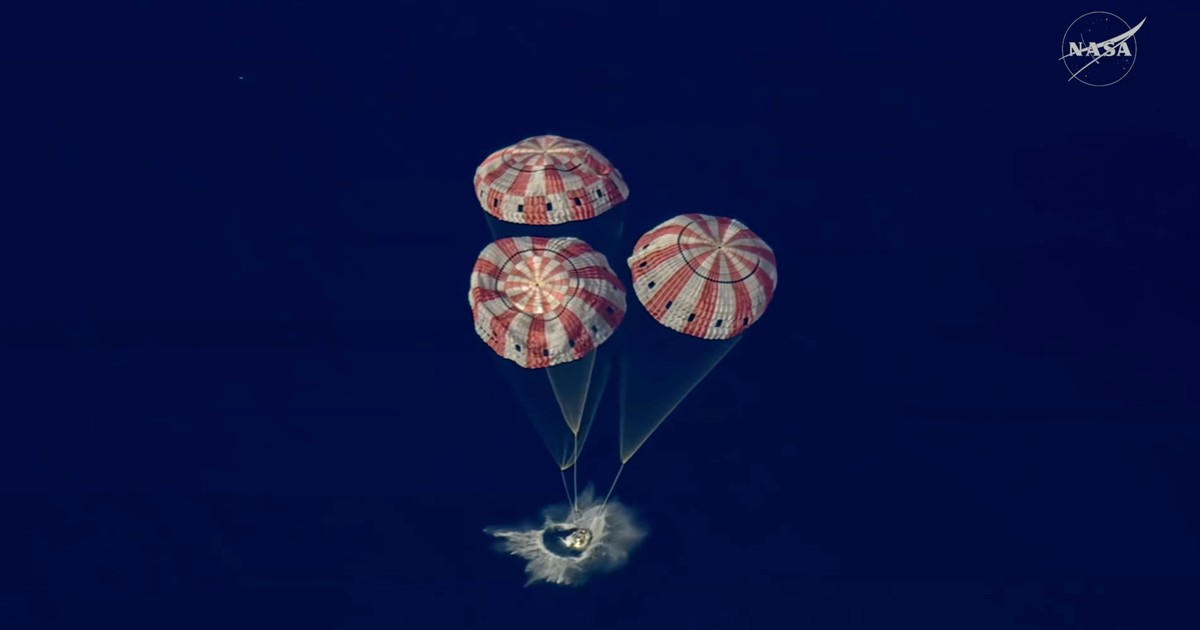
A four-person crew returned to Earth after a nine-day trip that took them from the Kennedy Space Center, into lunar orbit, and back with a splashdown off San Diego.
Astronauts aboard the Artemis II spacecraft have returned home after traveling from Earth and orbiting the moon. This mission was the first time in 54 years that America traveled near the moon. The splashdown ended a journey that tested systems, teamwork, and long-duration mission procedures.
The crew—Reid Wiseman, Victor Glover, Christina Koch and Canadian Space Agency astronaut Jeremy Hansen—landed at 8:07 P.M ET in the Pacific Ocean off the coast of San Diego. A combined NASA and U.S. military recovery team was standing by to welcome the Artemis II crew home. Recovery forces moved quickly to secure the capsule and ensure the astronauts were healthy.
The flight began on April 1 from the Kennedy Space Center and lasted nine days. Over the course of the mission the spacecraft covered more than 694,000 miles. Crews ran through communications, navigation, and life-support checks while the vehicle swung around and away from the moon.
Reid Wiseman, Victor Glover, Christina Koch and Jeremy Hansen operated as a tight team through trajectory adjustments and system checks. The presence of a Canadian Space Agency astronaut highlighted allied cooperation on the mission. On reentry, that cooperation shifted to recovery coordination between U.S. military units and NASA teams offshore.
Mission planners described Artemis II as a critical step toward sustainable lunar exploration and eventual crewed landings. While this flight did not include a lunar surface landing, it put people back on a path beyond low Earth orbit. The mission collected data on navigation, radiation exposure, and crew procedures that will inform future flights.
Artemis II astronauts have traveled 252,756 miles from Earth, flown around the Moon, and observed the lunar surface like never before. Now, they’re coming home. 🌎
Watch the crew splash down on Friday, April 10, around 8:07pm ET (0007 UTC April 11). https://t.co/Ccsk5Z3HFS pic.twitter.com/QoJW2oYVFG
— NASA (@NASA) April 10, 2026
Public interest in the splashdown was high, with tracking and commentary reported across multiple channels. Officials emphasized that the mission was designed to test the spacecraft and human systems under real mission conditions. The successful return marks a milestone in a multi-step plan to expand human presence in cislunar space.
Teams on the recovery ships followed preplanned contingencies to stabilize the capsule and transfer the crew. Medical checks and debriefs began immediately after the astronauts were aboard the recovery vessel. Those early assessments will feed into post-flight evaluations and mission reports.
The flight profile included a near-lunar orbit that tested navigation and life-support systems for deep-space operations. Engineers monitored spacecraft telemetry continuously to validate hardware performance. Data gathered over the nine days will be reviewed to refine procedures for longer missions.
Support personnel ashore coordinated logistics, data analysis, and public communications during the operation. The coordination effort spanned multiple agencies and international partners who contributed expertise and assets. That joint effort ensured the splashdown went smoothly and recovery proceeded without significant delay.
With the crew safely back, attention will shift to analyzing the mission’s technical and human performance data. Those findings will shape planning for subsequent Artemis missions and future exploration timelines. Officials will also use lessons learned to bolster training, safety procedures, and hardware improvements.
The return of Artemis II underscores renewed momentum in crewed missions beyond Earth orbit and demonstrates operational capabilities needed for future lunar objectives. The mission proved critical systems under flight conditions and provided a real-world rehearsal for more ambitious missions ahead. As teams unpack the data, the successful splashdown stands as clear evidence of the progress made over this concentrated nine-day effort.