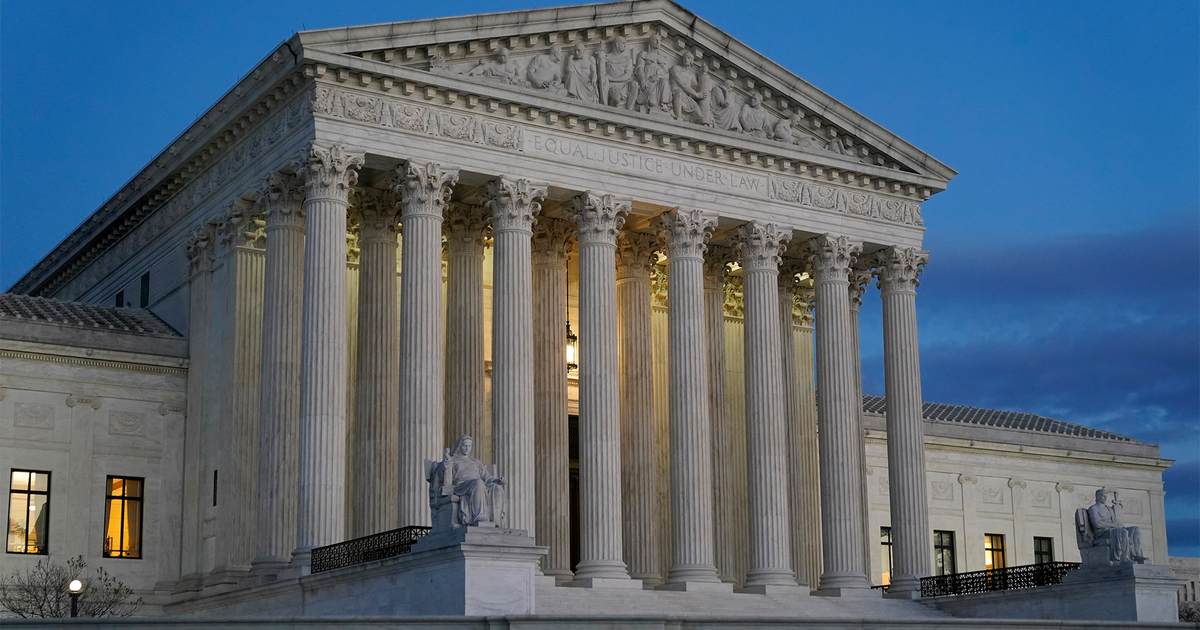
The Supreme Court’s decision in Louisiana v. Callais narrowed how Section II of the Voting Rights Act is applied, drew fierce reactions from Democratic leaders, and immediately reshaped the redistricting landscape while fueling a predictable political back-and-forth.
I expected a shriller reaction, with the usual accusations and breathless comparisons to a bygone era. The Court’s ruling didn’t abolish Section II, but it did limit when race can be the decisive factor in drawing districts, and that change has people on the Left panicking. Conservatives see this as a long-overdue correction to maps that treated voters as racial blocks instead of citizens.
The case centered on Louisiana’s decision to create a majority-black district after an initial map was rejected for violating the Voting Rights Act. The second map triggered litigation arguing the district was an unconstitutional racial gerrymander, and the Supreme Court, in a 6-3 decision, agreed. The result narrows Section II’s reach, meaning race will rarely be permitted as the primary basis for drawing districts.
SCOTUS Ruling on LOUISIANA v. CALLAIS by Matt Vespa
Former President Barack Obama issued a forceful statement in response that plays into the familiar narrative Democrats use whenever court decisions go against them. He framed the ruling as a gaping hole in protections for minority voters and urged mass mobilization at the ballot box. Those remarks were immediate and designed to rally the base for future elections.
Today’s Supreme Court decision effectively guts a key pillar of the Voting Rights Act, freeing state legislatures to gerrymander legislative districts to systematically dilute and weaken the voting power of racial minorities – so long as they do it under the guise of “partisanship” rather than explicit “racial bias.” And it serves as just one more example of how a majority of the current Court seems intent on abandoning its vital role in ensuring equal participation in our democracy and protecting the rights of minority groups against majority overreach.
Today’s Supreme Court decision effectively guts a key pillar of the Voting Rights Act, freeing state legislatures to gerrymander legislative districts to systematically dilute and weaken the voting power of racial minorities – so long as they do it under the guise of…
— Barack Obama (@BarackObama) April 29, 2026
The good news is that such setbacks can be overcome. But that will only happen if citizens across the country who cherish our democratic ideals continue to mobilize and vote in record numbers – not just in the upcoming midterms or in high profile races, but in every election and every level.
Another Democratic voice wasted no time making sweeping allegations about voter suppression and right-wing conspiracies. That kind of rhetoric aims less at policy debate and more at stoking fear. Republicans should respond with clear, concrete arguments about election integrity and equal treatment under the law.
Voter suppression is a way of life for Donald Trump and far right extremists on the Supreme Court.
Republicans know they cannot win a free and fair election in November and so they are desperate to rig it.
We will never let them succeed.
Responses from House Democrats and allied groups mixed alarm with attempts to nationalize the issue, but much of the public isn’t persuaded by claims that ordinary safeguards equal disenfranchisement. Voter ID and other integrity measures poll well with a broad cross-section of voters because people want secure elections. Democrats oppose those measures as a matter of strategy because they often benefit from looser rules and larger, less vetted voter rolls.
One odd line from the NAACP counsel at oral argument suggested distrust of white Democratic voters, and that argument didn’t land. It’s hard to make the case that an entire group of voters refuses to support candidates of another race, especially when political allegiance is usually about policy and party, not race alone. That point undercuts the idea that race should be the default mapmaking guide.
Local officials in Southern states are already moving to redraw maps after the decision, treating the ruling as permission to prioritize compact, politically coherent districts over race-based ones. Predictable claims that the South is stuck in Reconstruction ring hollow when the debate is over fair representation. Courts and legislatures will now have to navigate a narrower path when considering race in redistricting.
National outlets provided long recaps of the opinion and its immediate consequences, including noting Justice Alito’s majority opinion and Justice Thomas’ concurrence calling for a larger rollback of race-based districting. Those passages will be dissected for months as lower courts and state officials test the new boundaries of permissible mapmaking. The practical effect is a realignment that benefits mapmakers who favor political rather than racial criteria.
The justices, split 6-3 with the court’s conservatives in the majority, told states they can almost never consider race when drawing maps to comply with Section 2 of the Voting Rights Act, which was enacted to protect minority voters who long faced discrimination in elections.
Conservative Justice Samuel Alito, writing for the majority, said that while there may be extreme situations where the use of race can be justified to draw a map, it was not in the Louisiana case. As a result, the new map was an “unconstitutional racial gerrymander,” he added.
In a separate concurring opinion, conservative Justice Clarence Thomas, a longtime critic of the Voting Rights Act, said the ruling should “largely put an end” to a system that he saw as unlawfully dividing people into districts based on race.
I’m curious to see how opponents try to paint this as a return to old injustices, when the ruling is really about treating voters as individuals, not racial checkboxes. The politics will be messy, but courts have drawn a line that shifts redistricting debates back toward partisanship and away from race as the defining factor. That shift will drive litigation and political strategy in the coming election cycles.
Editor’s Note: Do you enjoy Townhall’s conservative reporting that takes on the radical left and woke media? Support our work so that we can continue to bring you the truth.
Join Townhall VIP and use promo code FIGHT to receive 60% off your membership.