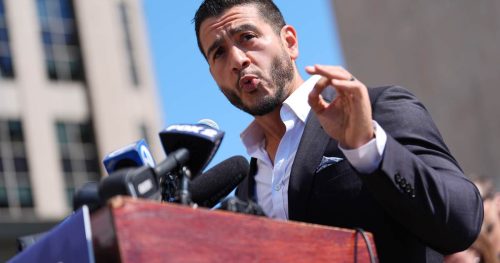
Democrats are desperately ducking questions about their cozy relationship with controversial streamer Hasan Piker, even as his past statements and behavior raise real concerns among voters.
With the midterms looming, Democrats are scrambling to distance themselves from a messy association they’ve tolerated for months. Hasan Piker keeps popping up at Democratic events and in fundraising circles, and his past rhetoric—claiming America deserved 9/11, praising Hamas, threatening violence against dissenting Democrats, attacking American Jews, and even shocking his dog on stream—makes that alliance toxic. Voters notice when parties stand beside people who have a record like that.
Local Democrats such as Abdul El-Sayed and Francesca Hong welcomed Piker to campaign events and took fundraising help from him, which tied candidates to his provocation. Now party leaders are signaling they want to steer conversations away from him, hoping the controversy will fade. That change of tone looks more like damage control than a principled response.
Some senior Democrats seem to be leading the cover-up. Representative Ro Khanna has urged colleagues to stop attacking the left-wing streamer and focus elsewhere, a move that reads like a top-down instruction to mute criticism. The maneuver suggests party strategy now prizes turnout and messaging over accountability.
“Rep. Ro Khanna (D-CA) is urging Democrats to “stop wasting time attacking Hasan Piker” to ensure progressives aren’t “demotivated” to stay home this election cycle.
“Too many demotivated Democrats stayed home in 2016 and 2024. We can’t repeat past mistakes,” Khanna posted on X. “Quit calling @BernieSanders an ‘antisemite.’ Stop wasting time attacking Hasan Piker instead of Trump’s robber baron corruption.”
https://x.com/dcexaminer/status/2092731571249836034
“Don’t put Israel hawks out of touch with our voters in charge of our Middle East policy,” he added. “It is time for a reckoning: are we a party that represents corporate interests and super PACs, or will we represent the American people?”
Read plainly, that thread reads like a defense rather than a critique, prioritizing turnout over confronting hateful or violent rhetoric. The party that once demanded moral clarity now shrugs when one of its visible supporters crosses lines. For many voters that’s not oversight; it’s acceptance.
One Democrat on the receiving end got the memo loud and clear. Representative Debbie Dingell snapped at reporters and declared she would no longer answer questions about Hasan Piker, signaling a shift from engagement to avoidance. Her reaction made the party’s new posture obvious: don’t talk about the inconvenient ally.
“I’m done!” she yelled. “So don’t any reporter ask me about Hasan Piker. It’s not what November is about. Republicans are trying to divide us and we gotta stop letting them try to divide us.”
That defensive line tries to flip the script, casting critics as partisans rather than observers of behavior. Meanwhile, Republican missteps get amplified into party-wide taint instantly, but when Democrats campaign with someone who has posed in Chairman Mao garb and trafficked in inflammatory remarks, the questions disappear. The double standard is stark and obvious.
They say “just a bit” when pressed, treating each controversy as a minor distraction instead of a recurring pattern that should matter to voters. The silence from party leaders speaks volumes: protecting turnout and coalition cohesion has trumped calling out extremism within their own ranks. That choice carries political risk, even if the leadership hopes it will pay off at the ballot box.
There is only one plain interpretation: Hasan Piker remains welcome within the Democratic coalition as long as he helps mobilize certain voters. Label it big tent or pragmatic coalition-building, but the practical effect is the same—tolerating rhetoric and behavior most Americans find alarming. Voters then decide whether that tolerance aligns with their values.
Expect the friendly outlets to follow the party line and pivot away from sustained scrutiny, parroting the “don’t let Republicans divide us” message whenever the topic resurfaces. That coordinated cooling-off tactic won’t erase what was said or done; it will simply bury it until the next time it becomes inconvenient. This is a new iteration of “Republicans pounce!”