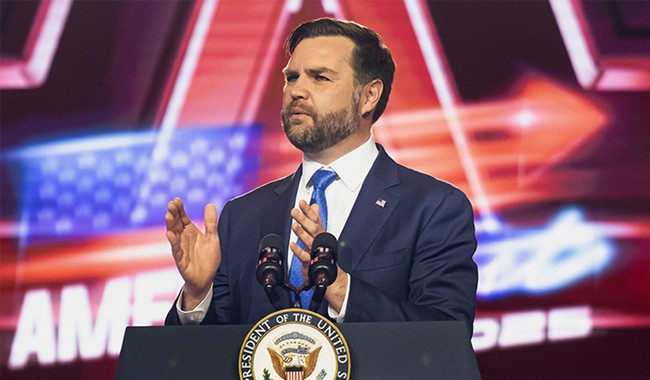
JD Vance told Nick Fuentes in blunt terms that anyone who attacks his wife can “eat s**t,” and the exchange highlights both Fuentes’ extreme rhetoric and a widening skirmish inside the conservative movement over influence, foreign policy and who counts as part of the coalition.
Vice President JD Vance responded sharply when asked about Nick Fuentes’ attacks on his wife, the Second Lady Usha Vance. Vance did not mince words, saying, “Anyone who attacks my wife, whether their name is Jen Psaki or Nick Fuentes, can eat s**t. That’s my official policy as vice president of the United States.” His tone left no room for ambiguity about defending his family.
Fuentes has hurled crude slurs at Vance and his wife, calling Vance a “fat, gay, race traitor” and referring to Usha Vance as a “jeet,” a slur directed at Indians. That kind of language and the openly antisemitic and neo-Nazi associations that follow Fuentes have made him toxic to many conservatives who value basic decency and clear lines about extremism.
Even so, Fuentes has tried to position himself as a conservative influencer among younger audiences by leaning into grievance politics. He has pushed the narrative that white men are being sidelined and has promoted ideas like Israel somehow controlling American foreign policy and that the United States was founded to be a white man’s country.
🚨 JUST IN: JD Vance says Nick Fuentes can "eat sh*t" after Fuentes attacked Vance's wife, Usha
"Let me be clear. Anyone who attacks my wife, whether their name is Jen Psaki or Nick Fuentes, can eat sh*t. That’s my official policy as vice president of the United States," Vance… pic.twitter.com/aSeZwjrpWF
— Eric Daugherty (@EricLDaugh) December 22, 2025
Shortly after Vance was tapped as Donald Trump’s running mate, Fuentes mocked him with the line, “Who is this guy, really? Do we really expect that the guy who has an Indian wife and named their kid Vivek is going to support white identity?” That barb underscores how Fuentes weaponizes identity to delegitimize conservatives who don’t fit his narrow, ugly model.
Fuentes also slipped in a critique of perceived inconsistency among conservatives when he wrote, “When conservatives attack Zohran Mamdani for being a foreigner, I just want them to keep the same energy with Vivek Ramaswamy and Usha Vance. Let’s be consistent.” The point was meant to stoke division, not to advance a serious debate about policy or principle.
When pressed on whether he disavowed Fuentes, Vance drew a moral line while trying to keep the conversation about policy on the table. “My attitude towards anybody, again, who is calling for judging people based on their ethnic heritage, whether they’re Jewish or white or anything else, it’s disgusting,” he said. He added, “[That said,] I think that Nick Fuentes, his influence within Donald Trump’s administration, and within a whole host of institutions on the Right, is vastly overstated — and frankly, it’s overstated by people who want to avoid having a foreign-policy conversation about America’s relationship with Israel,” which pushed the debate toward substance over sensationalism.
That last line points to a real tension: critics of U.S.-Israel policy often focus on Israel alone while giving a pass to other foreign partners. Commentators who want to have an honest foreign-policy discussion should be willing to scrutinize Ukraine, Qatar, Jordan, or Egypt with the same rigor they apply elsewhere.
All of this is playing out against a backdrop of intra-right fights that are already loud and public. AmericaFest opened with a conservative civil war on display, as Ben Shapiro launched withering attacks on Steve Bannon, Tucker Carlson, and Megyn Kelly. Those attacks prompted sharp pushback, and the scene looked more like a factional free-for-all than a unified movement.
They fired back in kind, with Bannon calling Shapiro a “cancer,” and Kelly revealing that she and Shapiro were no longer friends. Personal blows and purity tests are not unfamiliar to politics, but they do risk hollowing out a coalition that needs to be effective in elections and policy battles.
President Trump did not build the greatest coalition in politics by running his supporters through endless, self-defeated purity tests. I didn’t bring a list of conservatives to denounce or to deplatform. Let me just say the best way to honor [assassinated Turning Point co-founder] Charlie [Kirk] is that none of us here should be doing something after Charlie’s death that he himself refused to do in life.
Many on Ben Shapiro’s side have argued that Tucker Carlson would not have interviewed Fuentes until after Charlie was assassinated, as he was adamant about not giving the neo-Nazi a platform. Those nuances matter to voters who want a big-tent conservative movement that can win and govern without swallowing extremism whole.
Conservatives will soon have to decide its position on Israel and whether “America First” truly means that, or if it really means “America Only.” That choice will shape coalition boundaries and determine who matters in the movement going forward.