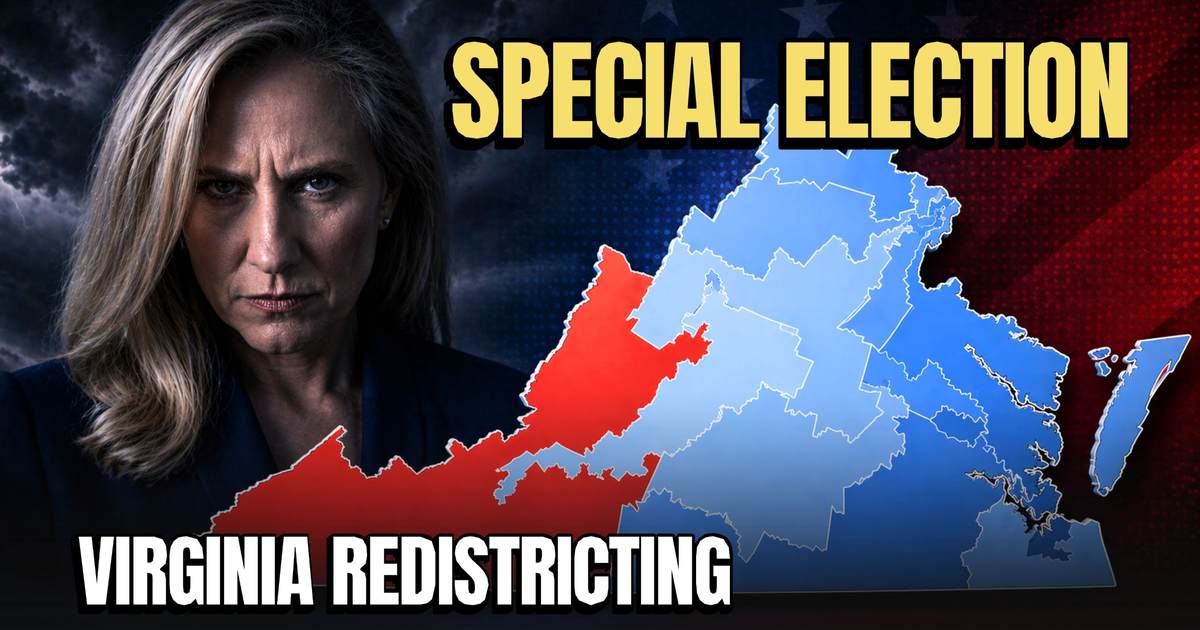
Virginia’s disputed congressional map and the legal fight over its certification have exposed sharp procedural questions and now face a Supreme Court ruling that paused certification while appeals play out.
The new map that would create a 10-1 Democratic advantage in Virginia is tangled up in court, and the state’s top court refused a last-minute stay that might have let certification move forward. Attorney General Jay Jones asked the court to pause a lower-court order so results could be certified while appeals continue, but that request was denied on April 28. The denial keeps the referendum in limbo and highlights how procedural details can upend what voters were told they approved.
The Tazewell County judge’s decision stopped the State Board of Elections from certifying the April 21 referendum, and the Virginia Supreme Court made clear it would not rubber-stamp a stay. The ruling on the stay was narrow — the court said only that certification cannot proceed while the matter is under review. That leaves the appeals process as the path forward, and it leaves the map unapproved for now.
🚨 The Virginia Supreme Court denied a request by AG Jones to pause a lower court order that blocked the certification of the redistricting referendum.
The election will remain uncertified as the legal process plays out. pic.twitter.com/oCbaS7rQfd
— SCOTUS Wire (@scotus_wire) April 28, 2026
The Supreme Court of Virginia has denied a request from Democrats and the state to pause last week’s ruling by a Tazewell County judge, which blocked the State Board of Elections from certifying the results of the April 21 redistricting referendum.
A Tazewell County judge declared that the State Department of Elections could not move forward with certifying the results of the April 21 referendum until the Supreme Court of Virginia weighed in.
Then, Democrats and the state requested this emergency stay, which would have allowed the Department of Elections to move forward with certification while the appeals process plays out.
However, the Supreme Court of Virginia ruled on Tuesday, April 28, that the Department of Elections cannot do that. Our 8News legal analyst confirmed that this is just a ruling on the request for a stay and not on the merits of the appeal.
Republicans who challenged the referendum focused on a narrow constitutional issue tied to timing requirements in Virginia law, and the court’s refusal to grant a stay effectively gives those questions time to be sorted out. The challengers argue the legislature didn’t meet the exact procedural sequence required by the state constitution. That contention matters because if the sequence wasn’t followed, the map’s approval process is legally suspect regardless of the vote tally.
Oral arguments before the Supreme Court turned on whether early voting that began before the first legislative approval undermines the constitution’s timing requirement. The dispute centers on whether a referendum truly passed “before a General Election” when early ballots had already been cast. Those technicalities are now the central battleground, and they could determine who controls several federal seats next cycle.
Virginia’s Supreme Court held oral arguments Monday in a Republican-backed effort to block voter-approved redistricting in the state.
Voters approved a redrawn congressional map last week that would eliminate nearly all Republican-leaning congressional districts in Virginia and net Democrats four additional U.S. House seats in the 2026 mid-term election.
[…]
The Virginia Constitution requires lawmakers to pass the referendum once before a General Election takes place, then again after the newly elected assembly is seated.
Opponents of redistricting argue that since early voting in the 2025 election had been going on for over a month when it passed the first time, the referendum did not meet the requirement to pass before a General Election.
Virginia Supreme Court Justice Wesley Russell peppered the Democrats’ attorney with questions about that issue.
“So your position requires us to interpret an election in such a manner that literally, every single vote that is cast for whatever the office is cast before the election even begins?” asked Justice Russell.
[…]
The plaintiff in this case is a Democrat who voted early in the 2025 election. She said had Democratic lawmakers announced their intention to gerrymander district lines before she voted, she would have voted differently.
Justice Wesley Russell’s pointed question underscored the court’s concern about reading the constitution in a way that swallows ordinary election practice. Republicans pushed that view hard, arguing the plain language matters and voters should not be subject to after-the-fact manipulation. The plaintiff’s position — a voter who said she would have voted differently — was put forward to show real-world consequences from rushed legislative timing.
Democrats, meanwhile, touted voter approval and the political gains the map would deliver, but in the face of procedural challenges their path forward looks uncertain for now. The map’s purported net gain of four U.S. House seats in 2026 and the 10-1 tilt are facts that make this a high-stakes fight. Courts are being asked to answer whether procedural missteps can erase what the electorate saw on the ballot.
Outside Virginia, the Supreme Court also rebuked lower courts in a separate dispute over Texas maps, signaling a strong reluctance to let trial judges rework election rules at the last minute. That decision landed as another setback to Democrats trying to block maps they dislike and suggested the high court prefers stability in electoral mechanics. The broader message from recent rulings is that judges will scrutinize attempts to short-circuit established procedures.
For now, certification is on hold and the legal fight will play out in the appellate process, with both parties braced for protracted argument. Republicans who brought the challenge say the system worked — the courts stepped in when procedural red flags appeared. Democrats insist the voters decided, but until the procedural questions are resolved, the elections tied to these maps remain in legal uncertainty.