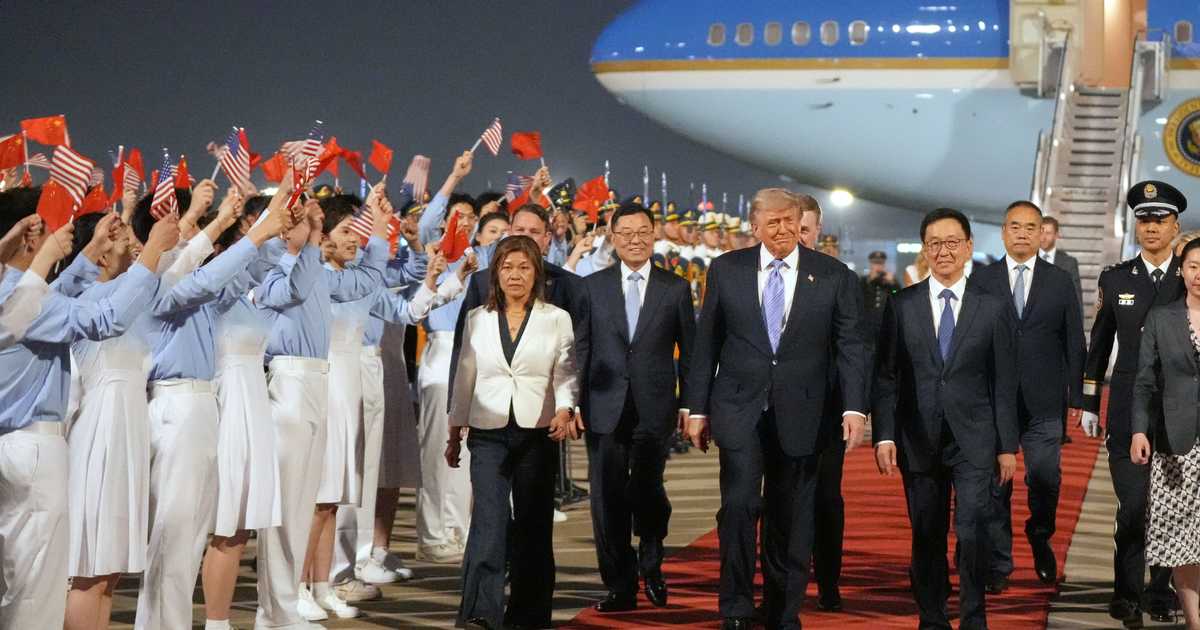
President Trump left China after a three-day visit with President Xi, where the two leaders talked trade, security and fentanyl precursors, attended a State Dinner with top U.S. executives, and issued public statements underscoring a working relationship rooted in mutual respect.
Early this morning President Trump boarded Air Force One and departed China after a three-day visit with President Xi. The meetings covered several policy areas, including efforts to stop the flow of fentanyl precursors into the United States, Chinese investment tied to American agricultural goods and oil, and cooperation on concerns involving Iran and the Strait of Hormuz. The trip mixed statecraft with business diplomacy in a high-profile setting.
China hosted a State Dinner for President Trump and his delegation, which included 16 American CEOs such as Elon Musk and Tim Cook who traveled to discuss expanding U.S. businesses in Chinese markets. The presence of major corporate leaders signaled a push to lock in commercial opportunities while pressing Beijing on security issues. At the dinner President Trump described the nations as sharing a “deep sense of mutual respect,” and called their relationship one of the most “consequential relationships in world history.”
Outside the formal sessions the leaders posed for a photocall where President Trump again expressed his respect for President Xi and emphasized personal rapport. The optics reinforced that U.S. diplomacy can combine tough policy demands with direct leader-to-leader engagement. That approach framed the visit as both transactional and strategic.
.@POTUS bids farewell to Chinese officials at Beijing Capital Airport as he concludes his historic state visit to China pic.twitter.com/siMCWwbJPe
— Rapid Response 47 (@RapidResponse47) May 15, 2026
“This has been an incredible visit,” the President said, “I think a lot of good has come of it and we’ve made some fantastic trade deals, great for both countries. He’s a man I respect greatly … we’ve known each other now 11 years, almost 12 years, that’s a long time, and we’ve settled a lot of different problems that other people wouldn’t be able to settle.” He delivered that line in a tone that mixed satisfaction with a clear sense of accomplishment.
“The relationship is a very strong one,” President Trump continued, “we’ve really done some wonderful things I believe. We did discuss Iran. We feel very similar on Iran, we want that to end. We don’t want them to have a nuclear weapon. We want the Strait open … and we want them to get it ended.” That passage underscored both a shared interest in regional stability and an American insistence on denying Iran a nuclear path.
“But we discussed a lot of other things also and I think we’re very much in agreement,” the President added, and he followed by saying, “I just want to thank President Xi and all of his representatives … and it’s an honor to be here,” the President said. Those remarks closed the formal public-facing elements of the trip while leaving implementation details to follow-up teams.
Air Force One left China shortly before 3 pm local time, and the President was expected to return to Washington, D.C. later the same evening. The timeline reflected a compact, agenda-driven trip that combined public diplomacy, behind-the-scenes negotiations, and business engagements. Officials on both sides said further technical talks will track the agreements and understandings announced at the summit.
The visit highlighted three practical threads: pressure on illicit fentanyl supply lines, commerce and investment openings for U.S. firms, and coordinated language on Iran and maritime freedom in the Strait of Hormuz. Bringing American CEOs to the table signaled an administration intent on marrying foreign policy with economic opportunity, using high-level meetings to create private-sector momentum. On the security front, staking out common ground on Iran and transshipment of illegal drugs was presented as a concrete deliverable.
From a Republican perspective the trip showed a willingness to mix leverage and engagement, using presidential-level talks to secure commitments on issues that affect American lives and industry. It also put U.S. commercial interests front and center, reminding Beijing that stable relations mean both accountability and market access. The next steps will be judged by how well those commitments turn into enforceable actions and measurable results.