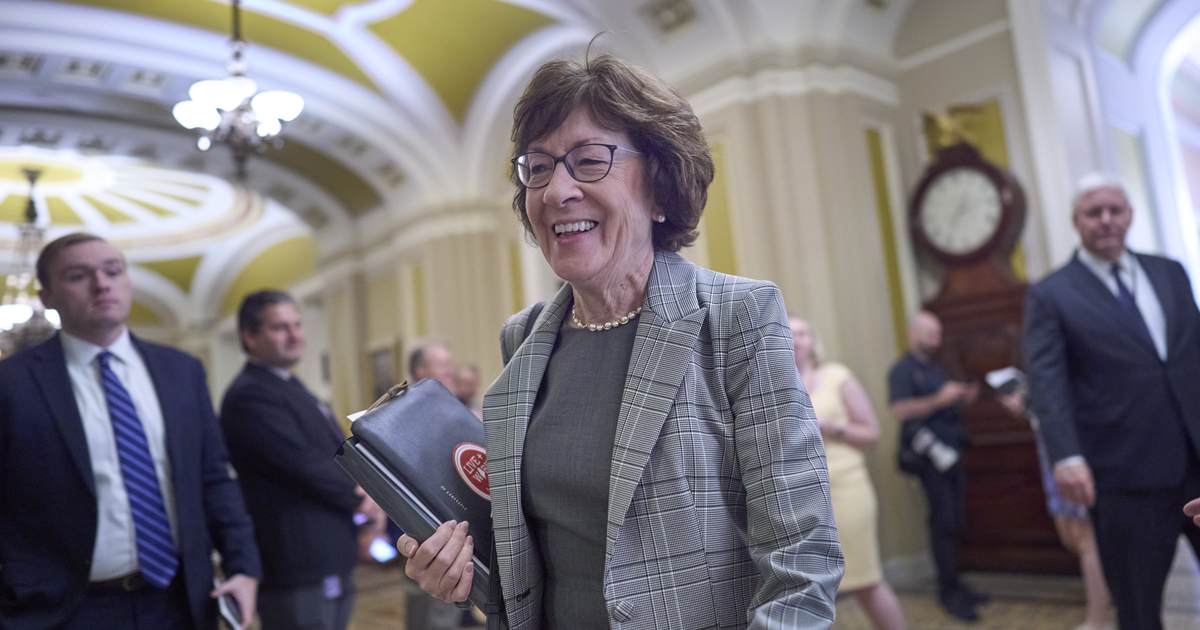
Sen. Susan Collins switched to support the original SAVE America Act in a late Senate vote, giving new momentum to a measure that would tighten voter registration and ID rules for federal elections amid GOP divisions and filibuster math.
Sen. Susan Collins’ late flip to back the original SAVE America Act came during a marathon Senate vote-a-rama tied to a broader $70 billion immigration enforcement package, and that single change altered the arithmetic on a contentious issue that had seemed stalled. Republicans tried to attach the election measure twice during the session, with different approaches from Sen. Lindsey Graham and Sen. Mike Lee producing divergent outcomes. Graham’s bundled amendment failed in part because it included extra policy items that drew opposition, while Lee’s cleaner amendment actually reached the 50-vote mark after Collins shifted her position.
Senate Republicans have struggled to move the ball on President Donald Trump’s voter ID and citizenship verification bill, but a late-night vote in the upper chamber breathed some life into an issue once thought dead.
During the Senate’s marathon “vote-a-rama” to advance the GOP’s $70 billion immigration enforcement package, Republicans tried twice to attach the Safeguarding American Voter Eligibility (SAVE) America Act to the massive bill.
They failed both times, with a cohort of Republicans joining Senate Democrats to stymie the effort, which was destined to fail either way given that the amendments from Sen. Lindsey Graham, R-S.C., and Mike Lee, R-Utah, had to break through the filibuster.
Graham’s attempt was to attach the modified version of the SAVE America Act, which included several policy additions, like barring men in women’s sports, that Trump demanded months ago.
Four Republicans, Sens. Susan Collins, R-Maine, Lisa Murkowski, R-Alaska, Mitch McConnell, R-Ky., and Thom Tillis, R-N.C., voted against it. Their defections prevented the bill from even getting 50 votes, a prerequisite for success if Republicans were to launch a talking filibuster.
But Lee’s attempt did hit 50 votes, with Collins flipping her vote to support the original version of the SAVE America Act.
Collins initially supported the SAVE America Act back in February, but she voted against Graham’s amendment when it was folded into a larger reconciliation-style package because that version bundled in other elements that made some Republicans uneasy. She had already voted yes on the clean version that Sen. Mike Lee offered, and critics suggested her earlier opposition to a bundled approach was tied to a difficult reelection campaign this fall. If Republicans push to eliminate the filibuster to pass the bill outright and Collins backs that move, the math would leave the chamber tied 50-50, which proponents argued would let the vice president cast the deciding vote in favor of the measure.
The SAVE America Act traces back to Rep. Chip Roy’s original SAVE Act, introduced in May 2024, and it aims to change the National Voter Registration Act so that anyone registering to vote in federal elections must provide documentary proof of U.S. citizenship. The bill spells out acceptable documents, including a birth certificate, passport, or certificate of naturalization, and it would also require voters to present a photo ID when casting ballots. Supporters describe these steps as basic safeguards that restore confidence in the system by ensuring that only citizens participate in federal contests.
https://x.com/MCarbonaraFL/status/2064345139925913848
The bill has essentially been stalled in the Senate since February because Democrats have opposed it en masse and have blocked the 60 votes needed to overcome a filibuster. President Donald Trump has been publicly urging Senate Republicans to scrap the filibuster rules in order to pass the measure, arguing that Democrats will discard the procedure if they ever retake control. Senate Majority Leader John Thune has been more cautious, saying he does not have the necessary GOP support to eliminate the filibuster right now, a reality that keeps the legislation in limbo.
The late-night vote-a-rama revealed the split within the GOP: some senators are willing to attach election integrity measures to broader spending or immigration bills, while others recoil at bundling controversial items and risk-voting consequences in close races. Collins, Murkowski, Tillis, and McConnell were notable no votes on Graham’s bundled amendment, a group that underscored how fragile unity can be on procedural maneuvers. With Collins now signaling support for the cleaner SAVE language, attention turns to the remaining holdouts and whether leadership can corral enough votes for a final push.
Practical questions remain about enforcement and implementation if the bill ever reaches the finish line, and opponents argue the changes would create barriers for eligible voters. Proponents counter that the proposal simply aligns federal voter registration with the standard expectation of documentary proof for other important civic processes. The politics of the measure matter as much as the policy, since senators from competitive states weigh the electoral fallout of high-profile votes more than abstract legislative goals.
At this stage, the Senate’s path forward depends on whether Republican leaders decide to test a filibuster-invoking strategy or continue trying to attach the SAVE language to other must-pass items. Collins’ switch changed the tenor of the moment and showed that a single vote can revive a stalled effort, but the outcome still hinges on a small group of senators who remain unconvinced. The next moves will reveal whether the GOP can close ranks and move this election-focused proposal from debate to a final up-or-down decision in the upper chamber.