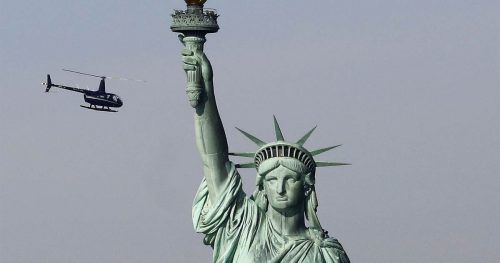
Old photos can do the heavy lifting of memory, and this 1984 image of the Statue of Liberty — a worker leaning in to kiss Lady Liberty during a major restoration — serves up a straight shot of patriotic nostalgia tied to hard work, immigrant roots, and a clear sense of national pride.
The photograph of a worker kissing the Statue of Liberty in 1984 has become a small cultural landmark in its own right, an image people reach for when they want to show what America looks like at its best. The restoration that framed that moment was a long, careful effort to preserve a symbol for future generations, and the picture captured both the risk and the tenderness of that work. On milestone anniversaries, images like this help anchor public memory and remind us why monuments matter.
The man in the photo has a backstory that fits the American narrative: he was the descendant of immigrants doing dangerous work to care for a national icon. That personal link — the grandson of immigrants restoring a statue that greeted so many newcomers — is the kind of detail that resonates politically and culturally. It’s easy to see why leaders referenced the shot when celebrating national anniversaries and why it keeps resurfacing around patriotic moments.
The restoration itself was no casual touch-up. It stretched over four years and required scaffolding, engineers, conservators, and skilled hands willing to balance hundreds of feet above water and rock. That labor is part of the story: preserving a landmark requires grit, expertise, and a willingness to accept real danger. The image captures that trade-off between risk and reverence, and we remember the workers as much as the monument.
https://x.com/AJacksonTV/status/2072398220869722174
Historic photos do more than decorate anniversaries; they help define how a country tells its own story. This one has a cinematic quality — a lone worker, the copper face of the statue, a fragile human gesture against a monumental backdrop. People see in it a tidy symbol of continuity: immigrants, work, and the stewardship of national heritage. It also reminds us how fragile public memory can be without records and images to hold it in place.
When presidents use an image in a speech, the picture takes on new weight, and that happened here. The photograph was mentioned publicly as the nation marked anniversaries and considered the statue’s centennial and beyond. Political leaders often turn to such moments because they crystallize complex themes — sacrifice, gratitude, national identity — into a single, memorable frame. That is how images move from newsprint to national lore.
The technical side of preservation mattered too: conservators had to protect the statue from further corrosion while keeping its original character intact. That kind of restoration work is about respect for craftsmanship and for the intentions of those who built the monument. The scaffolding that allowed a worker to press a brief kiss to the statue’s forehead also allowed a team to ensure Liberty would stand another century.
Public reaction to vintage images like this tends to be sentimental, and that’s not necessarily a weakness. Sentiment can bind communities and create pauses for reflection in a busy, polarized media landscape. When people on all sides stop to admire a photograph of honest labor and an iconic subject, it can momentarily cut through partisan noise. That doesn’t mean politics vanish, but it does mean a shared visual language can endure.
Photographs of restoration work also force a recognition of what’s required to preserve shared spaces: funding, expertise, and a political will to prioritize history. Those practical elements are often unnoticed until a crisis or a big anniversary brings attention back. The 1984 project was a reminder that monuments don’t maintain themselves — they need active stewardship backed by thoughtful public policy and civic pride.
For many Americans, the image stands as a neat embodiment of what celebrations like a 250th birthday are supposed to remind us of — continuity, sacrifice, and gratitude for the hands that keep the story alive. It’s a quiet, human moment that dovetails with broader narratives about immigration and work, and that alone helps explain why it endures. Photographs like this keep conversations about heritage grounded in concrete acts of care and courage.
During the 1984 restoration of the Statue of Liberty, construction worker Anthony Soraci was pictured planting a kiss on Lady Liberty’s forehead, decades after the monument welcomed his grandparents to America.
The incredible photograph shows the young worker perched on top of a scaffolding bar more than 200 feet off the ground, with Soraci leaning forward to kiss the statue’s head.
Reagan invoked the moment as he hailed America’s 210th birthday in the summer of 1986, celebrating the statue’s centennial after it was erected on Liberty Island.
“Many of us have seen the picture of another worker here, a tool belt around his waist, balanced on a narrow metal rod of scaffolding, leaning over to place a kiss on the forehead of Miss Liberty,” Reagan said as he kicked off his speech.
“Tony Soraci, the grandson of immigrant Italians, said it was something he was proud to do, ‘Something to tell my grandchildren,’” the former president said.
The restoration project was a four-year endeavor that saw the monument encased in scaffolding as architects, engineers and conservators came together to ensure the Statue of Liberty’s preservation for the next 100 years.