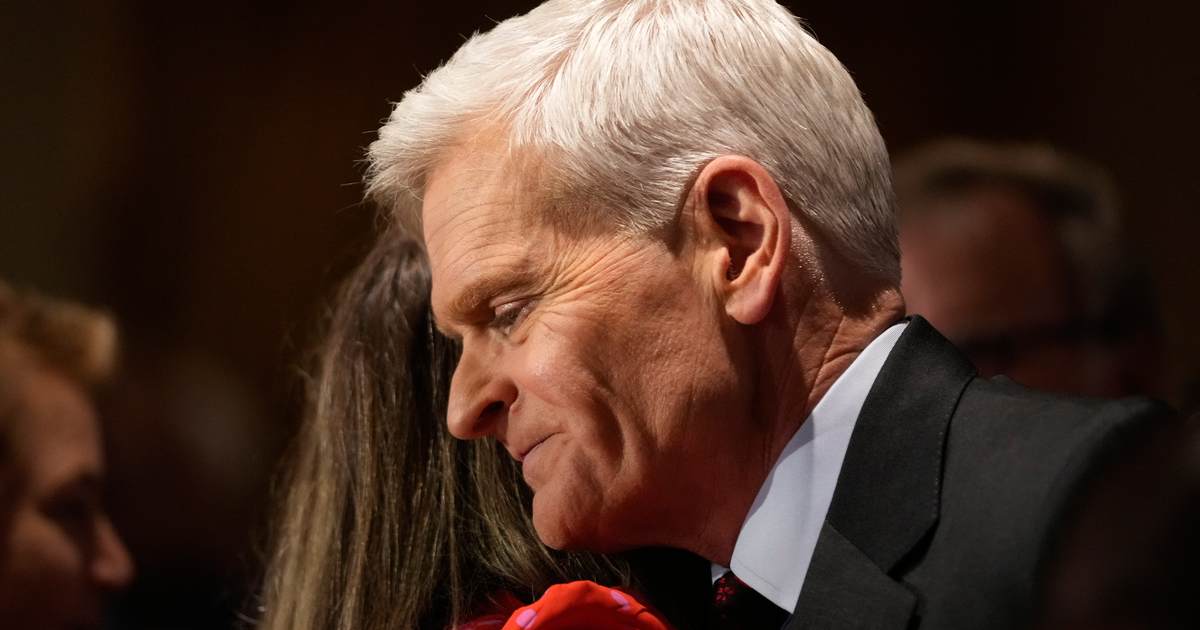
Sen. Bill Cassidy broke with his conference to help Democrats advance a war powers resolution, a move that has Republicans on edge after his recent primary defeat.
Democrats have pushed this war powers maneuver repeatedly, and Republicans have blocked it so far, but Sen. Bill Cassidy chose to join the breach. He voted to side with Democrats and advance the motion, a decision that signals both personal frustration after a tough primary and a willingness to break ranks at a critical moment. That choice instantly shifted the dynamics in the upper chamber and forced conservatives to rethink how fragile their margins really are.
Cassidy’s political history is well known to many in the party, and one fact is still a sore point for GOP voters: Cassidy voted to impeach Donald Trump during the second push by Democrats, and he paid a high price for it. That prior break with the base cost him support at home and narrowed his margin for error on big decisions. Now, having failed to advance in his state’s primary, he appears to be acting with less to lose and more willingness to side with Democrats on high-stakes items.
🚨 JUST IN: The US Senate ADVANCES anti-Trump Iran War Powers Resolution, 50-47, after RINO BILL CASSIDY and other Republicans joined Democrats — rebuking the Iran war
REPUBLICAN YEAs:
– Cassidy
– Rand Paul
– Lisa Murkowski
– Susan CollinsFETTERMAN sided with Trump.
The 8TH… pic.twitter.com/UvnWA9X6Xc
— Eric Daugherty (@EricLDaugh) May 19, 2026
The practical result of Cassidy’s late-breaking vote is immediate: the Senate cleared a procedural hurdle that had failed multiple times. Republicans still have procedural tools and the administration has the veto pen, but the symbolic win for Democrats matters. It demonstrates that a handful of defections can change the narrative and force leadership into defensive mode.
A Senate Republican spurned by President Donald Trump joined Senate Democrats to handcuff his war powers in Iran and provided the key vote to advance a war powers resolution through a key hurdle.
Sen. Bill Cassidy, R-La., who lost his primary bid over the weekend, sided with Senate Democrats in their war of attrition to curtail Trump’s policing powers in the Middle East. It comes after Democrats successfully gained another defector, Sen. Lisa Murkowski, R-Alaska, last week.
Democrats’ gambit finally worked after seven failed tries, with four Senate Republicans joining them to move the measure forward. But there is still a long way to go before the resolution becomes official. And even if it were to succeed, Democrats likely do not have a veto-proof coalition to counter Trump.
Those paragraphs lay out the mechanics: defections plus persistence can force a measure over the hump even when the numbers don’t promise final victory. Senate rules let a determined minority keep grinding away until enough senators break or procedural math shifts. For conservatives watching the White House’s ability to manage foreign policy, each defection is a threat to coherent, unified strategy.
From a Republican perspective, this is less an honest disagreement about policy and more a symptom of internal fracture. Senators who once voted with the conference are now signaling independence in ways that hand political leverage to Democrats. That leaves the party more vulnerable to messaging attacks and less able to maintain a consistent stance on national security and executive authority.
There are practical downstream effects too: even if the resolution never becomes law, the debate narrows the president’s room to maneuver and forces administration officials into a defensive posture. Congressional motions like this can chill operations, complicate relationships with allies, and empower adversaries who watch Washington’s internal arguments. Conservatives who prioritize strong deterrence and clear red lines should be alarmed by any move that limits presidential flexibility.
Republican leaders will have to decide whether to treat Cassidy’s vote as individual dissent to be tolerated or as a precedent to be punished politically. The answer matters. If the party tolerates repeated defections without consequence, Democrats will have an easier path in the future; if leadership disciplines such behavior, it risks opening a public intra-party fight during a moment that already looks messy.
Expect the next few weeks on Capitol Hill to be tense. With the narrow margins in the Senate, a handful of senators can alter outcomes and shape headlines, and that shift can have ripple effects beyond the resolution itself. The coming months will test whether the GOP can hold together on the big things or whether a few high-profile breaks will become a pattern.