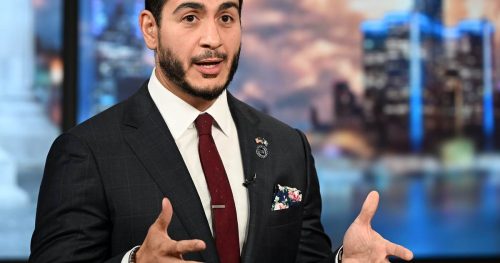
Abdul El-Sayed said he feels a lifelong duty to live by Sharia law, a statement that has sparked serious questions about how his beliefs would intersect with public office and American liberties.
Abdul El-Sayed, a Democratic candidate for the U.S. Senate in Michigan, once said he felt an “obligation” to follow Sharia law for his entire life, and that admission deserves scrutiny from voters and the press. That comment, made while he was a young man buying a home, has resurfaced as a clear example of tension between personal religious commitments and public responsibilities. From a conservative perspective, accountability on whether personal doctrine would shape public policy is a legitimate issue for any candidate seeking federal office.
Sharia law, as commonly understood, includes rules that govern family life, finance, and social behavior in ways that conflict with modern American norms and constitutional protections. Critics argue it can be restrictive toward women’s rights, hostile to LGBTQ people, and opposed to principles like free speech and equal treatment under the law. Those concerns are not abstract when a candidate says he will follow a parallel legal or moral code in his private life while seeking the power to shape public law.
Here are the details the public should know:
Michigan Democratic Senate nominee Abdul El-Sayed once declared his sacred “obligation” to follow Sharia law in every aspect of his life until he meets his maker on the day he dies, according to unearthed comments he made to the New York Times in 2009 as a young man buying his first home.
https://x.com/ChuckRossDC/status/2087261530509193451
“Ultimately, the question is, when I die and I stand before God and go through everything I did in my life, I don’t want to say I did it the easy way instead of the Shariah-compliant way. Not because of fear but because of obligation,” said El-Sayed, who the Times identified at the time as a 24-year-old medical student and Rhodes scholar who had just taken out a “Sharia-compliant” mortgage to purchase a $123,000 condominium in Ann Arbor.
El-Sayed has sought to walk back or downplay that language in later campaigns, but the original comments are on record and include specific examples like choosing a Sharia-compliant mortgage. Voters should weigh whether a pledge to live by a separate religious legal code, even privately, signals an approach to governance at odds with secular constitutional principles. The issue is not about faith generally; it’s about whether an elected official’s legal commitments could conflict with the rule of law in a pluralistic republic.
The reporting that followed also flagged books reportedly in El-Sayed’s past reading list, including titles that debate the causes of Islamic militancy and writings by figures linked to Islamist movements. One cited author, Sheikh Mohammed al-Ghazali, has been connected by critics to extremist views and controversial testimony from the 1990s. Those citations raise questions about intellectual influences and judgment that deserve straightforward answers from the candidate.
Not one journalist will ask him about this, or so the complaint goes, but the press has an obligation to press public figures on anything that bears on their fitness for office. Americans have a right to know whether someone seeking federal power intends to let religious doctrine trump constitutional protections. Journalists who skip these questions do a disservice to voters and to the principle of transparency in public life.
Sharia law is fundamentally at odds with the Constitution when it claims primacy over civil law or allows punishments and restrictions that violate constitutional rights. The First Amendment protects free exercise but also protects a secular legal framework that applies equally to everyone, regardless of faith. Any suggestion that a public official would prioritize a religious legal code over the Constitution is a red flag for those who want to protect liberty and equal treatment under the law.
The reaction from many on the right is predictably sharp, because this is about more than one man’s beliefs; it’s about preserving a system where no religion dictates public policy. Electing people who may answer first to a religious jurisprudence rather than to the Constitution creates risks that voters should evaluate honestly and without euphemism. Political opponents and the media both have roles to play in making those risks clear.
El-Sayed’s political allies dismiss the concerns as fearmongering, while critics see a pattern worth exposing and debating. Neither side should be allowed to bury the primary fact: he said he felt an obligation to follow Sharia law throughout his life, and that statement sits with voters until he addresses it plainly. Silence or evasions are not answers when constitutional fidelity is on the line.
“Will he lie and claim he is not an adherent of sharia law? As a Sunni he has less protection to do that than Shia Muslims do under the doctrine of Taqqiya. But he is also a communist and their doctrine is lie about everything until you gain power. Then lie about whatever you want. That combo makes him an Islamunist. Either one should be a red flag, except for these folks a red flag is a good thing. So is a green or black one,” Hanson wrote.
Voters in Michigan deserve clear, direct answers about how El-Sayed’s personal convictions would influence his public duties, and the debate should be aired out in public, not sidelined. The stakes are straightforward for conservatives who believe in the Constitution and in a single set of laws that apply to everyone regardless of faith. That is the standard this race—and every race—should be measured against.