Iran’s power structure is shifting as the IRGC fills the void left by recent airstrikes, sidelining civilian leaders and tightening military control over decision-making.
The Revolutionary Guard Corps has quietly moved from a powerful faction inside Iran to the center of government authority, stepping into roles that civilian officials once held. That shift follows U.S.-Israeli strikes that killed senior figures in Tehran, leaving a leadership vacuum that the Guard appears eager to fill. Washington and allies watching this unfold should expect a harder, less compromising Tehran if the trend continues.
Inside the capital, the Guard’s influence is visible in concrete ways: presidential nominations being blocked, security details rearranged, and key functions now run by military commanders rather than elected officials. Sources describe a tightening cordon around the new figure promoted as Supreme Leader, and reports say the Guard effectively runs major state operations today. Those moves make it harder for any civilian president to steer policy or negotiate outcomes that deviate from the Guard’s agenda.
Iran’s Islamic Revolutionary Guard Corps (IRGC), the elite branch of the Iranian armed forces, has blocked President Masoud Pezeshkian’s presidential appointments and erected what sources described as a security cordon around Supreme Leader Mojtaba Khamenei, a report published Tuesday by Iran International said.
The IRGC effectively has assumed control over key state functions, the report claimed.
“It was always a matter of when, not if, the IRGC was going to step forward even more than it has in the last three decades,” Behnam Ben Taleblu, senior director of the Iran program at the Foundation for Defense of Democracies, told Fox News Digital.
Pezeshkian has reached a “complete political deadlock” as tensions between his administration and the military leadership deepen, according to the report.
The reported shift could have major consequences far beyond Iran.
Analysts say a more powerful IRGC likely would mean a more confrontational Iran, less willing to compromise in talks with Washington and more inclined to continue military escalation across the region. With U.S.-Iran negotiations already faltering and uncertainty growing over whether Tehran will even send negotiators to the next round of talks, the rise of the Revolutionary Guard raises fresh doubts about who actually is making decisions in Iran and whether any civilian official can still speak for the regime.
“But it’s a mistake to assume this is some sort of coup,” Ben Taleblu said. “This has been the process in Iran for years now, as the regime has chosen conflict over cooperation and emboldened its security forces at every juncture.”
Iran’s government has been in chaos since the bombing campaign began in late February, and the Guard moved quickly to stabilize power on its own terms. Mojtaba Khamenei was pushed into the top role after his father’s death, but he has not appeared publicly and is believed to have been wounded in the strikes. In practice, the Guard’s commanders are making the big calls while civilian offices are sidelined or neutered.
As per latest report IRGC, hardliners has blocked President Pezeshkian’s presidential appointments and erected a security cordon around Supreme Leader Mojtaba Khamenei. Even Iran’s parliamentary speaker Ghalibaf & lead negotiator in earlier ceasefire talks with US sent a direct…
— αиѕнυℓ 🇮🇳 (@Humtumandfun) April 21, 2026
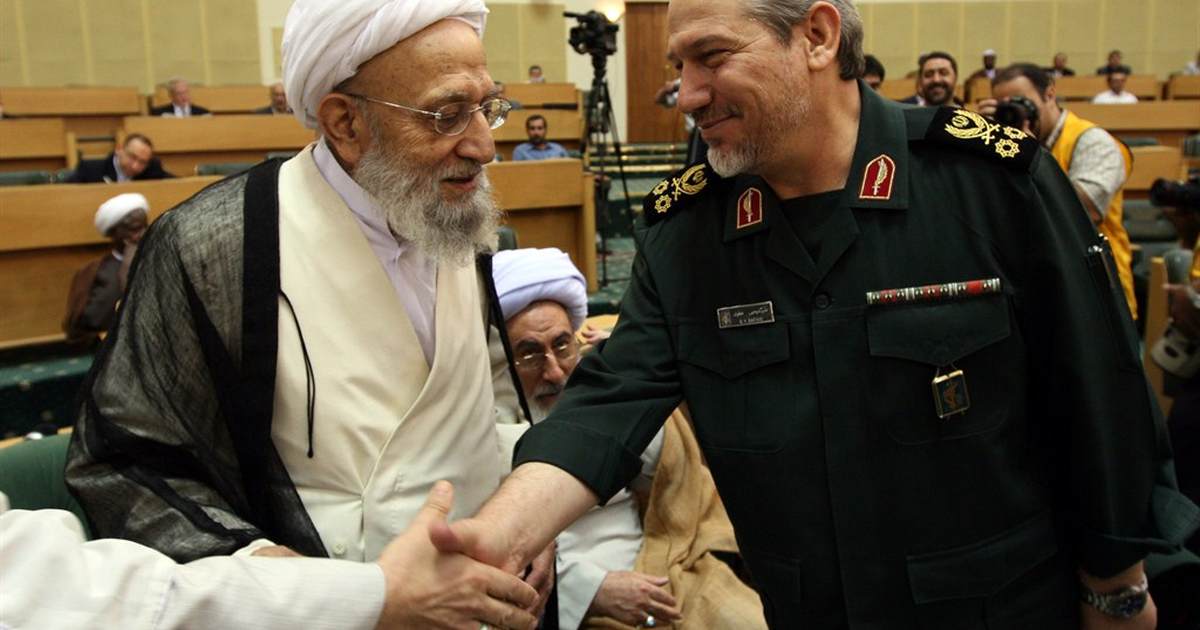
The country now reads less like a clerical state and more like a military command post, with major military and foreign-policy decisions flowing through Guard channels. Three men tied to the Guard—Mohsen Rezaei, Ahmad Vahidi, and Mohammad Bagher Ghalibaf—have been named by analysts as the real power centers behind Tehran’s current posture. Reports and former insiders warn the IRGC is silencing rivals and signaling that any challenge will be met with force or legal retaliation.
On the diplomatic front, a fragile ceasefire has held while President Donald Trump granted a two-week extension to allow negotiations a breathing space. Talks are set to resume with meetings in Islamabad this week, but signals are mixed and the Guard’s new dominance complicates any deal that would require concessions on Iran’s regional behavior. Trump also warned that further extensions are unlikely and has repeatedly threatened to resume strikes on strategic targets if talks stall.
Analysts caution that an emboldened IRGC means Tehran will be less inclined to negotiate in good faith and more prone to escalate across the region when it suits its goals. The Guard’s track record shows a preference for projection of power and influence through proxies rather than quiet diplomacy, which raises the risk of renewed clashes and wider instability. For U.S. policymakers, the key question is whether meaningful interlocutors still exist inside Tehran or whether the Guard has closed off any path to moderation.
Domestically, the political logjam leaves the civilian president boxed in and unable to deliver the sort of credible commitments that overseas rivals or negotiators need to see. That vacuum favors hardliners who view compromise as weakness, making concessions unlikely without clear leverage. The picture coming out of Iran is one of a regime consolidating around security institutions, and that reality will shape how the United States and its partners respond in the weeks ahead.