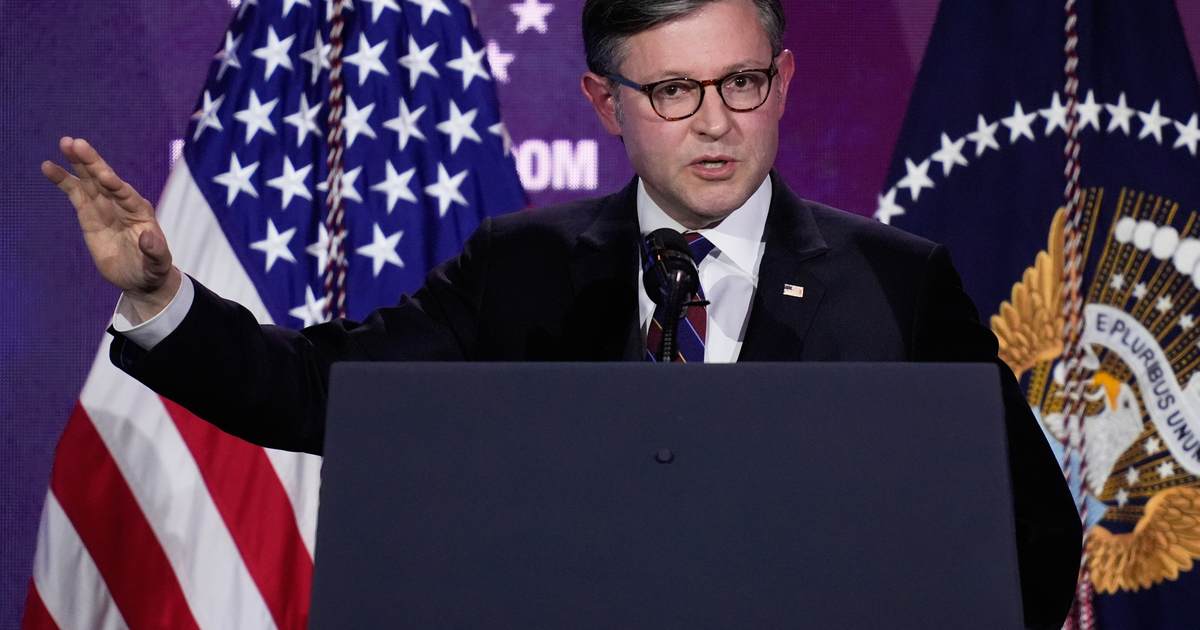
House Speaker Mike Johnson signaled that Republicans will press to make President Donald Trump’s executive order on birthright citizenship law after the Supreme Court struck it down, framing the move as necessary to protect the rule of law and national security while Congress explores legislative and constitutional options.
Republican House Speaker Mike Johnson (LA-04) responded quickly after the Supreme Court rejected the administration’s attempt to limit birthright citizenship, telling allies and reporters the GOP will pursue a permanent fix. He portrayed the issue as both a constitutional problem and a matter of national security that demands immediate attention from lawmakers. That position puts Republican leaders on a clear course to try to translate executive action into statutory or constitutional change.
The exchange unfolded during an interview on Fox News Sunday, where host Shannon Bream asked, “What say you about how this gets done if there’s a change to be made?” The question put the practical options on the table: fast-moving legislation, or the much slower path of a constitutional amendment. Johnson’s answer signaled Republicans will chase whatever avenue offers the best chance to stop what they call abuses of the current system.
“Well, I used to litigate constitutional law cases, so I really enjoyed Justice Clarence Thomas’s dissent,” Johnson replied. “…He explained that the 14th Amendment, the original intent was to enhance and really value citizenship, and it’s been devalued because of birthright tourism, which is what we have now. It’s a threat to the rule of law and national security. We do need to address it. We’re looking at all angles. If there’s some legislative fix, we’ll advance that immediately. If it’s a constitutional amendment, as you know, it takes a little more time. But we’ve got to address this.”
President Trump signed the executive order shortly after taking office last year, directing federal agencies not to issue citizenship documents to children born in the United States when the mother was in the country unlawfully and the father is neither a U.S. citizen nor a lawful permanent resident. The order was presented as a way to curb incentives for so-called birth tourism and to prevent what supporters described as a loophole around the 14th Amendment. That executive action was always meant to be a stopgap until Congress could act or the Constitution could be clarified.
https://x.com/SpeakerJohnson/status/2073849943928844706
Supporters argued the order would prevent the 14th Amendment from being exploited and would reduce incentives for illegal entry by removing automatic citizenship as a reward. They framed the policy as straightforward enforcement that restores fairness and deters exploitation of American citizenship. Opponents said the order overreached executive authority and raised fundamental constitutional questions about who is a citizen at birth.
The Supreme Court resolved that dispute in a 6-3 decision, with Chief Justice John Roberts writing the opinion that drew a clear line: children born on American soil to parents who are unlawfully or temporarily present “satisfy both elements of the Citizenship Clause” and “are citizens at birth” under the 14th Amendment. The majority opinion undercut the executive order by interpreting the Citizenship Clause as covering those births, leaving Congress as the primary arena for any legal change. The ruling reset the fight from the executive branch back to Capitol Hill.
Republican leaders reacted predictably: continue the fight through legislation or pursue the constitutional route. House Republicans say they will draft bills to alter the statutory understanding of citizenship, while some conservatives argue for a constitutional amendment to clarify the clause once and for all. That dual strategy reflects both the urgency Republicans attach to the issue and the practical limits of what can be done quickly.
Sen. Eric Schmitt (R-MO) has already signaled action in the upper chamber by announcing plans to file legislation aimed at changing how citizenship is defined, a move that mirrors House GOP priorities. Other Republican lawmakers have pledged to introduce bills and push for votes that test how much support there is for a legal change short of amending the Constitution. Expect maneuvering in both chambers as Republicans try to convert political momentum into durable law.
For conservatives who view the current reading of the Citizenship Clause as inviting abuse, the Supreme Court decision only shifted the battleground. Republican officials are framing new legislative proposals as necessary to protect borders, preserve the meaning of citizenship, and reassert Congress’s role in defining federal citizenship law. The coming weeks and months should reveal whether that rhetoric translates into concrete statutes or the longer, heavier lift of an amendment.