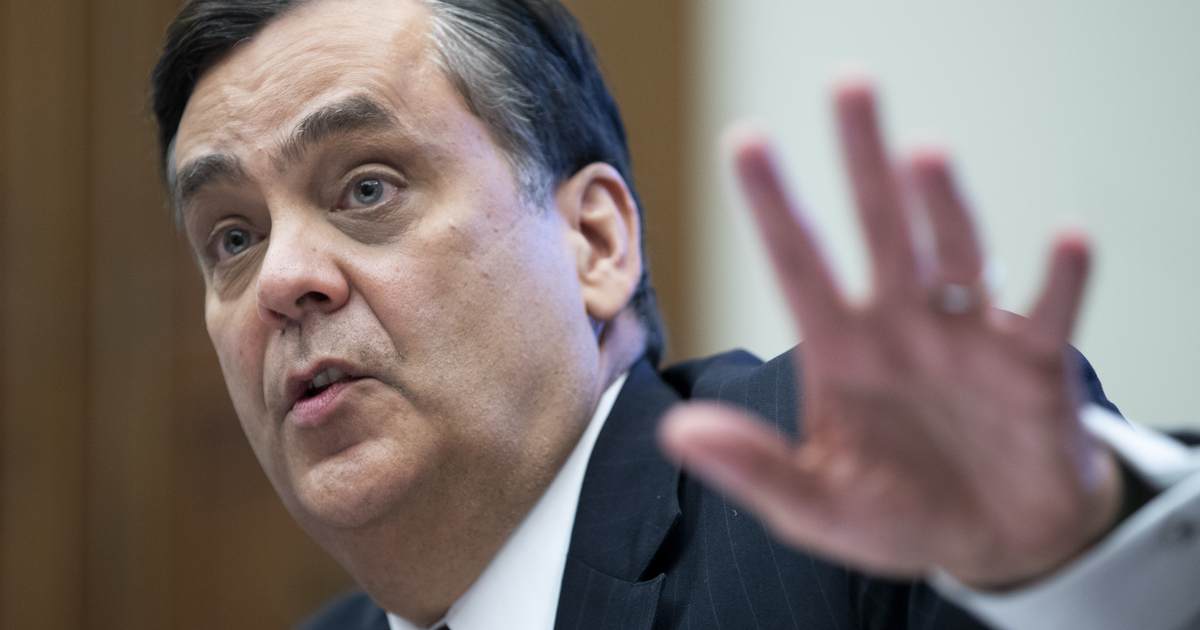
George Washington University law professor Jonathan Turley warns that a growing habit among some Democrats — treating impeachment like a routine political tool — risks turning a solemn constitutional process into a spectacle and doing lasting damage to the rule of law.
Jonathan Turley, a professor at George Washington University Law School, is not a doctrinaire conservative, but he has become a blunt critic of a particular habit on the Left: frequent, politically driven impeachment talk. He sees a pattern where impeachment is being treated as a reflexive weapon rather than a reserved remedy for grave misconduct. That trend, he argues, is dangerous to legal norms and public trust.
Many Democrats openly say they will file articles of impeachment if they regain the House next term, and that prospect has become a predictable talking point in liberal circles. The impulse to use impeachment whenever a political opponent wins or to target public figures purely out of personal dislike is alarming to observers who value constitutional limits. Turning a high constitutional safeguard into routine partisan theater makes the entire system look brittle and performative.
Impeachment in the United States is not the same as a parliamentary vote of no confidence; it is embedded in our law with specific standards and consequences. Treating it like a quick political fix dilutes its meaning and undermines the serious constitutional processes designed to check abuses of power. Using impeachment as a political cudgel signals a willingness to warp institutions to immediate partisan ends rather than respect established rules.
Jonathan Turley blasts Democrats for their persistent calls for impeachment:
"It's a very destructive series of pledges that they're making. It's part of this age of rage. They're promising straight revenge, straight retaliation. This is injecting that rage straight into the… pic.twitter.com/WTiCRKVfs1
— Julia 🇺🇸 (@Jules31415) April 20, 2026
The broader ideology behind this approach matters. Turley and others see a strain of progressivism that, when pushed to extremes, favors centralized authority and expansive state power over individual liberty and institutional restraint. That tilt can make legal mechanisms tools in service of an agenda, instead of neutral safeguards meant to protect the republic from excess and corruption.
“I cannot express how damaging that is for our constitutional values and history. They’re making impeachment into the English vote of no confidence; that’s not what it is. It is something much more serious than that, but they’re turning it into an unbridled circus,” said Turley.
That observation cuts to the heart of the problem: when the party in power views foundational texts as obstacles rather than guides, it invites continual effort to rewrite or bypass them. The result is not just episodic politics but a steady erosion of the norms that let different viewpoints coexist within one system of government. Once norms are discarded, institutions respond poorly under pressure, and the next crisis escalates faster and farther.
Weaponizing impeachment for short-term political gain also carries practical costs. Every time the process is invoked without clear, principled grounds, public confidence in accountability mechanisms falls. Future allegations of genuine misconduct lose urgency and credibility because the public becomes numb to the alarm, and that cynicism damages both parties and the people they represent.
There is a larger civic stake at work: preserving the dignity and restraint of constitutional structures. Impeachment was designed as a grave remedy for serious abuses, not a recurring penalty box for partisan disappointment. If that line is erased, citizens will face a shifted balance between law and politics where precedent and principle can be bent for immediate advantage.
Those who value constitutional government should push back against the casual politicization of impeachment without resorting to ad hominem attacks or hyperbole. The issue is institutional durability: safeguarding the mechanisms that allow political turnover without institutional collapse. The choice facing voters and leaders alike is whether to reassert restraint or accept a new normal where powerful tools are used reflexively for political ends.
Whatever one’s view of any current political figure, maintaining clear standards for impeachment protects the republic over the long haul. When legal instruments remain reserved for clear, demonstrable abuses, they retain force as deterrents and remedies. Letting them be cheapened for immediate partisan wins sacrifices that long-term protection and hands future actors a more dangerous playbook.